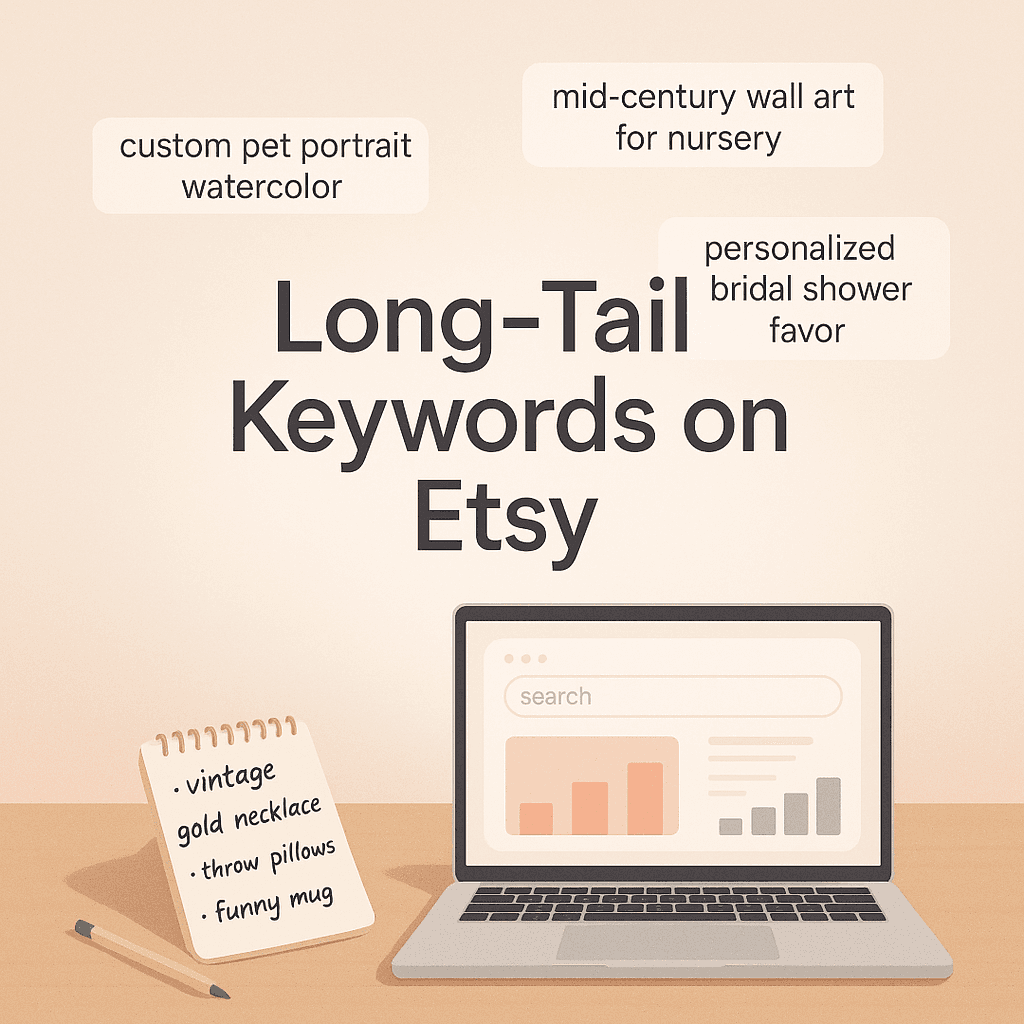
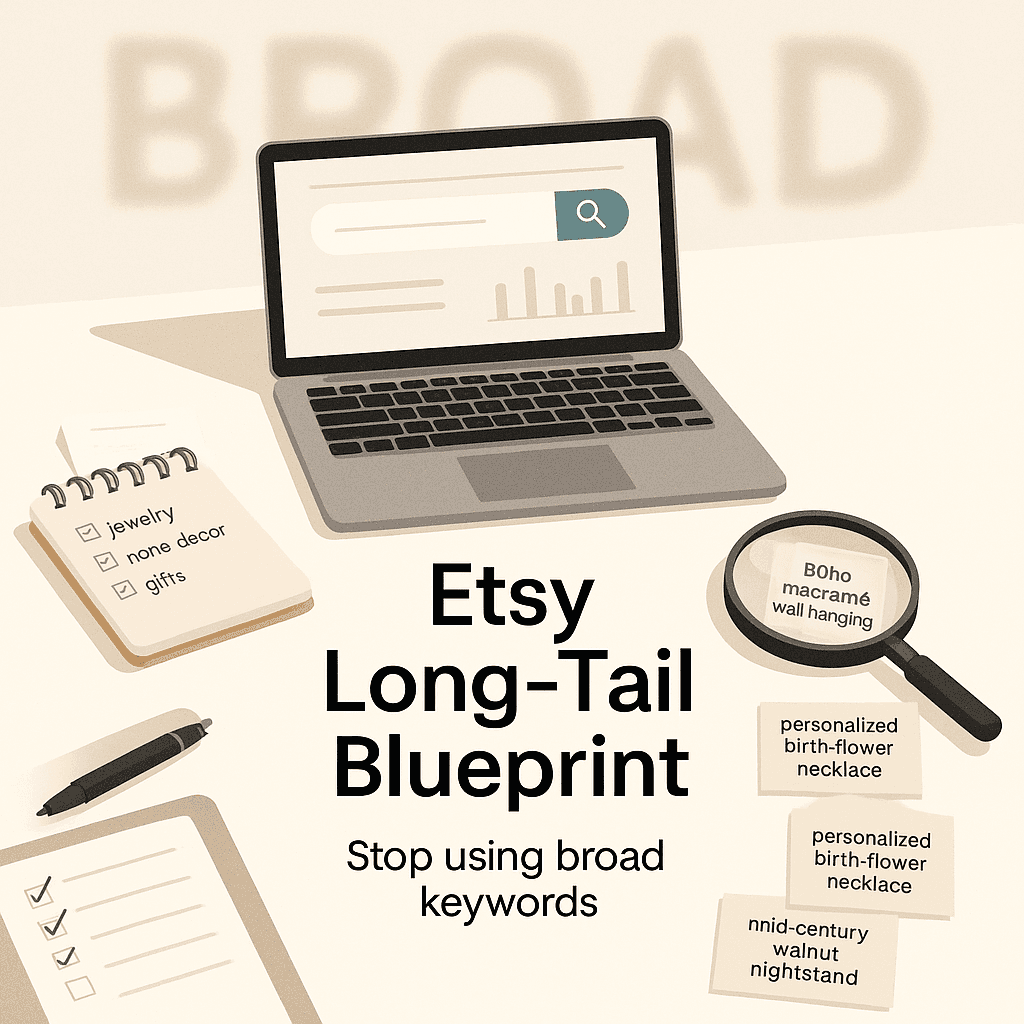
If you sell on Etsy and you’re still using broad keywords like “shirt”, “gift”, “wall art”, “mug”, or even “funny t shirt”… you’re basically walking into a stadium and trying to shout louder than everyone else.
It’s not that those keywords are “bad.” It’s that they’re vague. And Etsy search does not reward vague.
Broad keywords usually bring you the worst mix of problems:
Too much competition, not enough intent, low click through, and then Etsy quietly decides your listing is not the one people want. So it drifts. Page 7. Page 12. The place where listings go to hibernate.
This post is the blueprint I wish someone handed me early on.
We’re going to talk about long tail keywords for Etsy, how to find them, how to build a listing around them without keyword soup, and how to scale it in POD without losing your mind.
And yeah, I’ll mention a tool or two when it makes sense. Including NinjaSell (https://ninjasell.com) because it’s literally built to automate a big chunk of this exact workflow for POD sellers.
Why broad keywords don’t work (even if they get searches)
Here’s the misunderstanding: people think “more searches” means “more sales.”
On Etsy, more searches usually means more competition. And more competition means Etsy has more options that already have:
- sales history
- high conversion rate
- strong reviews
- established click behavior
Your new listing, with no history, doesn’t win that fight. Not often.
Also, broad keywords tend to match messy search intent.
Someone searching “mug” might want:
- a custom name mug
- a teacher mug
- a Starbucks dupe mug
- a handmade ceramic mug
- a funny mug
- a cat mug
- a mug with a lid
- a travel mug
Your listing can’t be all of those things. So Etsy sends you random impressions, buyers don’t click, Etsy takes the hint.
Long tail keywords fix that because they act like a filter. You get fewer impressions, but they’re the right impressions.
A quick Etsy SEO reality check (how Etsy actually matches you)
Etsy is basically trying to answer one question:
Which listing is most likely to get clicked and bought for this search?
So it looks at relevance first (keywords), then performance (clicks, favorites, purchases, etc). You can’t fake the performance part early on, but you can make relevance extremely clean.
Long tail keywords make that easier.
Because instead of trying to match “t shirt” you match something like:
“retro hiking tshirt for women”
Now Etsy has a clearer job. And the buyer does too. They see your listing and think, oh. That’s literally what I typed.
That moment matters more than people think.
What is a long tail keyword on Etsy (in plain English)
A long tail keyword is just a specific search phrase, usually 3 to 7 words, that describes:
- the product type
- the theme or niche
- the recipient or occasion
- the style
- sometimes the material, size, or personalization
Examples (POD friendly):
- “custom dog portrait sweatshirt”
- “minimalist birth flower necklace gift”
- “funny accountant mug for coworker”
- “retro pickleball shirt for men”
- “spooky season kitchen towel set”
- “mid century modern wall art printable”
Notice what’s happening.
You’re not targeting “mug.”
You’re targeting “funny accountant mug for coworker.”
And the buyer searching that is basically raising their hand saying, I am ready.
The Etsy long tail blueprint (step by step)
Step 1: Start with the buyer, not the product
Most sellers start like this:
“I’m selling a hoodie. What keywords should I use?”
Flip it:
“Who is buying this hoodie and why?”
Ask:
- Who is it for (mom, teacher, nurse, boyfriend, dog mom)?
- What’s the occasion (birthday, new job, Halloween, bachelorette)?
- What style (retro, minimalist, boho, funny, cute, edgy)?
- What niche identity (booktok, golf, hiking, crocheter, gamer)?
This is where long tails come from. It’s not a keyword hack, it’s buyer language.
If you get stuck, write one sentence:
“This is a ___ for a ___ who likes ___.”
Example:
“This is a sweatshirt for a new mom who likes cozy minimalist stuff.”
Now you can build keywords that actually make sense.
Step 2: Use Etsy autocomplete like a human, slowly
Go to Etsy. Start typing your base phrase and stop. Let Etsy finish the thought.
Type:
- “teacher mug…”
- “teacher mug funny…”
- “teacher mug end of year…”
- “teacher mug personalized…”
Write down the suggestions that feel buyer specific.
You are not looking for single words here. You’re looking for full phrases that look like purchases.

(Image: searching and researching keywords. Substitute with a screenshot of Etsy autocomplete later if you have one.)
Quick tip: do this inside an incognito window or logged out. Etsy will personalize suggestions based on your history.
Step 3: Build a “keyword cluster” (not just one keyword)
One long tail keyword is good.
A cluster is what makes you rank, because you can hit multiple close variations without sounding robotic.
Let’s do a real cluster.
Core product: pickleball shirt
Style: retro
Audience: women
Occasion: gift
Possible long tails:
- retro pickleball shirt for women
- pickleball gift for her
- vintage pickleball tshirt
- cute pickleball shirt womens
- pickleball mom shirt
- funny pickleball tee
Now you have a cluster. These are all basically the same buyer.
The point: one listing can rank for many related phrases if you structure it well.
Step 4: Choose long tails that are “specific but not dead”
This is the balancing act.
If it’s too broad, you drown.
If it’s too specific, nobody searches it.
A good long tail often has:
- a niche + product (“crochet tote bag”)
- a style (“boho crochet tote bag”)
- a recipient or use (“market bag” / “beach bag”)
You want a phrase that sounds like something a normal person would type.
Not like:
“gift mug mug gift cup funny present cup”
That’s not long tail. That’s panic.
Step 5: Write a title that reads like English (and still hits keywords)
Etsy titles can be long, sure. But you still want the first chunk to be clean and clickable.
A simple title structure that works:
Primary long tail keyword + secondary phrase + use case + extras
Example:
Retro Pickleball Shirt for Women, Vintage Pickleball Tee, Pickleball Gift for Her, Cute Sport TShirt
It’s not poetry. But it reads fine. And it contains your cluster naturally.
Two rules I follow:
- Put the best keyword first. Like, right at the start.
- Don’t repeat the same word 6 times.
Step 6: Tags are where you spread the cluster
You get 13 tags. Use them for variations, not duplicates.
Bad tags:
- pickleball shirt
- pickleball tshirt
- pickleball tee
That’s basically one tag in three outfits.
Better tag approach (example set):
- retro pickleball shirt
- pickleball gift for her
- womens pickleball tee
- vintage sports shirt
- cute pickleball top
- pickleball mom gift
- funny pickleball shirt
- pickleball lover gift
- racket sport shirt
- retro athletic tee
- pickleball outfit
- pickleball birthday gift
- sporty graphic tee
Are all of these perfect? Maybe not. But notice how the intent stays consistent.
Step 7: Description matters more than people admit
Descriptions don’t just help SEO. They help conversion.
And conversion is what keeps you ranking.
So write the first 2 to 3 lines like they’re the only lines that exist. Because on mobile… they kind of are.
Example opening:
A retro pickleball shirt made for the obsessed players. Soft, comfy, and an easy gift for her if she basically lives on the court.
Then add details:
- fit and sizing
- material
- how it’s printed
- shipping times
- gift notes
- care instructions
Sprinkle a couple keyword variations naturally, but don’t turn it into a list of tags.
The biggest long tail mistake: chasing “aesthetic” keywords that don’t match the design
This one hurts, because it’s subtle.
People see a trend like “coastal grandma” or “mob wife aesthetic” and they slap it onto a random product.
Etsy might even give you impressions at first. But the clicks won’t stick if the buyer lands and thinks… wait, this isn’t that.
Your long tail keyword has to match:
- the design style
- the product type
- the buyer expectation
If you promise “minimalist” and the design is loud, Etsy will figure it out through behavior. Fast.
Long tail keywords for POD: what actually works best
Print on demand has its own reality. You can make tons of designs, but you can’t handcraft uniqueness the same way. So your edge is:
- specificity
- speed
- trend awareness
- listing quality
Long tails that tend to work well for POD:
- recipient based: “gift for new teacher”, “gift for nurse”, “gift for grandpa”
- niche identity: “bookish sweatshirt”, “cat mom hoodie”, “pickleball dad shirt”
- occasion: “first mother’s day gift”, “halloween teacher shirt”
- style: “retro”, “vintage”, “minimalist”, “boho”, “coquette”
- personalization: names, years, locations (if your workflow supports it)
Also, avoid trademarks. Seriously. It’s not worth it.
Where NinjaSell fits (if you want this process faster)
If you’re doing POD for Etsy, the long tail process gets repetitive. Not hard, just repetitive. Research. Write. Tags. Description. Mockups. Check trademark. Repeat.
This is basically what NinjaSell is trying to compress into a simpler workflow.
A few things it’s built for:
- generates optimized Etsy listings (titles, tags, descriptions, SEO) based on Etsy bestseller and trend data
- creates Etsy style mockups
- trademark checks against USPTO data (huge, because accidental issues are common)
- one click publish to Etsy as drafts
- “ReSpark” refreshes underperforming listings with updated trend based keywords
- auto posts products to Pinterest for extra traffic
And the pricing angle is different too. Free to sign up, no subscription. You pay base cost and shipping when orders happen. Fulfillment is US only right now, so just note that.
If you’re at the point where keyword research is slowing you down more than design creation, take a look: https://ninjasell.com
Not saying you need it. But if you’re building volume, it’s the type of tool that saves you from burning hours on the same listing chores.

(Image: automation and dashboards.)
Examples: broad keyword vs long tail (and how the listing changes)
Let’s make this concrete.
Example 1: Mug
Broad keyword: “funny mug”
You compete with everything.
Long tail options:
- funny therapist mug
- gift for therapist mug
- therapist appreciation gift
- mental health counselor mug
Now your title, tags, and description can all align around the same buyer. That’s what makes Etsy confident showing your listing.
Example 2: Wall art printable
Broad keyword: “printable wall art”
That’s like saying “food.”
Long tail options:
- mid century modern printable wall art
- neutral abstract printable set of 3
- minimalist line art printable
- boho terracotta wall art
Now you can match style specific searches where buyers are picky, and ready to buy.
Example 3: T shirt
Broad keyword: “retro shirt”
Retro what.
Long tail options:
- retro hiking shirt for women
- vintage national park tshirt
- outdoorsy gift for her
- mountain lover graphic tee
Same product category, completely different search quality.
A simple 15 minute long tail routine (do this per design)
If you want a repeatable routine without getting lost:
- Pick the design. Describe it in one sentence.
- Identify audience + niche + occasion (if any).
- Etsy autocomplete: write down 10 phrases.
- Choose 1 primary long tail + 6 to 10 supporting variations.
- Write title using primary first.
- Fill 13 tags using variations. No duplicates.
- Description: strong first 2 lines, then details.
That’s it. No magic. Just consistency.
Mini checklist: you’re probably too broad if…
- Your title could fit 1,000 different designs.
- Your tags are mostly single words.
- You used “gift” as a tag without specifying who it’s for.
- Your listing gets impressions but almost no clicks.
- You’re ranking for weird searches that don’t match your product.
Using long tail keywords can fix most of these issues.
Wrap up (the part you actually need to remember)
Broad keywords feel safe because they’re popular. But popular on Etsy usually means crowded.
Long tail keywords feel smaller, almost boring. But they attract buyers with intent. And Etsy loves intent because intent turns into sales.
So yeah. Stop using broad keywords.
Pick a niche. Speak like the buyer. Build a cluster. Write a title that reads like a human sentence. Use tags for variations, not repetition.
If you’re scaling POD listings and want the whole process faster, from keywording to mockups to Etsy drafts, that’s literally the lane NinjaSell is in: https://ninjasell.com
Now go fix one listing. Not twenty. One.
It adds up.
Additionally, don’t forget the importance of optimizing other platforms as well, like YouTube, if you’re using it for marketing purposes. This guide provides some valuable tips on how to optimize your YouTube channel for better patient experience which can also be beneficial in reaching your target audience effectively.
FAQs (Frequently Asked Questions)
Why don’t broad keywords like “shirt” or “mug” work well on Etsy?
Broad keywords are vague and attract too much competition with mixed buyer intent. Etsy search favors relevance and performance, so listings targeting broad terms often get lost among established competitors with strong sales history and reviews, leading to low click-through rates and poor listing visibility.
What are long tail keywords on Etsy and why are they important?
Long tail keywords are specific search phrases, usually 3 to 7 words, that clearly describe the product type, theme, recipient, occasion, style, or personalization. They act as filters to attract fewer but more targeted impressions, increasing the chances that buyers ready to purchase will find and click your listing.
How does Etsy’s search algorithm prioritize listings?
Etsy looks for listings most likely to be clicked and bought by evaluating relevance first—how well keywords match the search—and then performance metrics like clicks, favorites, and purchases. New listings can improve relevance through precise long tail keywords even before building performance history.
How can I create effective long tail keywords for my Etsy listings?
Start with the buyer in mind by identifying who the product is for, the occasion, style preferences, and niche identity. Then use Etsy’s autocomplete feature to find specific buyer-like search phrases. Combine these insights into descriptive long tail keywords that match what your target customer would type.
Can you give examples of good long tail keywords for print-on-demand (POD) products on Etsy?
Yes! Examples include “custom dog portrait sweatshirt,” “minimalist birth flower necklace gift,” “funny accountant mug for coworker,” “retro pickleball shirt for men,” “spooky season kitchen towel set,” and “mid century modern wall art printable.” These phrases are specific and buyer-focused.
What tools can help automate finding and using long tail keywords for Etsy POD sellers?
Tools like NinjaSell (https://ninjasell.com) are designed to automate key parts of the workflow for POD sellers by helping discover relevant long tail keywords, build optimized listings without keyword stuffing, and scale your shop efficiently while maintaining focus on targeted buyer intent.