If you’ve been on Etsy for more than like… a week, you’ve probably heard it.
“New listings get a boost.”
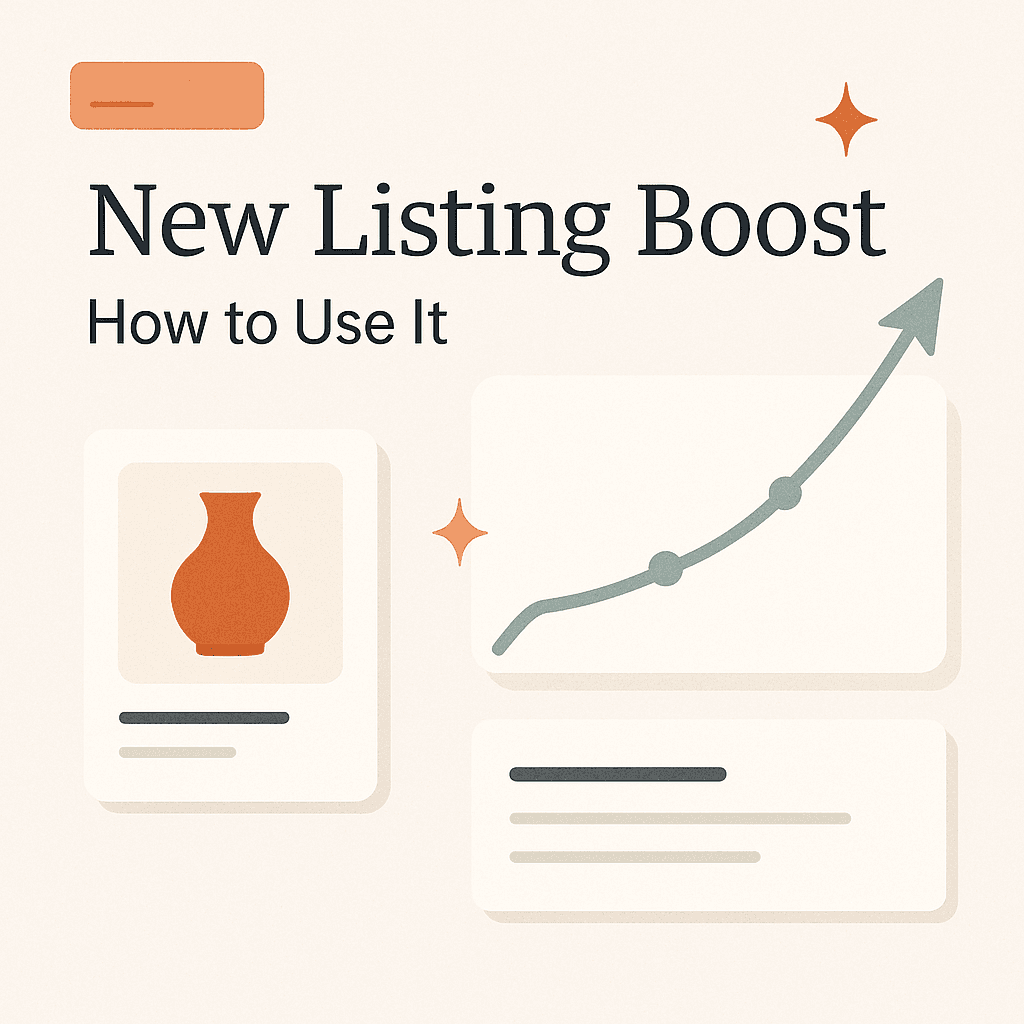
And yeah. The boost is real. But it’s not magic, and it’s definitely not forever.
What it is, is a short window where Etsy is basically testing your new listing. It’s trying to figure out: should this show up for people? If yes, for what searches? At what price point? With which photos? How often?
Your job is to make that testing phase as easy as possible for Etsy to “understand” your product, and to give it good early signals (clicks, saves, favorites, add to carts, purchases, and even just solid time-on-page).
This post is the practical, do-this-not-that breakdown. Especially if you’re doing print-on-demand and you’re posting a lot.
Quick heads up: what the “new listing boost” actually is (and isn’t)
Etsy doesn’t publish a neat chart that says “every new item gets boosted for 14 days.” That’s not how they talk about search.
But in practice, sellers see the same pattern over and over:
A new listing gets a little extra visibility.
Etsy watches how shoppers react.
The listing either finds traction and keeps showing… or it fades into the background.
So think of it less like a “boost” and more like a trial period. Etsy is collecting data fast.
🚫 It’s not a replacement for SEO
If your title is vague, your tags are random, and your photos don’t match the search intent, the boost just burns off faster. Like lighting a match in the wind.
⏳ It’s not just about recency
People assume “new = ranked.” It’s more like “new = tested.” And you want to pass the test.
Why Etsy gives new listings extra attention in the first place
Etsy has two problems it’s always trying to solve:
Shoppers want fresh stuff, not the same identical results every time.
Etsy needs to figure out what your item even is and who it’s for.
New listings help Etsy refresh search results and keep buyers engaged. But Etsy also has to protect buyers from junk, spam, and irrelevant products.
So Etsy basically says: “Cool, we’ll show it a bit. Let’s see what happens.”
That’s the window you’re working with.
The signals that matter most during the boost window
During the first days, Etsy is watching early engagement like a hawk.
Here’s what tends to matter (in plain English):
1. Click-through rate (CTR)
If Etsy shows your listing and no one clicks, it’s a bad sign.
Your main levers here: First photo, Title (the part Etsy shows in search), Price (and whether shipping is free), “What is it?” clarity.
2. Conversion rate
Clicks are nice. Sales are better. If people click and bounce, Etsy notices that too.
Conversion levers: Mockups that match what the buyer expects, A description that answers questions quickly, Clear personalization instructions (if relevant), Reviews (shop-level trust).
3. Favorites and add-to-carts
These are “soft conversions.” Not as strong as purchases, but still a signal.
4. Listing quality consistency
This one is fuzzier, but it’s real. If you repeatedly publish low-performing listings, Etsy learns what to expect from your shop.
So yes, posting more can help. But posting more good listings helps a lot more.
Step 1: Don’t publish until your listing is “boost-ready”
This is the part most people rush. They hit publish and then start fixing photos and tags later.
That’s backwards.
The boost window is when you want to look your best.
- Your photos have to match the search term – If someone searches “funny dad shirt” and your first image is a flat lay that barely shows the design, you’re fighting uphill.
Aim for: 1 hero mockup that screams the niche, 1 close-up where the design is readable on mobile, 1 “context” shot (someone wearing it, gift vibe), 1 sizing or fit graphic, 1 color/options image. - Title and tags need to be tight, not poetic – Bad: “Cute shirt for the best dad ever…” Better: “Funny Dad Shirt, Dad Joke T Shirt, Fathers Day Gift for Dad, Retro Dad Tee”.
- Don’t forget the boring stuff that stops purchases – Processing time, shipping time, returns/exchanges, size chart, what is included. Processing time reference.
Step 2: Launch timing matters more than people admit
Is Etsy going to punish you for posting at the “wrong” hour? Probably not.
But your boost is tied to shopper behavior. If you launch when nobody is shopping, you waste the first wave of impressions.
A practical approach: Post when your audience is awake and scrolling.
For US-focused POD, that usually means US mornings to evenings.
If you sell gifts, weekends can be strong because people browse.
If you’re not sure, start with: Thursday to Sunday, 9am to 9pm Eastern. And then adjust.
Step 3: Stack the deck with a mini traffic push (without being spammy)
A lot of sellers publish and just… wait. Etsy does its test, gets weak signals, and moves on.
Instead, give Etsy something to measure.
The simplest plays that work:
Pin it on Pinterest (even one pin helps, if it’s a decent pin)
Share to your IG story
Send it to a small email list (if you have one)
Put it in your Etsy shop announcement for a day or two
The goal is not to go viral. The goal is to generate real clicks and hopefully a favorite or two so Etsy sees engagement.
Step 4: Use the boost strategically (instead of posting random stuff)
This is where most POD shops can win, because you can publish faster than handmade sellers.
But the mistake is posting 20 designs in 20 niches. Etsy can’t tell what your shop is about, and shoppers feel that too.
A smarter method:
Publish in “clusters” – Pick one niche and publish a tight set of listings that support each other.
Example cluster: Teacher gifts – Funny teacher shirt, Teacher tote bag, Teacher mug, “End of year teacher gift” shirt, “Future teacher” sweatshirt.
Now Etsy sees consistent keywords, consistent shopper behavior, and your shop starts building topical relevance. That helps every listing over time.
Step 5: What to do in the first 48 hours (yes, actually do something)
If you want to treat the boost like an advantage, you have to watch early data.
Inside Etsy Stats, check: Views, Visits, Search terms (if any show up early), CTR, Favorites.
If you’re getting impressions but no clicks – your main photo and title are the issue. Fix: first photo readability, price competitiveness, title front-loading.
If you’re getting clicks but no favorites/carts/sales – then it’s the listing content. Fix: add clearer size chart, improve mockups, rewrite first 2 lines of description, adjust price, add variation.
If you get a sale early – don’t just celebrate. Duplicate the pattern. Make 3 more listings in the same niche.
The “relist” question: should you renew to get the boost again?
People try to game this. Here’s the honest take: Renewing can sometimes create a small freshness bump. But it’s not the same as a truly new listing with new data. If the product didn’t work the first time, renewing without improving anything is just paying Etsy to test the same weak offer again.
If you’re going to renew, do it with changes: new first photo, updated title and tags, better mockup set, tweaked price, stronger description opening.
The POD angle: how to use the boost without burning out
Print-on-demand makes it tempting to brute force Etsy with volume. But volume without quality turns into messy shop, low CTR, low conversion – listings that never escape the “tested and ignored” zone.
This is where automation can actually help, if it’s the right kind of automation.
Example workflow that’s actually sane
Pick one niche cluster. Create 5 to 10 designs that fit it. Publish listings with clean SEO, mockups, consistent branding. Watch early data. Double down on what gets clicks.
If you’re using a tool like NinjaSell, this is basically what it’s built for. You upload your design, it generates Etsy-ready titles, tags, and descriptions based on trend data, creates Etsy-style mockups, and lets you push listings to Etsy as drafts. Also, the trademark check against USPTO data is… not glamorous, but it saves you from listing something that turns into a headache later.
Common mistakes that waste the new listing boost (I see these constantly)
- The first photo is beautiful but unclear – Aesthetic is nice. Clarity sells. If I can’t tell what it is in half a second on mobile, you lose the click.
- Too many unrelated tags – Tags should reinforce the same intent. If it’s a “Funny Dad Shirt,” your tags should orbit that: funny dad shirt, dad joke shirt, fathers day shirt, gift for dad, dad tshirt, new dad gift. Not “retro shirt, meme shirt, gift idea, trendy tee” (noise). Consider keyword targeting strategies.
- Publishing duplicates with tiny changes – Etsy doesn’t see 12 exciting options, it sees redundancy.
- Ignoring underperformers forever – If a listing flopped, improve it and rework it, or let it die. Don’t keep feeding it paid renewals out of pity.
⭐ A simple 7 day “new listing boost” plan you can repeat
- Day 0: Prep – mockups, trademark check (USPTO guide), title/tags, variations, size chart.
- Day 1: Publish – share Pinterest, IG story; watch impressions/clicks.
- Day 2: Micro-optimizations – if high impressions low clicks → change photo 1 & title front; if clicks but no engagement → improve description & close-up mockup.
- Day 3–4: Cluster support – publish 1–2 more in same niche.
- Day 5: Traffic bump – one more pin, maybe small Etsy Ads only if organic CTR is ok.
- Day 6–7: Decide – if traction, expand cluster; if dead, rewrite & re‑photograph or move on.
That’s it. Not glamorous. But it’s repeatable.
Final thoughts (so you don’t overthink this)
The Etsy new listing boost is basically Etsy saying: “Show me what you’ve got.”
So show it. Make the listing clear. Make it searchable. Make the first photo do the heavy lifting. Launch in clusters so Etsy understands your shop. And then actually pay attention in the first couple days so you can adjust fast.
If you’re doing POD and you want to publish more without turning your shop into chaos, tools like NinjaSell can help you get listings out as drafts with trend-based SEO and mockups already done, so you spend your time on the part that really matters: the product idea and the offer.
Because the boost is short. But the compounding effect of good listings is not.
FAQs (Frequently Asked Questions)
© 2025 · pure SaaS style · unchanged content · built for Elementor