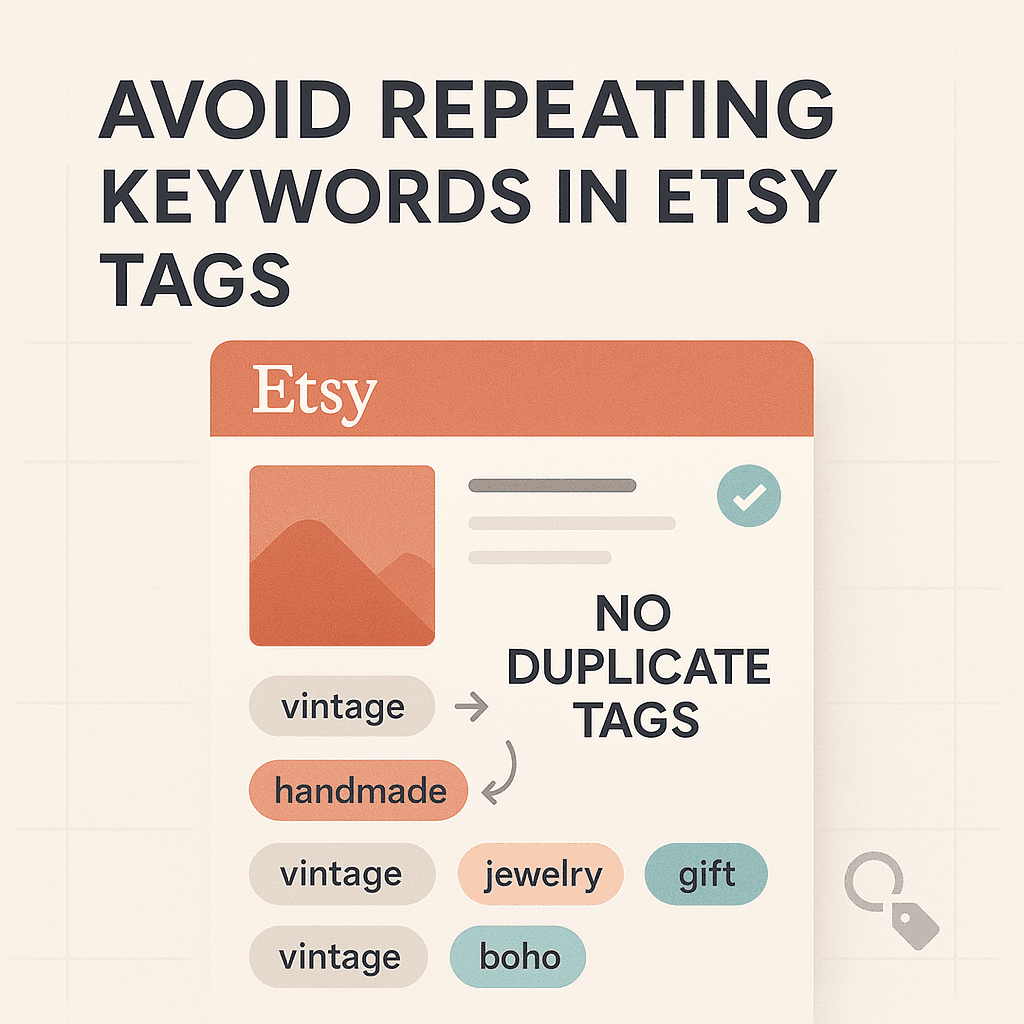
Etsy tags are one of those things you think you understand… until you look at your own listings and realize half your tags are basically saying the same thing.
Like:
- “cat shirt”
- “cat tshirt”
- “cat tee”
- “cat t shirt”
- “shirt cat”
I mean. I get it. You’re trying to cover variations.
But Etsy does not reward you for repeating the same keyword over and over. It usually just wastes space you could have used for new search terms.
And because you only get 13 tags, this matters more than people want to admit.
In this post, I’ll show you how to stop repeating keywords in Etsy tags without losing reach. And yeah, we’ll keep it practical, no fluff, so you can actually go fix your listings after reading.
Quick Etsy tag basics (so the rest makes sense)
Before we get tactical, two key things about Etsy search:
- Etsy mixes and matches words across your tags.
So if you have tags like “cat lover” and “funny gift”, Etsy can still match you for “funny cat gift”. You do not need to cram exact phrases everywhere. - Repeating a word in multiple tags doesn’t stack the ranking power.
Having “cat” in 6 different tags doesn’t make you rank 6 times harder for “cat”. It mostly just burns tag real estate.
So the goal is not “repeat the main keyword as much as possible”.
It’s “cover as many relevant search intents as possible without drifting into nonsense”.
What “repeating keywords” actually looks like (common patterns)
Sometimes repetition is obvious. Sometimes it’s sneaky.
Here are the patterns that usually kill tag variety:
1) Same keyword, different spelling
- tshirt vs t shirt vs t-shirt
Pick one. Etsy is pretty good at handling spacing and punctuation.
2) Singular vs plural spam
- “teacher gift”
- “teacher gifts”
You can usually pick one and move on.
3) Swapping word order
- “cat mom”
- “mom cat”
Not helping.
4) Repeating your product type in every tag
- “cat shirt”
- “funny shirt”
- “vintage shirt”
- “retro shirt”
- “oversized shirt”
You only sell a shirt, we get it. You want shirt in the tag set, yes. But not everywhere.
5) Using tags as mini titles
People try to recreate the whole title across tags. That’s where repetition explodes.
The mindset shift: stop tagging words, start tagging reasons someone searches
This is the cleanest way to stop repeating.
Instead of thinking:
I need to tag “cat” “shirt” “tshirt” “tee” “cat tee”…
Think:
Why would someone search for this?
Examples of search intent buckets:
- Recipient: gift for mom, gift for boyfriend, gift for coworker
- Occasion: Mother’s Day, birthday, Christmas, baby shower
- Style: minimalist, vintage, boho, cottagecore
- Theme: cats, plants, tarot, cowboy, bookish
- Profession/hobby: teacher, nurse, biker, gamer, gardener
- Location: Texas, New York, national parks (only if relevant)
- Personalization: custom name, monogram, birth flower
- Audience: plus size, kids, toddler, mens, womens (if accurate)
- Mood: funny, sarcastic, cute, spooky
Now suddenly you’re not repeating. You’re covering.
A simple method to remove repetition, step by step
This is the process I use when cleaning up tags on POD listings.
Step 1: List your “core keyword” once
Your core keyword is what the product literally is.
Examples:
- “cat shirt”
- “teacher sweatshirt”
- “birth flower necklace”
- “custom pet portrait”
Pick one version. Not five.
Step 2: Write down 8 to 12 supporting keywords (no product type)
These are modifiers that describe the design, vibe, or buyer.
For a “funny cat shirt”, supporting keywords might be:
- sarcastic
- introvert
- black cat
- cat mom
- halloween
- cozy
- minimal
- meme
- gift for her
- animal lover
Notice I didn’t write “shirt” again.
Step 3: Turn those into Etsy style tag phrases
Etsy tags can be up to 20 characters. So you’re building little phrases.
Example tags:
- “cat mom gift”
- “black cat”
- “sarcastic quote”
- “introvert gift”
- “halloween cat”
- “cute cat lover”
- “funny pet shirt” (this one includes product type, that’s fine, just not everywhere)
- “animal lover gift”
- “fall outfit”
- “spooky season”
Step 4: Only repeat a word if it unlocks a new intent
Sometimes repetition is worth it.
Example:
- “cat mom gift”
- “cat dad gift”
Yes, “cat” repeats. But the intent is different. Different buyer.
That’s good repetition.
Bad repetition is:
- “cat mom gift”
- “cat mom present” Same intent. Waste.
The “one word rule” (a good cheat code)
Try this: after you draft your 13 tags, highlight any word that shows up more than twice.
Ask:
- Is this word doing real work?
- Or am I just nervous and clinging to it?
Usually, the word you’re repeating is the product type: “shirt”, “sweatshirt”, “mug”.
You only need that a couple times max, especially if your title already clearly says it.
Example: fixing repetitive tags (before and after)
Let’s say you sell a POD listing: “Funny Mama Goose Sweatshirt” (just an example).
Before (repetitive)
- mama sweatshirt
- mama shirt
- mama sweater
- mama crewneck
- funny mama
- funny mama sweatshirt
- goose sweatshirt
- goose shirt
- goose sweater
- mom sweatshirt
- mom crewneck
- mom gift
- mothers day gift
A lot of these tags are basically the same.
After (more coverage, less repetition)
- mama crewneck
- goose design
- funny mom gift
- new mom gift
- mothers day
- cozy outfit
- farm animal
- cottagecore
- country mom
- sarcastic mom
- cute sweatshirt
- gift for mom
- spring outfit
Do you see what happened?
We still kept “mama crewneck” and “cute sweatshirt” so Etsy understands the product and style. But we stopped looping “mama sweatshirt” in five different ways.
Now you’re eligible for way more searches.
Use multi word tags, not single words (most of the time)
One of the easiest ways to avoid repetition is to stop using single word tags like:
- “cat”
- “gift”
- “funny”
- “mom”
Single words are broad, competitive, and they force you to repeat.
Instead, combine them:
- “funny cat gift”
- “gift for mom”
- “cat lover shirt”
- “sarcastic quote”
You cover more, with fewer tags.
Don’t “optimize” tags in a vacuum. Match your title and categories.
This part is boring but it’s where a lot of POD sellers mess up.
If your tags say “cottagecore goose” but your title says “Funny Goose Sweater Meme” and your category is wrong, Etsy gets mixed signals.
You don’t need to repeat keywords to force relevance.
You need consistency.
So do a quick alignment check:
- Does the category match the product?
- Do your top keywords appear naturally in the title?
- Are tags supporting, not rewriting, the title?
Images that help you audit tags faster
If you’re adding this post to WordPress, these visuals help a lot because Etsy SEO is abstract until you see it.
1) Tag audit checklist (simple graphic)
2) Example tag map (intent buckets)
3) Before and after tag cleanup (side-by-side)
If you don’t have these images yet, you can replace the URLs with your own media uploads later. But this is the kind of visual that keeps people reading.
How to find new keywords so you don’t feel forced to repeat
Repetition usually happens when you run out of ideas.
Here are a few fast ways to get better tag ideas without guessing.
1) Etsy search suggestions (still undefeated)
Start typing your core term and note the dropdown suggestions.
Type:
- “cat lover…”
- “cat mom…”
- “black cat…”
- “funny cat…”
Those suggestions are literally search behavior.
2) Competitor listings (but look for what they did not say)
Open 5 bestsellers in your niche and scan:
- title words
- photos (what vibe are they selling)
- personalization options
- occasions they mention
Then build tags that match that intent. Not copy paste their tags. Just… translate the idea.
3) Reviews and Q and A
If buyers say:
- “Bought this for my sister”
- “Perfect Halloween party sweater”
- “Love the oversized fit”
Those are tag clues.
To optimize your keyword strategy further, consider using Etsy seller SEO tools which can provide valuable insights and help streamline your tagging process.
4) Use trend data, not your gut (especially for POD)
Trends change fast. If you’re guessing, you’ll repeat safe keywords because you don’t trust the new ones.
This is where a tool can honestly save time.
If you’re using NinjaSell (https://ninjasell.com), it generates Etsy-ready listings based on bestseller and trend data, so your tags are naturally more varied. And it’s not just tags either. Titles, descriptions, mockups, the whole thing.
It also has built-in USPTO trademark checks, which matters a lot when you start exploring trend keywords and phrases.
You sign up free, no subscription fees. It’s more of a “pay base cost and shipping when orders happen” setup, which feels… realistic for POD.
A quick “tag formula” you can reuse for most POD listings
Not every listing needs the same structure, but if you’re stuck, try something like this:
Out of 13 tags:
- 2 tags: core product + main theme
Example: “black cat shirt”, “cat lover tee” - 3 tags: recipient + gift intent
Example: “gift for her”, “cat mom gift”, “teen girl gift” - 2 tags: occasion / season
Example: “halloween outfit”, “fall sweatshirt” - 3 tags: style / vibe
Example: “minimal design”, “retro aesthetic”, “cute graphic” - 3 tags: sub-niche / related interests
Example: “witchy cat”, “spooky season”, “introvert humor”
This naturally reduces repetition because each slot has a different job.
What NOT to do (because it’s tempting)
Don’t add “etsy” as a tag
Does nothing.
Don’t tag materials you aren’t using
If you’re doing POD tees, don’t tag “handmade” vibes that aren’t true. Etsy can ding you, customers can get mad, and returns are not fun.
Don’t tag “free shipping” or “sale”
Not useful as a search tag.
Don’t use irrelevant holiday tags just because traffic exists
If your design is not Christmas themed, forcing “christmas gift” usually lowers conversion. Etsy notices low engagement.
A quick final checklist (before you hit publish)
Read your 13 tags and make sure:
- You’re not repeating the same product type in half your tags.
- Each tag targets a different intent: style, recipient, occasion, niche, vibe.
- You’re using phrases, not lonely single words.
- You’re not stuffing synonyms that mean the same thing.
- Your tags match the listing. Like actually match.
If you want to speed this whole process up, especially when you’re uploading designs in bulk, NinjaSell can generate optimized titles and tags for you based on what’s selling right now. Then you tweak. That’s usually the sweet spot.
Wrap up
Avoiding repeated keywords in Etsy tags is mostly about discipline. And having enough keyword ideas to not panic repeat “shirt” six times.
Use intent buckets. Use multi word tags. Repeat only when it opens a new buyer or a new use case.
And once you clean up a few listings like this, it gets easier. You start seeing tags as coverage, not as a place to chant the same keyword.
If you’re building POD listings regularly and want the tags, titles, descriptions, mockups, and even drafting to Etsy handled in one place, you can check out NinjaSell here: https://ninjasell.com
FAQs (Frequently Asked Questions)
Why is repeating the same keyword in Etsy tags a bad idea?
Repeating the same keyword across multiple Etsy tags doesn’t improve your ranking and wastes valuable tag space. Since you only get 13 tags, using duplicates limits your ability to cover diverse search intents, reducing your overall reach.
How does Etsy handle word combinations in tags?
Etsy mixes and matches words across your tags, meaning you don’t need to cram exact phrases everywhere. For example, if you have ‘cat lover’ and ‘funny gift’ as tags, Etsy can match searches like ‘funny cat gift’ by combining those words.
What are common patterns of keyword repetition to avoid in Etsy tags?
Common repetition patterns include: using different spellings of the same word (e.g., ‘tshirt’ vs ‘t shirt’), singular vs plural forms (‘teacher gift’ vs ‘teacher gifts’), swapping word order (‘cat mom’ vs ‘mom cat’), repeating the product type in every tag (‘cat shirt’, ‘funny shirt’), and using tags as mini titles replicating the full listing title.
How should I rethink my Etsy tagging strategy to avoid repetition?
Shift your mindset from tagging individual words to tagging reasons someone would search. Focus on covering relevant search intents such as recipient, occasion, style, theme, profession, location, personalization, audience, and mood to maximize tag variety without redundancy.
What is a practical step-by-step method to remove repetition in Etsy tags?
- Choose one core keyword that describes your product (e.g., ‘cat shirt’). 2) List 8-12 supporting keywords that describe design, vibe, or buyer without repeating the product type. 3) Turn these into concise Etsy-style tag phrases up to 20 characters. 4) Only repeat a word if it unlocks a new search intent (like different recipients). This approach maximizes reach while avoiding wasted tag space.
What is the ‘one word rule’ for optimizing Etsy tags?
After drafting your 13 tags, highlight any word that appears more than twice. This helps identify unnecessary repetition so you can replace repeated terms with new keywords that cover additional search intents, improving your listing’s discoverability on Etsy.