Most Etsy sellers obsess over titles and tags. Which, yeah, you should. That stuff matters.
But shop sections? They usually get treated like a junk drawer. “New Arrivals”. “Best Sellers”. “Stuff I Made”. Random collections that were set once and never touched again.
And that’s a mistake.
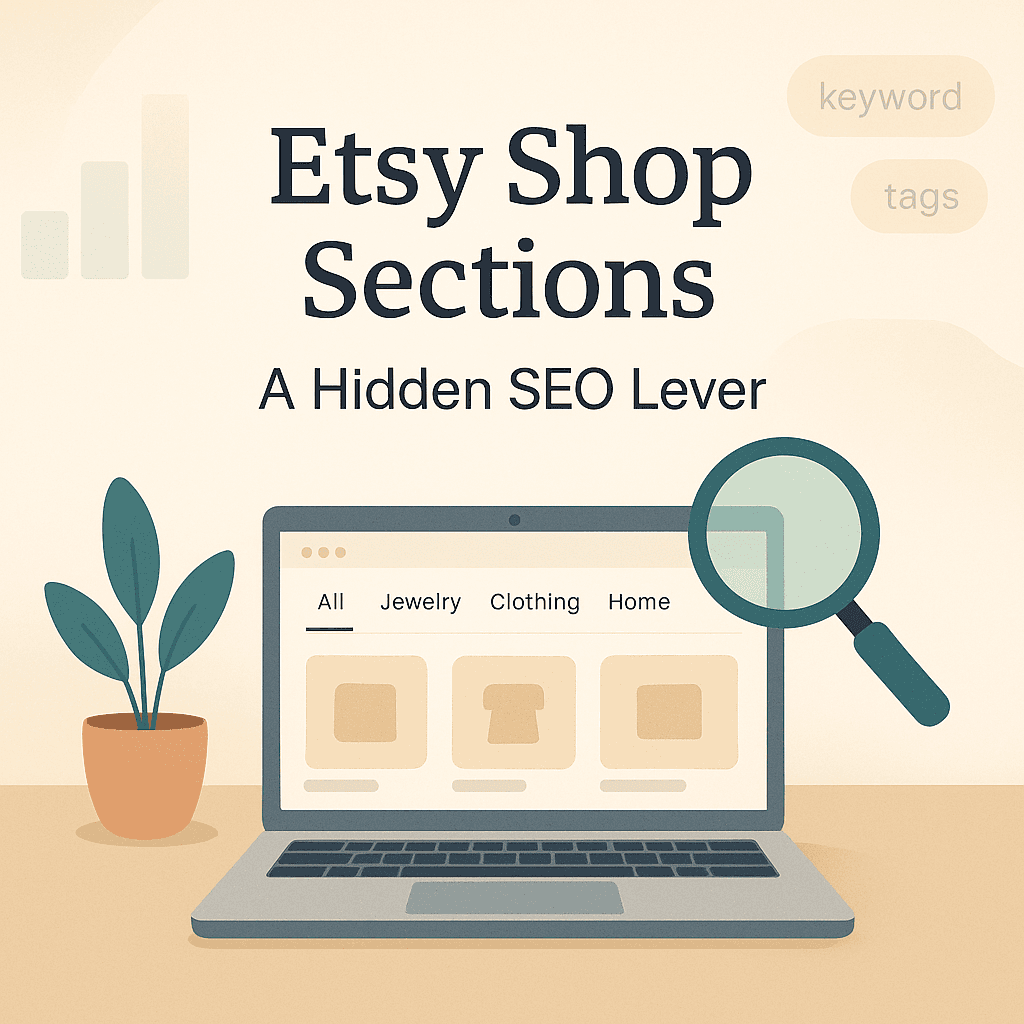
Because Etsy shop sections are one of those quiet levers that helps shoppers (and Etsy) understand what you sell. It affects click paths, time on shop, browsing depth, and whether a buyer feels like they landed in a real store or a flea market table.
Also, sections show up in places people forget. In your shop navigation. In buyer flows. Sometimes in Google. Sometimes in Etsy internal browsing when someone lands on your shop from a listing and then starts exploring.
So let’s talk about how to set them up like an SEO minded seller, without turning your shop into a robot catalog.
First, what an Etsy “shop section” actually does
A shop section is basically a category inside your Etsy shop. It is not the same as:
- Your listing category (like Clothing, Home and Living, etc.)
- Your tags
- Your attributes
- Your shop title or announcement
Sections are more like… internal aisles in your store.
And Etsy uses internal structure signals all the time. Not always in obvious ranking ways, but in “does the marketplace understand this shop” ways.
Here’s what sections do in practice:
- They reduce friction. A buyer lands on a shirt listing, clicks your shop, and immediately sees clear sections like “Funny Teacher Shirts”, “Retro Sports Tees”, “Matching Family Sets”. They keep browsing.
- They cluster relevance. If someone is in a section full of similar items, the chance of additional clicks and favorites tends to go up.
- They create keyword anchors. Section names are text. Text is indexable. Etsy and Google both parse text. Not magic, but it’s real.
- They help you scale. Once you pass 30 to 50 listings, a shop without sections starts to feel messy. And messy shops do not convert.
Conversion is the part a lot of SEO talk ignores. Etsy is a conversion marketplace. If your shop converts better, Etsy tends to trust it more.
The hidden SEO angle: section names are searchable language
Etsy doesn’t give you a big “sections boost” checkbox. Nothing like that.
But section names still matter because they do two things at once:
- They communicate to humans.
- They communicate to systems.
If your section is called “For Her”, that might be cute. But it’s vague. It does not tell anyone what’s inside. Etsy cannot map it to intent very well either.
Compare that to:
- “Custom Pet Portrait Shirts”
- “Bachelorette Party Shirts”
- “Boho Nursery Wall Art”
- “Funny Dad Hats”
- “Minimalist Wedding Signs”
Suddenly you’re using language buyers actually type.
And that’s the whole game.
One important note though
Do not keyword stuff your section titles like it’s 2009.
“Funny Shirt Gift Shirt Funny Gift For Her Trendy Shirt”
That looks spammy. Buyers bounce. Etsy can smell it.
A good section title feels like a normal category sign in a store. Clear, specific, buyer language.
How shoppers actually use sections (and why this affects sales)
A lot of Etsy traffic lands on a single listing from search. Then the buyer thinks:
“Okay, do they have more like this?”
They click your shop. And now they are scanning.
If your sections are:
- Too broad (“Shirts”)
- Too many (“Shirt 1”, “Shirt 2”, “Shirt 3”)
- Too random (“Cute Stuff”, “Random”, “Sale”)
They leave. Or they scroll endlessly, which feels like work.
But if your sections match how buyers think, they stick around.
Here’s a pattern that works well for POD:
- Section by audience (Teacher, Nurse, Mom, Dog Lover)
- Section by occasion (Father’s Day, Halloween, Graduation)
- Section by product type (Shirts, Sweatshirts, Mugs)
- Section by style (Minimal, Retro, Cute, Goth)
You do not need all four. Pick the one that matches your shop depth.
If you sell 80 percent shirts, sectioning by “Shirts” doesn’t help. It’s redundant. Section by audience or occasion instead.
The best Etsy shop section strategy (simple, scalable)
This is the approach I recommend for most POD sellers who want to scale beyond 20 listings.
Step 1: Pick one primary organizing logic
Choose one:
- By niche/audience (best for POD)
- By occasion (great if you ride seasonal trends)
- By product type (best for multi product shops)
- By collection/style (best for art focused shops)
Then commit to it. Consistency matters more than perfection.
Step 2: Keep your section count reasonable
A good range:
- 3 to 8 sections if you are under 50 listings
- 6 to 12 sections if you are 50 to 200 listings
- Over 12 can still work, but only if your shop is big and each section has enough items to feel real
If a section has 1 or 2 listings, it looks abandoned. Combine it.
Step 3: Name sections like buyers search
Use phrases that could plausibly be typed into Etsy search.
Good:
- “Teacher Shirts”
- “Funny Dog Mom Gifts”
- “Retro Camping Tees”
- “Custom Name Sweatshirts”
Weak:
- “Collection 1”
- “Summer Vibes”
- “For Him”
- “Gifts”
Step 4: Sort listings into sections like you mean it
This part is boring but it matters. If sections are half filled or inconsistent, buyers notice.
Also, sections are a maintenance task. Every time you upload new designs, assign them properly. Not later.
Keyword research for sections (without overthinking it)
You do not need a separate research process. Just reuse what you already know.
Here are a few easy ways to find section name ideas:
1. Use Etsy autocomplete
Start typing:
- “teacher shirt”
- “nurse gift”
- “bachelorette shirt”
- “grandma sweatshirt”
See what Etsy suggests. Those phrases are buyer language. Great section title candidates.
2. Look at competitor section names (the good ones)
Open a top shop in your niche and scan their sections. You’ll notice patterns.
Do not copy exactly, but borrow the structure.
3. Use your own listing tags and titles
If 10 of your listings use “retro mama shirt”, that’s basically telling you a section exists.
4. Use trend based keyword tools
If you’re using a platform like NinjaSell, this becomes way easier because you’re already generating listing SEO from real Etsy bestseller and trend data. When you see clusters of keywords popping up across designs, that cluster often deserves its own section.
And if you’re refreshing older listings with trend terms (NinjaSell’s ReSpark style workflow), you can also refresh your sections so your shop structure matches what’s currently selling, not what sold six months ago.
Subtle difference. Huge impact over time.
What NOT to do with Etsy shop sections
This is where most shops quietly hurt themselves.
Mistake 1: Making sections too broad
“Shirts” is not helpful if you sell only shirts.
Same with “Mugs” if mugs are your whole store.
You are wasting valuable navigation space.
Mistake 2: Making sections too clever
“Good Vibes Only” sounds fun, but what is it?
A buyer doesn’t want a poem. They want a category.
Mistake 3: Creating sections that compete with each other
If you have:
- “Teacher Shirts”
- “Teacher Gifts”
- “Teacher Tees”
That’s basically the same aisle three times. Combine or differentiate.
Mistake 4: Leaving dead sections up
Old holiday sections with no items. Sections with one listing. Stuff you no longer sell.
It makes your shop feel neglected, even if your listings are great.
Mistake 5: Using section names that trigger policy issues
Don’t put trademarked terms in section titles. It is still text content tied to your shop.
If you’re not sure, run a quick trademark check. NinjaSell includes built in USPTO based trademark checks, which is honestly useful because you can accidentally bake risky phrases into your shop structure, not just listings.
A practical section naming template you can steal
If you want a dead simple formula, use this:
[Primary keyword] + [product type or intent]
Examples:
- “Teacher Gifts”
- “Cat Lover Shirts”
- “Custom Pet Portraits”
- “Halloween Sweatshirts”
- “New Dad Gifts”
- “Minimalist Wall Art”
Or, if you want it more specific:
[Style] + [Audience] + [Product]
- “Retro Teacher Shirts”
- “Minimal Dog Mom Tees”
- “Cute Nurse Stickers”
Just do not go overboard. If it looks like a search query, it’s too much. If it looks like a store sign, it’s usually right.
How to organize sections for POD specifically (the setups that convert)
POD has a peculiar challenge: with the ability to create infinite designs, your shop can quickly spiral into chaos.
Here are three section structures that have proven successful.
Option A: Audience first (best for evergreen)
- Teacher Shirts
- Nurse Shirts
- Mom Shirts
- Dad Shirts
- Dog Lover Gifts
This structure works well because these audiences keep buying year-round.
Option B: Occasion first (best for seasonal spikes)
- Father’s Day Gifts
- Graduation Gifts
- Halloween Shirts
- Christmas Shirts
- Birthday Gifts
This option requires maintenance. You will need to add and remove sections as seasons change.
Option C: Hybrid, but controlled (best for larger shops)
- Teacher Shirts
- Nurse Shirts
- Halloween Collection
- Christmas Collection
- Personalized Gifts
This approach combines evergreen sections with seasonal spikes. Just ensure it remains tidy.
Do shop sections affect Etsy ranking directly?
Here’s the honest answer.
Etsy does not publicly state that “shop sections are a ranking factor.”
However, Etsy’s ranking is based on performance and relevance signals. Sections influence:
- How long buyers stay in your shop
- How many listings they view after landing
- Favorites and add to carts across your catalog
- Shop coherence, which affects buyer trust
- The path a buyer takes before purchase
So no, sections are not a magical SEO hack.
But yes, sections can absolutely raise conversion and engagement, which tends to positively impact everything else.
Additionally, section titles can appear in places that get indexed. So there is a direct “text exists” aspect too.
Essentially, it’s about leverage. Not a cheat code.
To further enhance your shop’s performance and increase sales, consider exploring more strategies from this Etsy Sellers Reddit thread or join discussions in this Etsy SEO Facebook group where experienced sellers share valuable insights.
A quick process to audit your shop sections in 15 minutes
If you want something concrete, do this:
- Open your shop like a buyer. Not as the owner. Pretend you know nothing.
- Look at your section list. Do you understand it instantly?
- Count sections with fewer than 4 items. Merge them.
- Rename vague sections into buyer language.
- Check for duplicates like “Gifts” and “Gift Ideas”. Pick one, make it specific.
- Make sure your best sellers are in the right sections. Buyers browse what they like. Help them stay in that lane.
Then stop. Don’t spend 4 hours “optimizing” sections instead of uploading products.
Where NinjaSell fits in (without turning this into an ad)
If you’re building a POD shop and you’re constantly adding designs, the real challenge is consistency.
You list a product, you generate a title, tags, description, mockups. Then you forget to organize it properly. Then two months later you have 80 listings and no structure.
That’s why tools like NinjaSell are useful in a practical way. You upload designs, it generates Etsy ready listings based on bestseller and trend data, creates Etsy style mockups, checks trademarks, and lets you publish to Etsy as drafts.
And once you have a consistent flow of products, it becomes way easier to also keep your sections clean, because you can see what niches you’re actually building. Not just what you randomly uploaded at 1am.
If you want to check it out, NinjaSell is here: https://ninjasell.com
Wrap up
Etsy shop sections are not just decoration. They’re navigation, they’re clarity, and quietly, they’re SEO adjacent.
If your shop feels easier to browse, buyers browse more. If they browse more, they buy more. And when that happens, your whole shop tends to rise.
So, quick checklist:
- Use 3 to 12 sections depending on shop size
- Name sections in buyer language, not clever vibes
- Organize by audience or occasion if you sell POD
- Merge dead sections and remove clutter
- Keep sections updated as you add new listings
Do that, and you’ll be ahead of most sellers. Because most sellers never touch sections again after week one.
FAQs (Frequently Asked Questions)
What is the purpose of Etsy shop sections and how do they differ from tags or listing categories?
Etsy shop sections act as internal categories or aisles within your shop, helping both shoppers and Etsy understand what you sell. Unlike listing categories, tags, attributes, or your shop title, sections organize your listings into clear groups that reduce friction for buyers, cluster relevant items together, create keyword anchors for SEO, and help scale your shop for better conversion.
How do well-named Etsy shop sections improve SEO and buyer experience?
Well-named sections use searchable language that communicates clearly to both humans and search systems like Etsy and Google. Specific section names like “Custom Pet Portrait Shirts” or “Bachelorette Party Shirts” match buyer intent and keywords they actually type, improving discoverability. This clarity encourages more browsing, increases click-through rates, and signals to Etsy that your shop is organized and trustworthy.
What are common mistakes sellers make with Etsy shop sections?
Many sellers treat shop sections like a junk drawer with vague or random titles such as “New Arrivals” or “Stuff I Made,” which don’t guide buyers effectively. Overly broad sections like “Shirts” or too many similar sections (e.g., “Shirt 1,” “Shirt 2”) cause confusion or endless scrolling. Keyword stuffing section titles also looks spammy and drives buyers away, harming both user experience and SEO.
How should I structure my Etsy shop sections to maximize sales and browsing depth?
Choose one primary organizing logic that fits your shop’s focus—by niche/audience (e.g., Teacher, Mom), occasion (e.g., Father’s Day), product type (e.g., Shirts), or style (e.g., Retro). Keep section counts reasonable: 3-8 for under 50 listings or 6-12 for 50-200 listings. Sections should be clear, specific, and reflect how buyers think to encourage longer browsing sessions and higher conversion rates.
Why does having organized Etsy shop sections matter beyond just SEO?
Organized sections improve the shopper’s experience by making it easy to find related items quickly, reducing friction in navigation. This leads to increased time spent in your shop, more clicks on additional listings, higher chances of favorites or purchases, and ultimately better conversion rates. Since Etsy favors shops that convert well, good section organization indirectly boosts your overall marketplace trust and ranking.
Can Etsy shop section names influence search results on platforms outside of Etsy?
Yes. Section names are indexable text that both Etsy’s internal algorithms and external search engines like Google parse. Using descriptive, keyword-rich section titles helps your listings appear in relevant searches beyond Etsy itself. However, avoid keyword stuffing; instead use natural language that clearly describes the items inside each section to attract genuine buyer interest.