You ever open Etsy, type a word like “gift”, and suddenly it feels like the whole internet is screaming at you.
“Trending now.” “Hot keyword.” “Exploding niche.” “Get in before it’s saturated.”
And honestly. Sometimes it is real.
But a lot of the time… it’s not. It’s just noise. Or worse, it’s a keyword that looks hot because someone made it look hot, not because buyers are actually buying.
If you sell print on demand on Etsy, chasing fake hot keywords is one of the fastest ways to burn time, burn listing slots, and end up with 30 new products that get 7 views total.
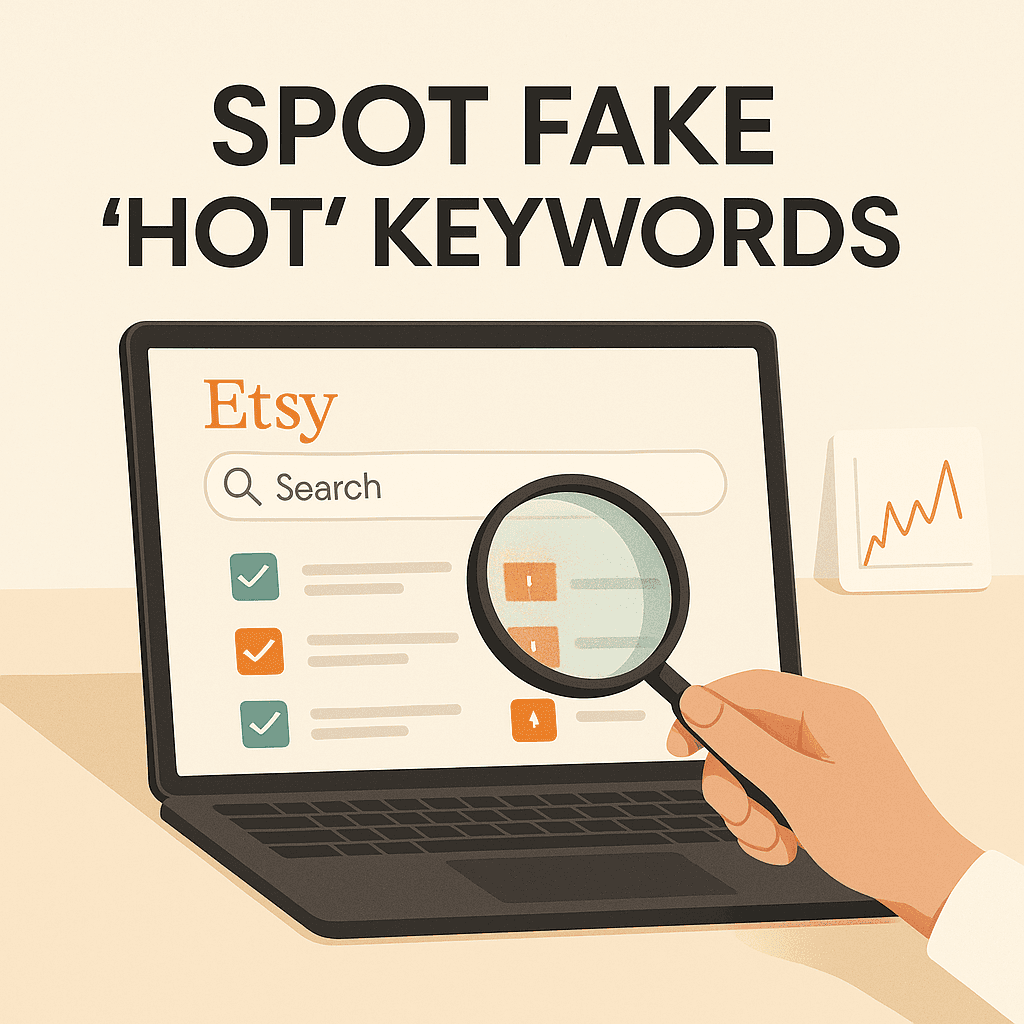
So let’s talk about how to spot the fakes. The “trend-shaped objects”. The keywords that look like money but behave like a brick.
What “fake hot” actually means (it’s not always a scam)
A fake hot keyword usually falls into one of these buckets:
- It’s getting searches but not purchases.
- It’s being pushed by other sellers, not pulled by buyers.
- It’s a micro trend already over, but tools are still reporting it.
- It’s broad to the point of useless.
- It triggers irrelevant traffic, which quietly tanks your conversion.
That last one matters more than people think. Etsy is a marketplace. If Etsy sends you shoppers and they bounce, Etsy learns. Your listing can slowly lose momentum even if your design is fine.
So yeah. Fake hot keywords can cost you more than just “a listing that didn’t work”.
The weird truth about Etsy trends
Etsy trends are messy because Etsy is messy.
You’re dealing with:
- personalization keywords
- seasonal demand
- TikTok and Pinterest waves
- wedding and baby cycles
- gifting spikes
- influencer phrases
- plus a million sellers copying each other like it’s a group project
So you’ll often see a keyword look “hot” when it’s really just a temporary echo chamber.
And if you’re a POD seller, you feel it extra hard because you can spin up new listings quickly. Which is a blessing. And also how people speedrun themselves into confusion.
Quick visual: real trend vs fake trend

A real Etsy keyword trend usually has:
- multiple unrelated shops ranking for it (not the same style copy pasted)
- listings with real review velocity in the last 30 to 90 days
- a clear buyer intent phrase (“custom”, “for”, “gift”, “shirt”, “sign”, “invite”)
- room for differentiation (sub niche, audience, occasion)
A fake one usually has:
- tons of results, but they all look suspiciously similar
- bestsellers that are actually old listings coasting
- lots of favorites, not a lot of recent reviews
- vague search intent (“aesthetic”, “coquette”, “cute” with no object)
- the top results are mostly ads
Let’s get practical.
9 ways to spot fake “hot” keywords on Etsy
1. The keyword has a ton of results but the top listings look dead
This is the easiest tell.
Search the keyword on Etsy. Open the first page. Click 5 to 10 listings that show up near the top.
Now look for:
- recent reviews (not “reviews” overall, recent)
- recent photos in reviews
- variation activity (sizes, colors, personalization fields being used)
- updates (some sellers tweak photos, options, etc)
If the keyword is supposedly “hot” but the listings feel like abandoned mall stores, that’s a red flag.
A lot of “hot keyword” lists are basically reporting what’s popular to list, not what’s popular to buy.
2. The trend phrase is not a product phrase
This is where so many POD sellers get tricked.
Example: “coquette”
Coquette is a style word. Not a product. People might search it, sure. But what are they trying to buy?
- coquette shirt
- coquette phone case
- coquette wall art
- coquette birthday invite
If the keyword is only the vibe, it can be fake hot for you unless you pin it to an object and an audience.
So instead of “coquette”, you want combos like:
- coquette bow shirt
- coquette baby shower invite
- coquette bridesmaid gift
- pink coquette sweatshirt
If you can’t naturally attach the keyword to a real product phrase, don’t build 20 listings around it.
3. It’s “hot” because sellers are teaching it
This one is awkward, but it’s real.
A keyword can spike because:
- YouTube gurus make videos about it
- TikTok seller coaches scream “new niche!”
- Everyone rushes to list it
- Tools detect the new listing volume and call it trending
But listing volume is not buyer demand.
So when you see a trend keyword, ask:
Is this being talked about by sellers more than customers?
If you search the phrase on TikTok and every video is “how to sell this on Etsy”… that is not a demand signal. That’s a competition signal.
4. The search results are mostly ads
If you search a keyword and the top of page one is stuffed with “Ad by Etsy seller” labels, it can mean one of two things:
- the keyword is valuable and competitive
or - the keyword doesn’t convert organically so sellers have to pay to stay visible
How do you tell which it is?
Click those ads. Look at their review velocity. If they’re paying for traffic but still getting steady recent reviews, ok, it might be a real buyer term.
If they’re paying and the shop looks like it’s struggling… again, red flag.
5. The keyword is super broad and your conversion will be trash
Some keywords get labeled “hot” because they have search volume:
- gift for her
- wall art
- funny shirt
- personalized gift
Yeah… those are basically entire Etsy categories.
You can rank for those if you’re already strong, have a conversion history, and your listing is insanely relevant. But if you’re newer, those broad terms are often a trap.
Better approach:
Take the broad keyword and “corner it” into a specific buyer.
Instead of “gift for her” try:
- gift for her nurse
- gift for her new mom
- gift for her long distance
- gift for her 30th birthday
That’s where purchase intent lives.
6. You can’t find “evidence listings” with recent reviews
This is my favorite quick check.
For any keyword you’re considering, you should be able to find at least a few listings that:
- have reviews within the last few weeks
- match the keyword tightly
- and the reviews clearly show the buyer bought because of that theme
If you can’t find that evidence, your tool might be showing you a ghost trend.
And if you can find it, screenshot it. Seriously. Make a folder. Those screenshots become your “this is real” library.
7. The keyword is seasonal but you’re late
A lot of fake hot keywords are just late seasonal keywords.
The tool says “Father’s Day gift” is trending. Great. When?
If it’s two weeks before Father’s Day, that trend might be real, but it’s not useful for a new listing unless you already have traffic and reviews. Etsy SEO takes time. Not forever, but time.
Same with:
- Christmas
- teacher gifts
- graduation
- Halloween
If you’re going to trend chase seasonally, you need to be early. Like uncomfortably early. Two to three months early is usually safer.
8. The keyword is “trend bait” with no differentiation angle
Some keywords are real, but fake for you.
Example: “Swiftie shirt”
Real demand, sure. But now you’re dealing with:
- trademark risk
- saturated competition
- fan base expectations
- constant take downs
Even if it looks hot, it may not be worth building around.
This is where having a built in trademark check matters. If you’re doing POD, the worst feeling is spending a whole weekend building listings and then realizing the keywords you used are legally radioactive.
(If you’re using a platform like NinjaSell, this is one of the underrated parts: trademark checks against USPTO data are built into the workflow, so you catch problems early instead of after you’ve published a bunch of drafts.)
9. The keyword “spikes” but it’s only one product type
Sometimes a keyword is real… but only for one format.
Example: “bachelorette itinerary”
This might be hot for Canva templates. Not for shirts. Or mugs. Or wall art. So if you’re a POD seller, it becomes a fake hot keyword because it doesn’t match your catalog.
Always ask:
Is this keyword hot for the product I actually sell?
Not the vibe. Not the phrase. The product.
A simple checklist before you commit to any “hot” keyword

Before you create anything new, run through this:
- Can I find 3 to 5 listings ranking for it with recent reviews in the last 30 days?
- Do those listings look like different shops, not clones?
- Does the keyword include an object or clear product intent?
- Can I niche it down to an audience, job, hobby, event, or relationship?
- Can I make a design that is clearly different, not just “same but mine”?
- Is it safe from a trademark standpoint?
- Is it seasonal, and am I early enough?
If you can’t answer most of those with a yes, don’t build a whole batch. Test one listing at most.
What to do instead of trend chasing (but still ride trends)
Trend chasing usually fails because it’s random.
What you actually want is a repeatable system:
- Use trend data as a filter, not a command.
- Validate with Etsy itself.
- Publish fast, but in controlled tests.
- Refresh what’s underperforming, don’t just abandon it.
That last point is big. Most Etsy sellers never revisit listings. They just keep uploading new ones like a slot machine.
But updating underperformers with better tags and tighter titles is often easier than starting from scratch.
This is basically why automation features like NinjaSell ReSpark exist. You take listings that are flat, refresh them with updated trend-based keywords, and see if they catch again. It’s not magic. It’s just not wasting what you already built.
The “2 bucket” keyword strategy (works well for POD)
Here’s a structure that keeps you sane:
Bucket A: Evergreen money keywords
These are stable phrases with steady demand:
- funny mom shirt
- personalized family name sign
- nurse gift
- teacher sweatshirt
- couple matching shirts
They’re not exciting. That’s why they work.
These keywords fall under the category of evergreen content, which remains relevant over time and continues to attract traffic.
Bucket B: Trend flavored add ons
These are the trend elements you can layer in without rebuilding your whole shop:
- design style: retro, minimalist, coquette, western
- micro themes: “pickleball”, “booktok”, “cowgirl”, “grandmillennial”
- seasonal hooks: graduation 2026, summer trip, spooky season
So you don’t bet everything on “coquette”. You do “teacher sweatshirt” with a coquette bow style, if it fits.
That’s how you ride trends without getting wrecked by them.
How I’d validate a “hot” keyword in 10 minutes
Let’s say someone claims “cowgirl aesthetic shirt” is trending.
I would:
- Search it on Etsy.
- Open top 10 listings.
- Check reviews. Are there recent ones?
- Are buyers saying “so cute” with photos? Or is it silent?
- Look at the titles and tags vibe. Is everyone stuffing the same words?
- Scroll page 2 and 3. Sometimes page 1 is mostly ads and old giants. Page 2 shows the real market.
- Identify one niche angle: “bachelorette cowgirl”, “Nashville trip”, “rodeo mom”, “western bride”.
- Make one test listing, not ten.
If I’m using a tool to speed things up, I want it to pull from actual Etsy bestseller and trend patterns, not just generic keyword volume. That’s the difference between “data” and “noise”.
This is also where NinjaSell is handy for POD sellers because it takes your design, generates an Etsy ready title, tags, description, and even mockups. You can publish to Etsy as drafts with one click, then tweak. So you can test faster without committing your whole week to one maybe trend.
Common fake hot keyword examples (and how to fix them)
A few patterns I see constantly:
“Aesthetic” keywords
- fake: “pink aesthetic”
- better: “pink aesthetic phone case”, “pink aesthetic wall art set”
- best: “pink aesthetic dorm wall art set” (audience + use case)
“Core” keywords
- fake: “cottagecore”
- better: “cottagecore mushroom shirt”
- best: “cottagecore gardening sweatshirt” (niche hobby)
“Era” keywords
- fake: “in my ___ era”
- better: “in my teacher era shirt”
- best: “in my teacher era comfort colors” (product detail buyers actually filter for)
The point is not that these are bad. It’s that they’re incomplete.
Tiny conclusion, because you have listings to build
Fake hot keywords usually look loud and easy. Real keywords look specific and a little boring.
So the move is:
- validate with Etsy search results and review velocity
- avoid pure vibe words unless they’re attached to a product
- don’t confuse seller hype with buyer demand
- test small, then scale what converts
- refresh older listings instead of endlessly starting over
And if you want the “speed advantage” without the chaos, that’s basically what NinjaSell is built for. Upload a design, get optimized Etsy listings based on bestseller and trend data, run trademark checks, generate mockups, publish to Etsy as drafts, then iterate. Simple loop.
Because the real win is not spotting every trend.
It’s not wasting your time on fake ones.
FAQs (Frequently Asked Questions)
What does ‘fake hot’ keyword mean on Etsy?
A ‘fake hot’ keyword on Etsy refers to keywords that appear popular but don’t translate into actual sales. They might be getting searches without purchases, pushed by sellers rather than buyers, represent micro trends already over, are too broad to be useful, or trigger irrelevant traffic that hurts your conversion rates.
Why is chasing fake hot keywords risky for Etsy print on demand sellers?
Chasing fake hot keywords can waste your time and listing slots, resulting in many new products with very few views. It can also harm your listing’s momentum because if shoppers bounce from your listings due to irrelevant keywords, Etsy’s algorithm may reduce your visibility even if your designs are good.
How can I spot a fake hot keyword on Etsy?
Look for signs like a high number of results but top listings appearing inactive or outdated, lack of recent reviews or customer photos, vague search intent without clear product association, and listings dominated by similar styles or ads. Also, check if the trend is being driven more by sellers than actual buyer demand.
What makes an Etsy keyword trend genuine and valuable?
A real Etsy keyword trend usually has multiple unrelated shops ranking with diverse styles, recent review activity indicating active sales, clear buyer intent phrases like ‘custom’, ‘gift’, or ‘shirt’, and room for differentiation through sub-niches or specific audiences.
How do seller-driven trends differ from buyer-driven trends on Etsy?
Seller-driven trends often spike because of YouTube tutorials, TikTok coaching videos, or mass listing efforts by sellers themselves rather than genuine customer demand. These trends can mislead tools into reporting them as hot due to increased listing volume instead of actual purchases.
What strategies can help avoid wasting effort on fake hot keywords in Etsy POD selling?
Focus on keywords with clear buyer intent attached to specific products (e.g., ‘coquette baby shower invite’ instead of just ‘coquette’), verify recent sales activity and reviews on top listings, watch out for broad or vague terms, and be cautious about trends heavily promoted by other sellers rather than customers.