You look at your Etsy stats, and it’s the same story again.
A few sales. Mostly from the US. Maybe the UK if you’re lucky. And then you start thinking, wait. Etsy is global. People in Germany buy gifts. People in France buy wall art. People in Spain buy funny shirts. Why am I basically invisible outside English speaking countries?
So you see the “Translate listings” option (or you hear about listing translation apps). And you wonder if it’s one of those things that sounds smart but does absolutely nothing.
This post is my honest take on Etsy listing translation. When it’s worth it, when it’s a waste, and what I would actually do if I was running a POD shop today and trying to grow fast without turning my workflow into chaos.

First, does Etsy even translate listings?
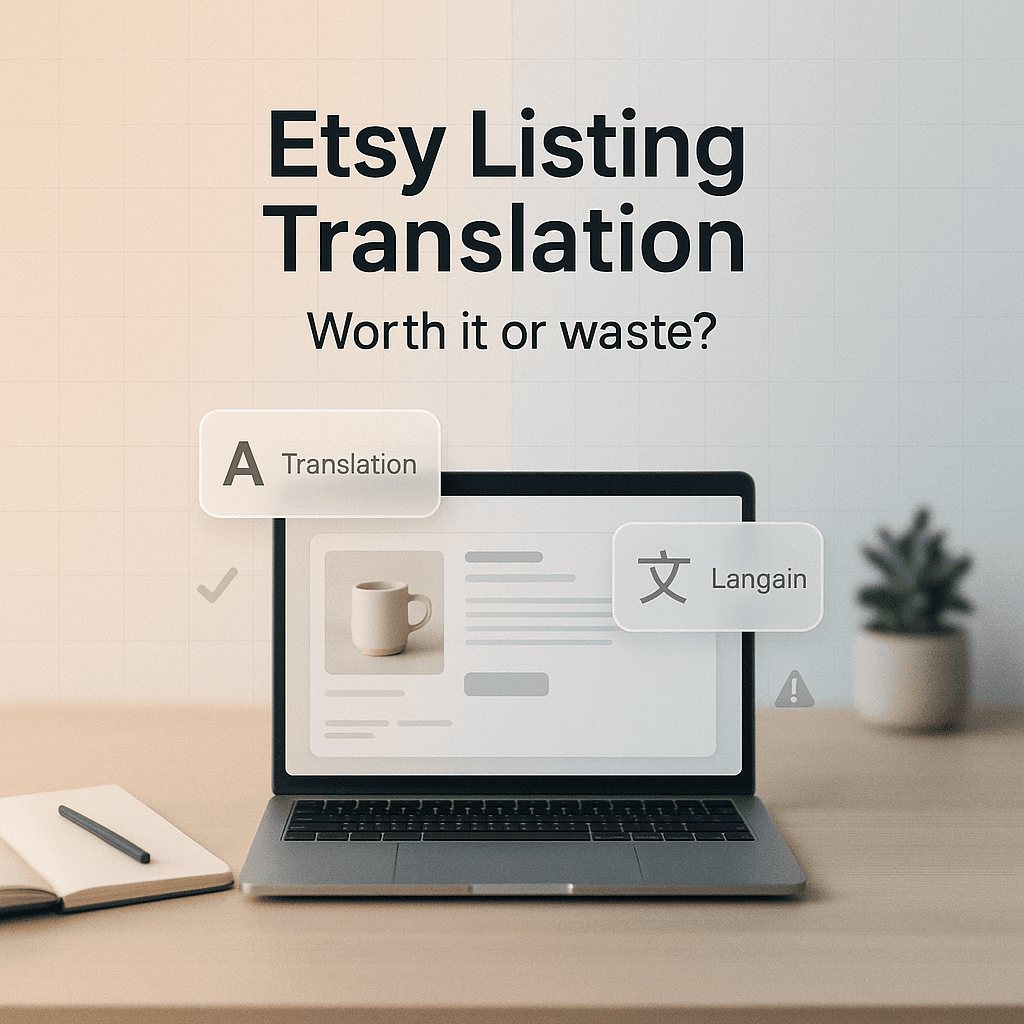
Yes. Etsy has built in translation for certain languages and markets. It can translate parts of your listing automatically for shoppers browsing in their language.
But. This is where people get tripped up.
Etsy translation is not the same as you writing a localized listing that matches how people actually search in that country.
Etsy can translate “Funny teacher shirt” into something technically correct in another language. But it might not translate into the phrase a real shopper types into the Etsy search bar over there.
And on Etsy, being technically correct is… not the game. The game is matching search intent.
So the real question isn’t “does Etsy translate?” The real question is:
Do translated listings help you rank and convert better in non English markets?
Sometimes yes. Sometimes not at all.
The two ways translation can help (and the one way it hurts)
1. It can help conversion
Even if the keywords are imperfect, shoppers are human. If someone lands on your listing and the description is readable in their language, that can increase trust.
Especially for higher intent purchases. Personalized items, wedding stuff, expensive wall art sets, things where people actually read.
2. It can help discovery a little
In some cases, Etsy’s translated content can help you show up when a shopper searches in their language, mainly if the translation overlaps with common phrasing.
But this is hit or miss. Some languages have more direct keyword mapping than others. German compound words alone can turn this into a mess.
3. It can hurt if you do it wrong
Bad translation can make your listing look scammy. Or just confusing. Or weirdly aggressive, like those AliExpress listings that sound like a robot begging you to buy.
Also, if you stuff translated keywords unnaturally, you can tank conversion. And conversion is part of Etsy’s feedback loop. Low conversion means Etsy stops testing you as much.
So yeah. Translation can be helpful. But it can also quietly sabotage you.
What matters more than translation: whether you can actually fulfill internationally
Before you spend one minute translating anything, answer this:
Can you ship to those countries reliably, at a price that doesn’t make the customer laugh?
For print on demand sellers, this is huge.
If you’re printing in the US and shipping worldwide, international shipping can be slow and expensive. For some products it still works. Stickers, small prints, lightweight tees. For other products, it kills the deal.
And if your fulfillment is US only, then translation might be mostly pointless unless you’re targeting non English speakers inside the US (which is a real market, just different).
Quick note if you use NinjaSell: NinjaSell’s fulfillment is currently focused on US only printing and shipping. So if your whole plan is “let’s translate everything and sell heavily into Europe,” your bottleneck probably won’t be language. It’ll be logistics.
But. If your goal is still to tighten listings, rank better in English, and run a clean POD workflow (drafts, mockups, SEO, trademark checks), NinjaSell is actually useful. Translation just isn’t the first lever I’d pull.
Etsy SEO reality: Etsy search is not Google
A common misconception is that translating your title and description is like translating a blog post.
On Etsy, the real SEO drivers are:
- Your title (keywords at the front matter more)
- Your tags (still very important)
- Your category and attributes (they act like structured tags)
- Your listing quality score signals (click through, favorites, conversion)
- Your price, shipping, reviews, shop trust signals
Descriptions matter more for conversion than ranking, in most cases.
So when people translate listings, they often translate the description and maybe the title. But they ignore the tags and attributes. Which is basically like putting a translated sign on your store but not changing what’s in your product aisle labels.
Translation that doesn’t touch keyword strategy is usually a waste.

When Etsy listing translation is actually worth it
Here are the situations where I’d say yes, do it.
You already get international traffic
Go to Stats and look at “Shop traffic by location.”
If you already get visits from Germany, France, Canada, Australia, Netherlands, etc. Translation can improve conversion because those people are already finding you somehow.
This is the easiest win. You’re not trying to force discovery. You’re just making the landing page easier to buy from.
Your product is language light
Some products don’t require much reading.
- Minimalist wall art prints
- Simple typography (ironically, as long as the typography itself is in English, you still need to think about the buyer)
- Patterns, clipart, digital papers
- Aesthetic items where photos do most of the selling
In these cases, translation can reduce friction without needing perfect localization.
You sell giftable, universal categories
Stuff like:
- Pet themed designs
- Family roles (mom, dad, grandma)
- Hobby shirts (golf, fishing, hiking)
- Occupation humor (nurse, teacher)
Just know. A joke that works in English often does not work in another language. So be careful with humor. Sometimes you should not translate the design concept at all. Instead you create a separate localized design.
You’re willing to localize, not just translate
This is the big one. If you’re willing to do keyword research in that language and build listings around how people search there, then yes. It can be a growth lever.
But if you’re going to paste your English title into Google Translate and call it a day, no. That’s usually a waste.
When it’s a waste (or at least low priority)
You have under 20 to 30 strong listings
If your shop is still small, translation is often procrastination disguised as strategy.
A better move is usually:
- Create more listings
- Improve mockups
- Fix your keyword targeting in English
- Improve pricing and shipping settings
- Get more reviews
- Build a real listing “system” so you can publish consistently
Translation can wait.
Your listings don’t convert in English yet
If your conversion rate is weak in your main market, translation just spreads the problem to more countries.
Fix the core offer first. The design, the photos, the value. Translation is not magic.
You can’t compete on shipping time/cost internationally
If your shipping is $18 and takes 3 weeks, translating into French won’t fix that. It might actually create more unhappy customers because now you’re attracting buyers who don’t realize how US based your fulfillment is.
A practical middle ground: translate for clarity, not for SEO
If you don’t want to go all in, here’s the approach I like.
- Keep your English title optimized for your main market.
- Let Etsy handle some of the translation for browsing experience.
- Add a short translated “summary” at the top of your description for your top 1 to 2 countries.
Example:
- A short German blurb if you see Germany traffic.
- A short French blurb if you see France traffic.
Not your whole description. Just enough to remove doubt.
Also, do not translate your policies manually unless you’re confident. Policies are where misunderstandings get expensive.
Titles and tags: the part everyone gets wrong
Let’s talk about the messy truth.
Etsy titles and tags are not meant to read like a sentence. They’re meant to match queries.
If you translate them literally, you might end up with phrases no one searches.
So if you’re translating for SEO, you have to do it like this:
- Pick the market (say Germany).
- Find out what German buyers actually type.
- Build a German keyword set.
- Then rewrite the listing keywords around that.
That’s not translation. That’s localization.
And yes, it takes work.
“But can I just use AI?”
You can. But you still need a human brain in the loop.
AI can help you generate variants, synonyms, and phrasing ideas. But AI does not automatically know Etsy search behavior in that country, especially for niche phrases. It also can make stuff up that looks right but isn’t used.
A decent workflow is:
- AI for drafts
- Actual Etsy search suggestions for validation (type keywords into Etsy in that language and see what autocomplete shows)
- Competitor scan (top listings in that market)
- Final edit
Don’t translate everything. Translate your winners first.
This is the simplest advice that saves time.
If you have 200 listings and you translate them all, you may spend hours and get nothing because 150 of those listings were never going to sell anyway.
Instead:
- Find your top 10 to 20 listings by revenue or conversion.
- Translate and localize those first.
- Watch stats for 2 to 4 weeks.
- Only then expand.
How I’d test Etsy listing translation (without losing my mind)
Here’s a clean testing plan.
Step 1: Pick one market
Choose based on your traffic data or obvious demand.
Germany, France, Canada, Australia are common. Spain and Italy can work too depending on niche.
Step 2: Pick 5 listings that already sell
Don’t test with losers. Test with proven products.
Step 3: Localize the listing text that impacts buying
- First 2 lines of description
- Sizing info
- Shipping expectations
- Personalization instructions (if any)
Clarity reduces messages. And messages are time.
Step 4: Localize keywords only if you can validate them
If you can’t validate the keyword set, don’t touch it. Bad keywords can tank relevance.
Step 5: Watch the right metrics
- Visits from that country
- Conversion rate from that country
- Message volume (did confusion go up?)
- Returns/cancellations (did expectations get worse?)
If conversion improves but issues spike, you didn’t translate the right part. Usually sizing, shipping, or personalization.
POD specific translation issues (people forget these)
Sizes are not universal
US sizes vs EU sizes. Inches vs centimeters. Paper sizes. Frame sizes.
If you translate anything, translate sizing properly and add conversions.
Materials and care instructions
Some markets care a lot about fabric composition, eco inks, certifications. If you can’t support those claims, don’t imply them in translation.
Personalization fields
If you do custom text, translating instructions matters. Otherwise you get blank personalization fields and angry buyers.
Where NinjaSell fits into this (and where it doesn’t)
If you’re doing POD on Etsy, your biggest problem is rarely “I need more languages.”
It’s usually:
- You can’t publish consistently
- Your keywords are weak
- You keep repeating the same tags
- You accidentally step on trademarks
- Your mockups look generic
- Your listings go stale and stop getting tested
That’s the stuff NinjaSell is built for.
NinjaSell takes your uploaded design, generates Etsy ready listings based on bestseller and trend data (titles, tags, descriptions), creates Etsy style mockups, runs trademark checks against USPTO, and lets you publish to Etsy as drafts. Then you can refresh underperformers with updated keywords using ReSpark, and even auto post to Pinterest for extra traffic.
So here’s the honest play:
- Use NinjaSell to get your English listings really tight and scalable first.
- Once you have winners, then consider translation or localization for specific markets, if your fulfillment setup supports it.
If you want to check it out, NinjaSell is free to sign up at https://ninjasell.com and you don’t pay a subscription. Costs happen when orders happen.

So… worth it or waste?
It’s worth it if:
- You already get international traffic and want better conversion.
- You can actually ship to those countries competitively.
- You’re willing to localize keywords, not just translate words.
- You start with your winners and test.
It’s a waste (or at least not urgent) if:
- Your shop is small and you need more good listings first.
- Your English listings don’t convert yet.
- Shipping internationally is a mess.
- You plan to do a lazy copy paste translation and hope Etsy rewards you.
If you want the simplest version of my recommendation, here it is:
Get your core listings profitable in English. Scale with a system. Then translate the winners for the specific markets already sniffing around your shop.
Everything else is just… busywork that feels productive. And Etsy sellers have enough of that already.
FAQs (Frequently Asked Questions)
Does Etsy automatically translate my product listings for international shoppers?
Yes, Etsy has built-in translation features for certain languages and markets, which can automatically translate parts of your listing for shoppers browsing in their native language. However, this automatic translation may not match how people actually search in those countries, as it focuses on technical correctness rather than localized search intent.
How can translating my Etsy listings help improve sales internationally?
Translating your listings can help in two main ways: first, it can boost conversion by making descriptions readable and trustworthy in the shopper’s language, especially for personalized or higher-priced items; second, it can slightly improve discovery if the translated content overlaps with common search phrases in that language. However, effectiveness varies by language and product.
What are the risks of poorly translating Etsy listings?
Bad translations can make your listings appear scammy, confusing, or unprofessional—similar to robotic or overly aggressive sales pitches. Additionally, unnaturally stuffing translated keywords can hurt conversion rates, which negatively impacts Etsy’s ranking algorithms since low conversion reduces Etsy’s willingness to promote your listings.
Is translation worthwhile if I cannot ship internationally to those countries effectively?
No. Before investing time in translation, ensure you can reliably fulfill orders to those countries at reasonable shipping costs. For print-on-demand sellers especially, international shipping from the US can be slow and expensive. If fulfillment is limited to the US only, translating for non-English speaking countries might not yield significant benefits unless targeting non-English speakers within the US market.
Which parts of an Etsy listing should I translate to improve SEO and sales?
While many focus on translating titles and descriptions, it’s crucial also to translate tags and attributes since these elements drive Etsy’s search algorithm. Descriptions mainly influence conversion rather than ranking. Ignoring keyword strategy in tags and attributes means translation efforts might not help your listings rank better in foreign markets.
When is it most effective to invest in translating Etsy listings?
Translation is most worthwhile when you already receive international traffic from specific countries like Germany, France, Canada, Australia, or the Netherlands. In such cases, translating your listings can improve conversion rates because these visitors are already finding your shop organically. This approach offers an easier win than trying to force international sales through translation alone.