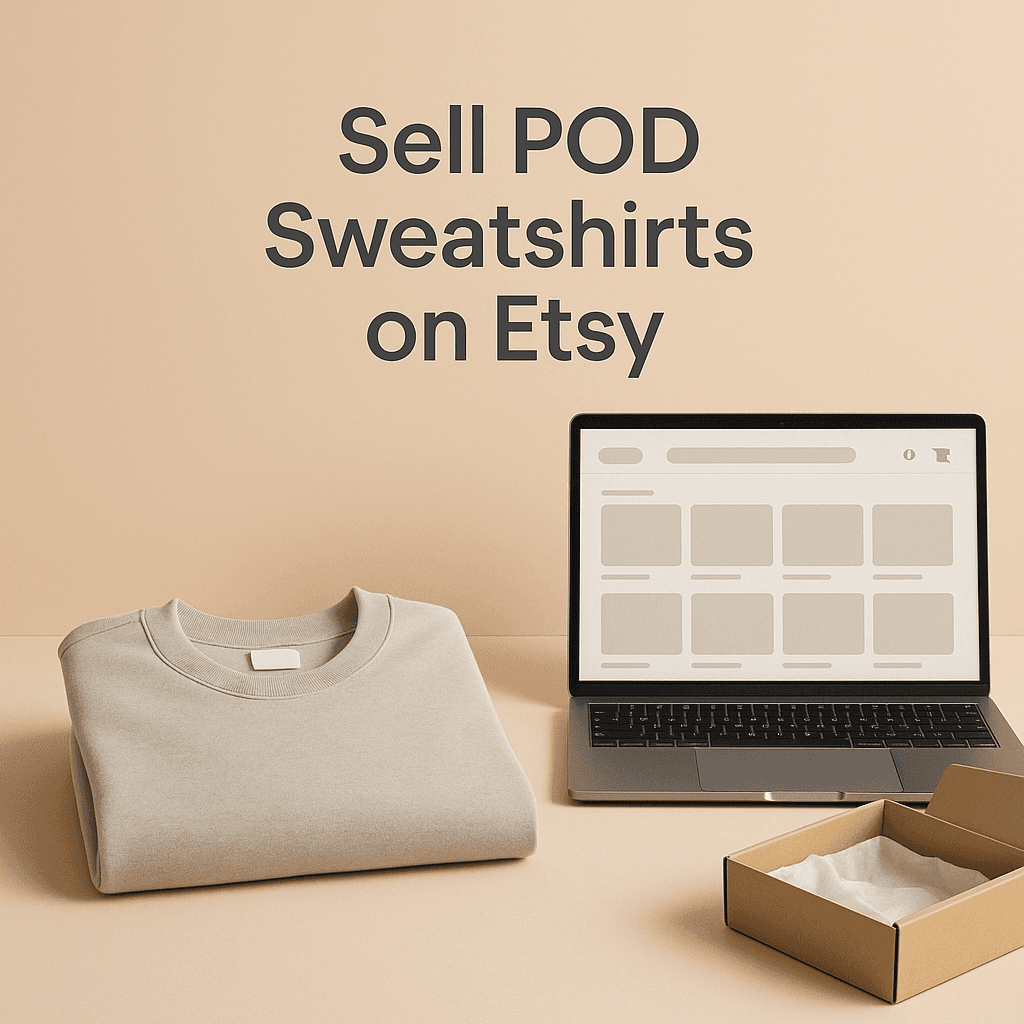
Selling print on demand sweatshirts on Etsy sounds simple on paper. Put a design on a crewneck, list it, and wait for the cha ching.
In real life, it’s a little messier.
You have Etsy SEO, mockups, pricing that still leaves you room after fees, customers asking for size charts, holiday shipping panic, and the big one, staying consistent long enough for the algorithm to actually trust your shop.
The good news is sweatshirts are one of the best print on demand products on Etsy when you do the basics right. They are giftable, comfy, higher ticket than tees, and people buy multiples. Also, you can build a whole shop around one vibe and still have endless angles.
This guide walks you through the whole process, from picking a niche to setting up listings that actually get found, and then fulfilling orders without turning your life into a customer service simulator.
Why sweatshirts do so well on Etsy (if you don’t overthink it)
A few reasons:
- People shop Etsy for “specific” stuff. Not generic. They want “minimalist hiking sweatshirt” or “custom dog mom crewneck” not just “sweatshirt”.
- Sweatshirts have a higher perceived value than t shirts, so you can price in a healthier margin.
- Seasonal demand is massive. Fall and winter are obvious, but spring bonfires, beach trips, camping, “cozy” year round, it all still moves.
- Gifting. Birthdays, Mother’s Day, bachelorette weekends, Christmas, new baby, teacher gifts. Sweatshirts are a safe gift.
The catch is competition. You’re not the only person who noticed.
So you win by being more specific, more consistent, and faster to execute.
Step 1: Pick a lane (niche + angle) before you make designs
If you try to sell “funny sweatshirts” to everyone, Etsy will treat you like background noise.
Instead, pick a niche and an angle. That’s how you become the obvious choice for a certain buyer.
Niche ideas that work for sweatshirts
Not exhaustive, just a good starting list:
- Mom niches: boy mom, girl mom, sports mom, tired mom, crunchy mom, new mom
- Pet niches: specific breeds, rescue themes, cat humor, custom pet portraits (even text based)
- Careers: nurse, teacher, therapist, hairstylist, electrician, realtor
- Hobbies: hiking, pickleball, golf, gym, yoga, camping, knitting
- Local pride: small towns, states, lakes, neighborhoods (be careful with trademarks)
- Aesthetic vibes: minimalist, coastal grandma, retro, goth, cottagecore, western
- Relationship and life events: bridesmaid trips, engagement, new home, graduation
- Faith and inspirational (keep it tasteful, Etsy buyers can be picky)
- Sports themes (avoid team trademarks)
“Angle” examples (this is what makes you not boring)
Same niche, different angle:
- Teacher sweatshirt: “teacher life” generic
- Better: “2nd grade team” with personalization
- Better: “reading intervention teacher” hyper specific
- Better: minimalist small chest embroidery style + big back print option
The goal is to make the buyer say: this was made for me.
Step 2: Know what you can and cannot sell (quick trademark reality check)
This part is annoying, but it’s how you keep your shop alive.
Avoid using:
- Disney, Marvel, Harry Potter, Taylor Swift lyrics, sports team names
- Brand names and slogans
- Anything that looks “inspired by” a franchise if it’s clearly recognizable
Even if you see other people doing it, that does not mean it’s safe. Some shops get away with it for months. Some get nuked instantly.
If you want to be cautious, search the phrase on the USPTO trademark database (or at least Google “phrase trademark”) before you build a whole product line around it.
Step 3: Choose the right sweatshirt blank (this matters more than you think)
On Etsy, customers are picky about feel and fit. They’ll ask:
- Is it soft?
- Is it thick?
- Is it oversized?
- Does it shrink?
So pick blanks that match what your buyers expect, and write it clearly in the listing.
Popular blank styles for print on demand sweatshirts (commonly used in the market):
- Gildan 18000: classic, budget friendly, a bit boxier
- Bella Canvas 3901 / similar: softer, more retail feel
- Independent Trading Co (like IND4000 crewneck): higher quality, heavier, premium vibe
You don’t have to start premium. But you do have to be honest. If it’s a classic fit mid weight crewneck, say that. If it’s heavyweight and oversized, say that too.
Also, decide early:
- Crewneck vs hoodie vs quarter zip
- Unisex sizing vs women’s cut (unisex is easier)
- Embroidery look vs printed look (printed is easier to start)
For your first 20 listings, keep it simple. One blank. One style. More colors later.
Step 4: Create designs that sell on Etsy (not designs that look cool to designers)
This is where people get stuck. They make “art”. Etsy buyers want wearable statements.
Some design formats that consistently work for sweatshirts:
- Bold text + small icon
- Minimalist left chest + bigger back print
- Retro arched text
- College varsity lettering
- Line art (simple, readable)
- Cute doodle style (but clean)
- Personalization: name, year, town, role, number
A quick rule for sweatshirt design
If it can’t be read in a small thumbnail, it will struggle.
Your listing photo grid is tiny on mobile. The design needs to communicate fast.
File basics
Most POD providers want a transparent PNG, high resolution (300 DPI), sized properly for chest print.
But honestly, what matters most is you don’t upload a blurry file and then act surprised when the customer complains.
Step 5: Mockups that don’t scream “POD”
Etsy is visual. Your mockups do a lot of the selling.
You have a few options:
- Provider generated mockups
- Styled mockups (more Etsy like, cozy, lifestyle scenes)
- Real photos (best, but takes effort)
If you’re brand new, start with solid mockups and upgrade later.
What makes a mockup convert better:
- Neutral lighting
- Cozy vibe, clean background
- The design placement looks realistic, not floating
- Multiple angles: front, back (if relevant), close up
- A size chart image
Also include at least one image that answers questions, like:
- “Printed on a soft unisex crewneck”
- “Size up for oversized fit”
- “Ships in 2 to 5 business days”
Step 6: Set up your Etsy shop like you actually plan to be here a while
Before you upload 50 listings, do the shop basics:
- Shop name that fits your niche
- Banner and logo (simple is fine)
- About section: who you are, what you sell, why it’s special
- Shop policies: shipping, returns, personalization rules
- FAQ section (seriously reduces messages)
Etsy likes complete shops. Customers do too.
Step 7: Build Etsy listings that get found (SEO without the headache)
Etsy search is basically matching buyer intent to keywords.
So your job is to use the words buyers already type.
The 3 biggest SEO levers in your listing
- Title
- Tags
- First lines of your description (plus overall relevance)
How to write a strong sweatshirt title
Bad:
“Funny Sweatshirt Cozy Cute”
Better:
“Pickleball Sweatshirt, Retro Pickleball Crewneck, Funny Pickleball Gift for Her, Unisex Cozy Pullover”
Notice what’s happening. It’s not poetry. It’s search terms.
A simple title formula:
- Primary keyword (what it is)
- Secondary keyword (style)
- Recipient / gift angle
- Occasion or niche
Tags
You get 13 tags. Use all of them.
Mix:
- Core product: “crewneck sweatshirt”, “unisex sweatshirt”
- Niche: “pickleball gift”, “teacher crewneck”
- Style: “retro sweatshirt”, “minimalist sweatshirt”
- Recipient: “gift for mom”, “gift for her”
- Occasion: “christmas gift”, “birthday gift”
Don’t repeat the exact same phrase 13 times. Cover different angles.
Description (keep it human, but structured)
Your description should answer:
- What is it
- What material / fit
- How to order (especially personalization)
- Shipping timeline
- Care instructions
- A gentle note about colors varying on screens
A quick structure that works:
- 2 to 3 sentence intro, who it’s for
- Bullet list of details
- Sizing and fit tips
- Processing and shipping
- Care instructions
Step 8: Pricing print on demand sweatshirts so you don’t lose money
Pricing on Etsy can feel like guessing. Don’t guess.
Your profit needs to cover:
- Base sweatshirt cost + print
- Shipping (if you offer “free shipping”, it’s still paid by you)
- Etsy fees (transaction fee, payment processing, listing fee)
- Occasional refunds, replacements, discount promos
A simple way to do it:
- Start with your total cost per unit (product + fulfillment + shipping if included)
- Add a buffer for fees (often 10 to 15 percent is a rough ballpark, varies)
- Add profit you’re actually happy with
Many successful Etsy sweatshirt shops land in the mid 30s to 50+ range depending on niche, blank quality, and whether it’s personalized.
Also, don’t be afraid to price higher if your listing is specific and premium looking. Cheap is not a brand.
Step 9: Fulfillment without chaos (where automation actually helps)
Once sales start, the annoying part is not printing. It’s everything around it.
- Creating optimized listings over and over
- Generating mockups
- Syncing orders
- Making sure the customer gets tracking
- Keeping shipping white label so it feels like your brand
This is where a tool like NinjaSell fits nicely if you want to move faster.
NinjaSell is an AI print on demand company focused on Etsy automation for POD. The basic idea is:
- You upload your designs
- NinjaSell automatically creates optimized Etsy listings
- It generates mockups
- It fulfills print on demand orders with white label shipping
If you are the type of person who can design but you get stuck in the listing grind, automation can be the difference between 10 listings and 200 listings. And on Etsy, more quality listings in a tight niche usually means more data, more chances to rank, more sales.
Still, you should review what it creates. Automation gets you speed. You provide taste and judgment.
Step 10: Customer service stuff you need to decide upfront
Sweatshirts bring sizing issues. It’s normal.
Decide your policies now, not when someone is mad in your inbox.
Things to be clear about:
- Returns and exchanges (POD shops often do returns only for defects)
- What counts as a defect (misprint, damaged item, wrong size sent)
- Personalization rules (double check spelling, confirm in messages if needed)
- Processing time vs shipping time (customers confuse these constantly)
Add a size chart image. Then in the description, say something like:
“Please review the size chart before ordering. Unisex fit. For an oversized look, size up.”
That one line will save you time.
Step 11: Marketing that actually works on Etsy (without becoming an influencer)
You do not need to dance on TikTok to sell sweatshirts on Etsy.
A few moves that consistently help:
1. Release in small collections
Instead of uploading random designs, drop a mini set.
Example: “Lake Weekend” collection
- Lake hair don’t care crewneck
- Custom lake name sweatshirt
- Cozy cabin vibes
- Matching family set
Etsy likes listings that get clicks and favorites in clusters. Customers like sets too.
2. Use Etsy ads lightly, not emotionally
Turn on ads for a few listings that already convert organically. Don’t advertise a listing with bad photos and hope ads fix it.
3. Seasonal timing
Sweatshirts spike early.
- Fall: start listing in late summer
- Christmas: start pushing in October, not December
- Mother’s Day: early spring
- Back to school teacher stuff: midsummer
If you wait until the season is obvious, you’re late.
4. Pinterest still works for this category
Sweatshirt mockups do well on Pinterest because they look like lifestyle content. Link pins to your Etsy listings.
Step 12: What to track (so you don’t spin your wheels)
If you want to grow, track a few simple numbers:
- Views per listing
- Conversion rate (orders divided by visits)
- Which keywords bring traffic (Etsy Search Analytics)
- Best colors and best sizes (helps you decide mockups and variants)
- Message volume per product (some designs attract picky buyers)
If a listing gets views but no sales, usually it’s one of these:
- The mockups are weak
- The price doesn’t match the perceived value
- The design is unclear in thumbnails
- The keywords attract the wrong buyer
Adjust one thing at a time. Otherwise you won’t know what fixed it.
Common mistakes (I see these constantly)
- Copying bestsellers exactly and wondering why you don’t rank
- Using vague titles like “Cute Aesthetic Sweatshirt”
- Not showing a size chart
- Having 40 color options but only 1 mockup
- Pricing too low and getting buried anyway
- Selling trademarked phrases and building your whole shop on borrowed time
- Making designs that look good on a screen but not on a chest
Also, not uploading enough. Etsy rewards consistency. You can be “good” and still lose to the shop that is good enough but publishes every week.
A simple plan for your first 30 days
If you want something practical, do this:
Week 1:
- Pick one niche and one blank sweatshirt style
- Create 10 solid designs (variations are fine)
- Build your shop page, policies, FAQs
Week 2:
- Publish 10 listings with strong titles, tags, and clean mockups
- Add size chart and shipping expectations to every listing
Week 3:
- Publish 10 more listings
- Turn on Etsy ads for 2 to 3 listings that get favorites and clicks
Week 4:
- Look at analytics
- Double down on the keywords and styles that are getting traction
- Start a seasonal mini collection for the next holiday or event
If you are using an automation tool like NinjaSell, this is where you can move faster. Upload designs in batches, let it generate the optimized framework, then you go in and tweak the parts that need human taste. Photos, first image choice, title wording, personalization prompts.
Wrap up
Selling print on demand sweatshirts on Etsy is not magic, but it is very doable. The sellers who win are usually not the most artistic. They’re the most consistent, the most specific, and the least sloppy with listings.
Pick a niche people actually buy in. Make readable designs. Use mockups that feel real. Write titles and tags like a shopper. Price with margin. Then fulfill orders smoothly, whether that’s manual or automated with a tool like NinjaSell that handles listings, mockups, and white label POD fulfillment.
And then keep going. Etsy is momentum. One good sweatshirt listing can become five, then twenty, and suddenly you have a shop that looks like it’s always been there. Which is kind of the point.
FAQs (Frequently Asked Questions)
Why do sweatshirts perform well as print on demand products on Etsy?
Sweatshirts do well on Etsy because shoppers look for specific, niche items rather than generic ones. They have a higher perceived value than t-shirts, allowing for better pricing margins. Sweatshirts also enjoy strong seasonal demand year-round due to their cozy appeal and are popular gift items for occasions like birthdays, Mother’s Day, and Christmas.
How do I choose the right niche and angle for selling sweatshirts on Etsy?
To stand out on Etsy, pick a specific niche like mom groups, pet lovers, careers, hobbies, local pride, or faith-based themes. Then find a unique angle within that niche—such as personalization or a minimalist design style—that makes your sweatshirt feel made just for your target buyer. This focused approach helps your shop become the obvious choice in that category.
What trademark considerations should I keep in mind when creating sweatshirt designs for Etsy?
Avoid using copyrighted names, slogans, lyrics, or trademarks such as Disney characters, Marvel logos, sports team names, or popular brand slogans. Even ‘inspired by’ designs can be risky if they are clearly recognizable. To stay safe, check phrases against the USPTO trademark database or Google “phrase trademark” before building your product line.
Which sweatshirt blanks are recommended for print on demand sales on Etsy?
Popular sweatshirt blanks include Gildan 18000 (classic and budget-friendly), Bella Canvas 3901 (softer with a retail feel), and Independent Trading Co IND4000 (premium quality and heavier weight). Choose blanks that match your buyers’ expectations regarding softness, thickness, fit (oversized or classic), and shrinkage, and clearly describe these details in your listings.
What design styles work best for sweatshirts on Etsy to attract buyers?
Effective sweatshirt designs include bold text paired with small icons, minimalist left chest prints with larger back designs, retro arched text, college varsity lettering styles, simple line art that’s easy to read in thumbnails, cute but clean doodles, and personalized elements like names or years. Designs must be easily readable even in small thumbnail images to perform well.
How can I manage my Etsy shop efficiently while selling print on demand sweatshirts?
Start by focusing on one niche and one sweatshirt blank style to keep things simple. Use clear sizing charts in your listings to reduce customer questions. Stay consistent with listing new products so the Etsy algorithm favors your shop. Also plan ahead for holiday shipping demands to avoid last-minute stress and maintain good customer service without it becoming overwhelming.