Etsy tags feel like this tiny, boring field you fill in at the end of a listing. Then you hit publish, wait, and… nothing. Or you get a couple visits, but not the kind that turns into consistent orders.
Here’s the thing. Tags are not a “nice to have”. Tags are one of the main ways Etsy understands what you’re selling and when to show it. And if your tags are vague, repetitive, or just kinda guessed… Etsy has to do extra work to match you to buyers. It usually does not.
So let’s make this practical. No theory marathon. Just what to do, what not to do, and how to build tags that pull in real search traffic.
How Etsy tags actually work (in normal human terms)
Etsy is basically doing matchmaking.
A buyer types something like:
- “personalized dog mom sweatshirt”
- “minimalist line art face print”
- “funny teacher tote bag”
Etsy tries to find listings that match those words and the intent behind them.
Your tags help Etsy connect your listing to those searches. Tags also work together with your title, categories, and attributes. It’s not “tags alone”, it’s the whole signal stack.
But tags matter because they’re one of the clearest places where you can say, directly, “this is what my product is for”.
A simple way to think about it:
- Title is for the shopper and Etsy.
- Tags are mostly for Etsy.
- Attributes are Etsy’s structured filters, and they can act like extra tags.
If your tags are dialed in, Etsy can confidently show your listing more often. More impressions. More clicks. More chances to sell.
The biggest tag mistake: describing the product, not the buyer search
A lot of sellers write tags like:
- “shirt”
- “gift”
- “cute”
- “handmade”
- “custom”
Not wrong in the English language sense. But wrong for search.
Buyers do not search “cute gift shirt”. They search specific stuff. Who it’s for, what style, what occasion, what vibe, what exact item.
Your job is to mirror real search phrases.
So instead of “gift”, you want:
- “gift for mom”
- “birthday gift for her”
- “new baby gift”
Instead of “shirt”, you want:
- “graphic tee”
- “oversized t shirt”
- “vintage style tee”
- “embroidered sweatshirt”
Specific beats generic almost every time.
Etsy tag rules you should follow (or you’re wasting slots)
Etsy gives you 13 tags per listing. Each tag can be up to 20 characters.
A few rules that keep you out of trouble and keep your tags doing actual work:
1) Use all 13 tags
Leaving blanks is like leaving free traffic on the table. Even if a few are “supporting” tags, fill them.
2) Do not repeat the same phrase in multiple tags
If you have “cat mug” once, you don’t need “mug cat” again. Etsy is smart enough about word order in many cases. Use the space for new keyword angles.
3) Avoid single word tags when you can
Single words are usually too broad. “Mug” is a bloodbath. “ceramic mug” is better. “funny cat mug” is even better.
4) Plurals and misspellings are usually not worth it
Etsy generally matches close variants. Use that tag space for intent instead.
5) No need to include “Etsy”, “sale”, “free shipping”
Not useful for search relevance. And sometimes it just looks spammy.
Start with the search phrase, not the keyword list
Most tag guides say “do keyword research”. True. But the mindset that actually helps is: collect real search phrases.
A search phrase already contains intent.
“teacher appreciation gift” is a buyer.
“teacher” is… just a word.
Here are a few quick ways to find phrases that buyers actually use:
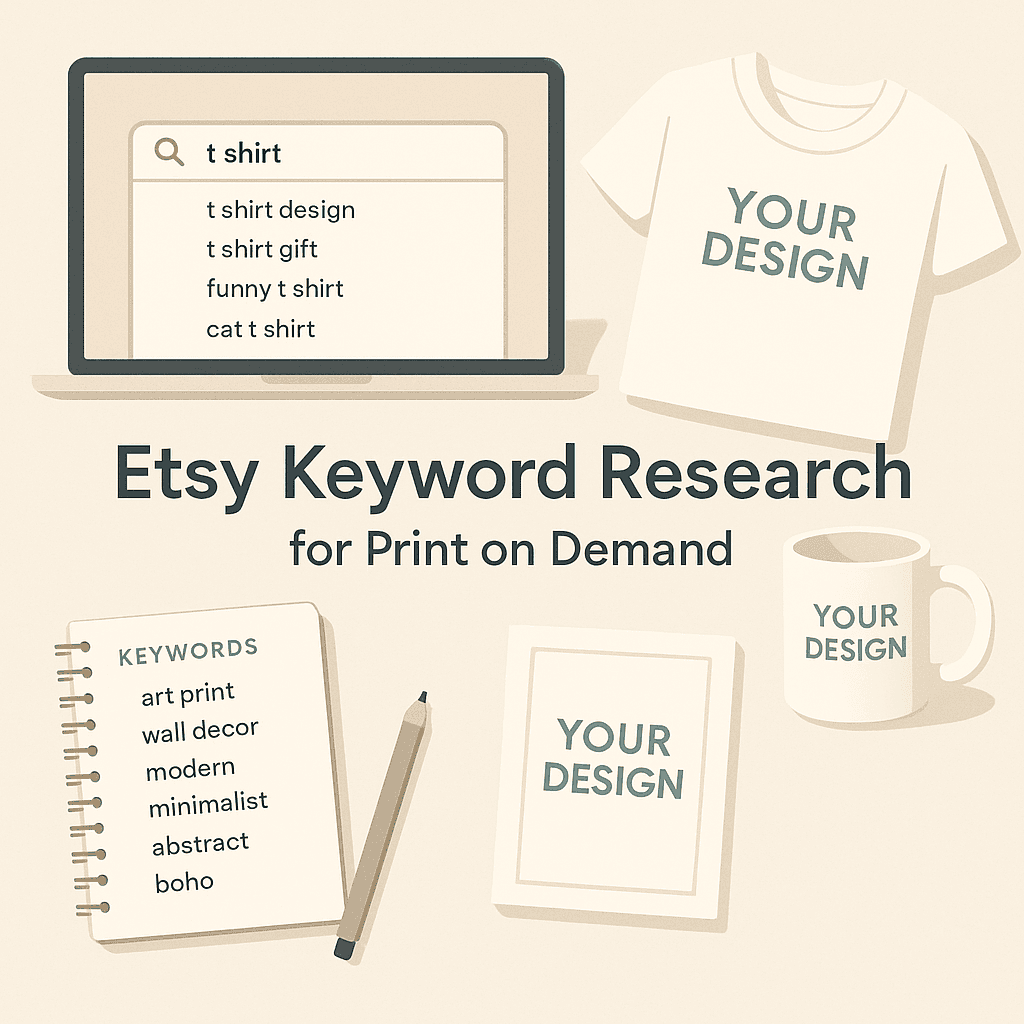
Etsy search bar suggestions
Start typing your product idea and let Etsy autocomplete finish it.
Type: “dog mom”
You might see: “dog mom sweatshirt”, “dog mom gift”, “dog mom shirt”, “dog mom mug”.
Those are not random. They’re based on what people search.
Competitor listings (but do it cleanly)
Open top listings in your niche and look at:
- their titles
- the repeated phrasing across multiple shops
- their category and attributes
You’re not copying. You’re mapping the language buyers use.
Your own order messages and reviews
People literally tell you why they bought.
- “Bought this for my sister’s birthday”
- “Perfect gift for my coworker”
- “I needed something for our bridal party”
Those phrases belong in tags, or at least inspire tags.
Build tags like a coverage map (not 13 random ideas)
Here’s the method that keeps your tags balanced and not repetitive.
You want to cover 4 types of intent:
- Core product (what it is)
- Recipient (who it’s for)
- Occasion (why they’re buying)
- Style or feature (what makes yours different)
If you sell print on demand on Etsy (shirts, sweatshirts, mugs, posters, totes), this structure works insanely well.
Example: “Personalized Dog Mom Sweatshirt”
Possible tag coverage:
Core product tags
- dog mom sweatshirt
- embroidered sweatshirt (if true)
- custom sweatshirt
- cozy crewneck (if it’s a crewneck)
Recipient
- gift for dog mom
- gift for pet lover
Occasion
- mothers day gift
- birthday gift for her
Style/feature
- minimalist sweatshirt (if true)
- custom name sweatshirt
- pet mom sweater
- dog lover gift
That’s already 12. Then you add one more that fits your specific angle like “new dog gift” or “rescue dog mom”.
Notice what we did not do:
- we did not use “gift” alone
- we did not use “shirt” when it’s a sweatshirt
- we did not use the same phrase five times
It’s coverage, not stuffing.
Use multi word tags, but keep them readable
A good Etsy tag often looks like a mini search query. Like something a real person would type.
Good:
- “funny teacher shirt”
- “custom pet portrait”
- “boho wall art print”
- “minimalist line art”
Weird:
- “shirt funny teacher”
- “gift her birthday”
- “wallartprintboho”
You’re not writing code. You’re matching human language.
Also, you do not need perfect grammar. People search messy. But it should still look like a phrase.
Stop wasting tags on things Etsy already knows (via categories and attributes)
This part is subtle. But it matters.
If your listing category is T Shirts, Etsy already knows it’s a shirt. If you also use “shirt” as a tag, that tag is doing less work than it could.
Same with attributes like:
- color
- occasion
- holiday
- room (for home decor)
- recipient
Attributes can function like extra tags because Etsy uses them for filtering and matching.
So you can often replace low value tags with higher intent ones.
Instead of “tshirt”, use:
- “bachelorette shirt”
- “bridesmaid tee”
- “girls trip shirt”
You still get the shirt relevance from category, and your tags focus on intent.
How to choose between similar tags (so you do not spiral)
You will constantly run into “Should I use X or Y?”
Like:
- “teacher gift” vs “gift for teacher”
- “new mom gift” vs “gift for new mom”
- “cat lover gift” vs “gift for cat lover”
Pick the one that:
- fits within 20 characters
- looks more like what you see in autocomplete
- matches your title phrasing (bonus)
And then move on. The goal is coverage and relevance, not perfection.
A simple 10 minute tag optimization workflow
If you want a repeatable process for every listing, do this:
- Write down your exact product phrase
Example: “custom pet portrait poster” - Collect 10 to 20 autocomplete phrases
Etsy search bar. Write the good ones down. - Pick 3 to 5 core product phrases
Like “custom pet portrait”, “pet portrait print”, “dog portrait poster”. - Pick 3 recipient phrases
“gift for dog lover”, “gift for pet mom”, “pet memorial gift” (if relevant). - Pick 2 to 3 occasion phrases
“birthday gift for her”, “christmas gift”, “housewarming gift” (depending on product). - Pick 2 to 3 style phrases
“minimalist pet art”, “watercolor pet portrait” (only if true), “line art pet”. - Check for duplicates
Make sure each tag adds a new angle. - Check character count
Etsy is strict. 20 characters max. - Align title and first 40 characters
Your strongest phrase should appear early in the title too. Not just in tags. - Save and do not touch for at least 2 to 4 weeks
Etsy needs time to test your listing in search. Changing tags daily resets the learning.
Print on demand sellers: tags are your edge (because products are similar)
If you sell print on demand, you already know the uncomfortable truth. There are a lot of similar mugs, shirts, posters. Same blank providers, similar mockups, similar price points.
So what actually differentiates you in search?
Usually:
- niche targeting (specific audience)
- design style keywords
- occasion keywords
- personalization keywords
Tags are where you can be sharp about all of that.
A few tag angles that work especially well for POD listings:
Personalization tags (only if you truly offer it)
- custom name shirt
- personalized hoodie
- add your name
- custom text mug
Niche identity tags
- nurse life shirt
- gym girl gift
- booktok shirt (careful with trademarks, but you get the idea)
- firefighter wife
Micro occasions
Not just “birthday”. More specific:
- first mothers day
- new homeowner gift
- pregnancy announcement
- bridal shower gift
Style and aesthetic tags
People search aesthetics now.
- minimalist wall art
- retro vintage shirt
- cottagecore print
- boho home decor
Just do not lie. If your design is not retro, do not tag it retro.
A note about trademarks (because this can wreck your shop)
Do not put brand names, celebrity names, sports teams, or trademarked phrases in tags unless you have rights.
Even if it gets traffic, it can get listings removed. Or worse, your shop flagged.
If you are unsure, look it up, and play it safe. There is plenty of traffic in non trademark niches.
Where NinjaSell fits in (if you are scaling listings)
If you are doing print on demand, tag optimization is also a volume game. Not just one perfect listing. You need a clean system so every new design gets a real shot.
That’s where a tool like NinjaSell can help. It’s an AI print on demand automation platform that can take your uploaded designs and automatically create Etsy listings with optimized elements, generate mockups, and fulfill orders with white label shipping.
The practical benefit here is consistency.
Instead of you trying to manually rewrite 13 tags for every single design at 1am, you can standardize your approach, then let automation handle the repetitive parts. You still want to review and tweak for niche language, sure. But it gets you out of the “I’ll optimize later” trap that kills a lot of new shops.
Tag examples you can copy, then customize
A few quick templates. Swap the brackets.
For a funny niche t shirt
- funny [niche] shirt
- [niche] gift
- gift for [niche]
- [job] humor tee
- [occasion] shirt
- sarcastic t shirt
- unisex graphic tee
- [style] t shirt
- [recipient] gift
- [holiday] gift
- [trend] shirt
- [location] shirt (if relevant)
- [interest] lover gift
For minimalist wall art print
- minimalist wall art
- [subject] line art
- modern wall decor
- printable wall art (if digital)
- [room] wall art
- neutral home decor
- gift for new home
- scandi wall art
- abstract line art
- [size] wall print (if you want)
- black white print
- gallery wall print
- housewarming gift
Try to keep the tags honest and specific to the actual design.
Quick checklist before you hit publish
- I used all 13 tags
- Most tags are 2 to 4 words, not single words
- Tags cover product + recipient + occasion + style
- No duplicate phrases
- No trademarked terms
- Strongest phrase appears in title too
- Category and attributes are filled correctly
If you do just that, you are ahead of a lot of listings already.
Wrap up
Optimizing Etsy tags is not about gaming Etsy. It’s about clarity.
When your tags match real buyer searches, Etsy can place you in front of the right people. And when you do that consistently across your shop, traffic stops feeling random.
Use the coverage map. Fill all 13 tags. Focus on search phrases with intent. Then give it time to work.
And if you’re building a print on demand store and you plan to scale beyond a few listings, consider using an automation tool like NinjaSell so your listing creation, mockups, optimization, and fulfillment don’t turn into a full time job you did not sign up for.
FAQs (Frequently Asked Questions)
Why are Etsy tags important for my listings?
Etsy tags are crucial because they help Etsy understand what you’re selling and when to show your listing to buyers. Tags work alongside your title, categories, and attributes to signal relevance, increasing your chances of getting impressions, clicks, and sales.
What is the biggest mistake sellers make with Etsy tags?
The biggest mistake is using vague or generic tags that describe the product rather than mirroring buyer search phrases. For example, instead of ‘shirt’ or ‘gift’, use specific phrases like ‘graphic tee’ or ‘birthday gift for her’ that reflect what buyers actually search for.
How many tags should I use on each Etsy listing and why?
You should use all 13 available tags per listing. Leaving any tag slots blank means missing out on potential traffic. Even supporting or less obvious tags can help capture different buyer search intents.
Can I repeat the same phrase in multiple Etsy tags?
No, repeating the same phrase in different word orders is unnecessary because Etsy’s search algorithm understands word variations. Use each tag slot for unique keyword angles to maximize your listing’s visibility.
Should I include single-word tags, plurals, or misspellings in my Etsy tags?
Avoid single-word tags as they are often too broad and competitive. Plurals and common misspellings usually aren’t worth it since Etsy matches close variants automatically. Instead, focus on specific multi-word phrases that indicate buyer intent.
How can I find effective Etsy tag phrases that buyers actually use?
Start with real search phrases by using Etsy’s search bar autocomplete suggestions, analyzing competitor listings for repeated language patterns, and reviewing your own customer messages and reviews to identify why people buy your products. Use these insights to craft targeted, intent-driven tags.