Etsy SEO is one of those things that sounds like it should be “set it and forget it”.
And then you list 20 designs, get a couple views, maybe one favorite, and you realize Etsy is basically a search engine with cute fonts.
For print on demand sellers, SEO matters even more because you are usually not competing on “handmade uniqueness”, you are competing on speed, relevance, photos, and how well you match what someone is already typing into that search bar.
So this is the checklist I’d use if I was building or cleaning up an Etsy POD store today. It’s practical. It’s not theory. And yeah, it’s a little repetitive on purpose, because Etsy rewards consistency.
Before You Touch Anything: Know What Etsy Actually Ranks
Etsy ranking is not just “keywords”. It’s a mix of:
- Relevance (does your listing match the query?)
- Listing quality score (do people click and buy?)
- Customer and market experience score (shipping, reviews, cases, etc)
- Recency (new or renewed listings get a small boost)
- Price, shipping, and location context (varies per buyer)
Your job is to help Etsy understand what you sell. Then help shoppers want it. Then make sure the order experience doesn’t ruin your momentum.
That’s the whole game.
1. Start With One Clear Target Keyword Per Listing
If your listing is “Funny cat shirt” but your photos and description scream “minimalist cat line art tee”, Etsy gets mixed signals. Shoppers do too.
Checklist:
- Pick one primary keyword that describes the product exactly.
- Make sure it matches the style, audience, and occasion.
- Don’t try to target 5 different product identities in one listing.
Examples of clear primary keywords:
- “custom pet portrait sweatshirt”
- “teacher appreciation tote bag”
- “retro halloween t shirt”
- “minimalist birth flower necklace” (not POD usually, but you get it)
For POD specifically, your best keywords usually include at least one of these:
- Audience (teacher, nurse, mom, dad, grandma, couple)
- Occasion (birthday, halloween, christmas, graduation, bachelorette)
- Style (retro, minimalist, funny, cute, gothic, coquette)
- Product type (t shirt, sweatshirt, hoodie, mug, tote, sticker)
2. Build Your Keyword List Like a Human, Not Like a Spreadsheet
You need a small set of keywords that are truly related, not “technically connected”.
Checklist:
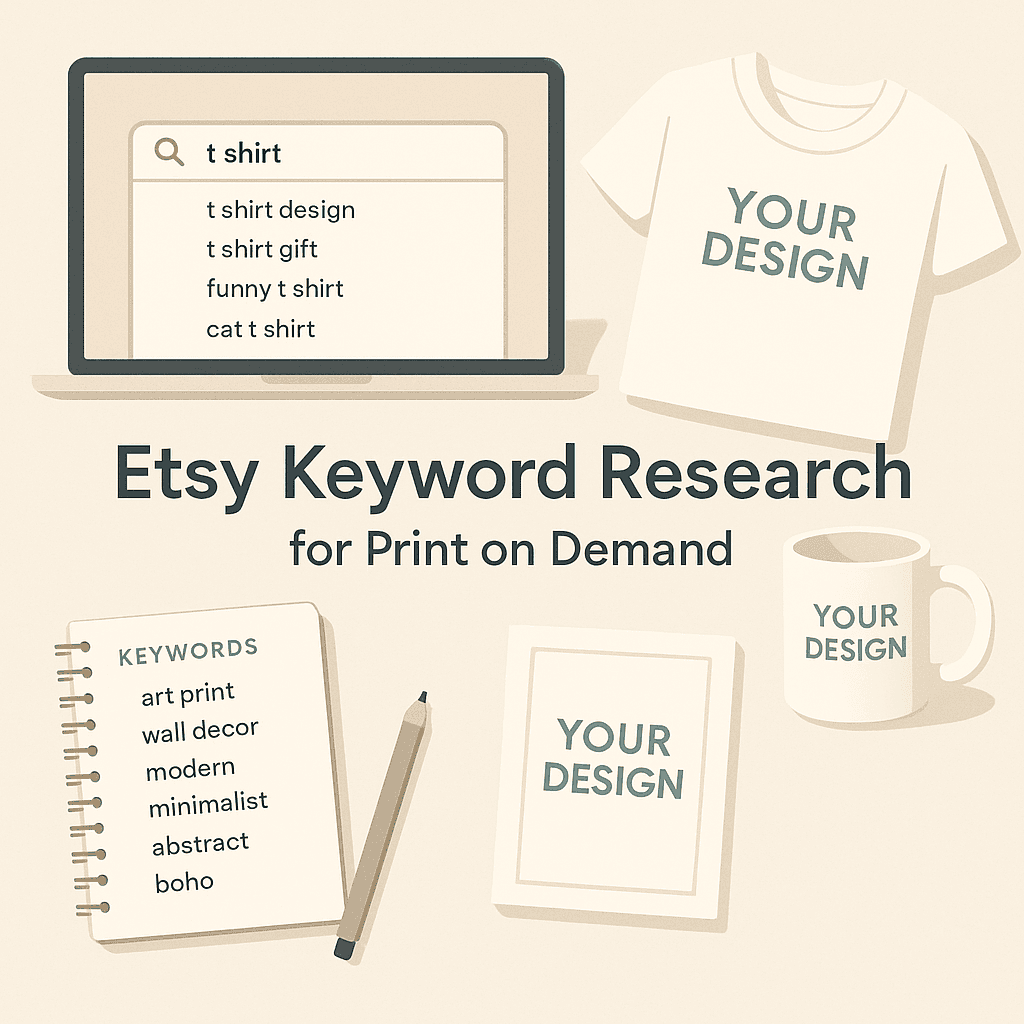
- Grab Etsy autocomplete suggestions (type your main keyword and see what Etsy completes).
- Open the top 5 to 10 best selling listings for that term.
- Note repeated phrases in their titles and in their first 2 image slides.
- Write down buyer language, not designer language.
Buyer language examples:
- “gift for new mom”
- “matching couples shirts”
- “bridesmaid proposal box” (again, product type varies but keyword logic is the same)
- “funny dad shirt”
- “custom name sweatshirt”
Designer language that usually doesn’t help:
- “hand drawn”
- “vector”
- “typography design”
- “aesthetic”
If shoppers aren’t typing it, Etsy doesn’t care.
3. Title Checklist (Do This Every Time)
Etsy titles still matter a lot for relevance. But the old days of “keyword soup titles” are fading. You want readable, but also packed with the right phrases.
Checklist:
- Put the primary keyword in the first 40 characters if possible.
- Add 2 to 4 secondary keyword phrases that are closely related.
- Use separators like commas or pipes.
- Avoid repeating the same word 10 times.
- Don’t mislead. If it’s a unisex tee, don’t call it a “baby onesie”.
A solid POD title structure:
Primary keyword + key modifier | audience/occasion | gift intent + product type
Example:
Retro Halloween T Shirt, Spooky Season Tee | Cute Ghost Shirt | Fall Outfit, Halloween Gift
Not perfect grammar, but it reads like something a person would click.
Also, don’t waste early title space on fluff like “High Quality” or “Fast Shipping”. Etsy doesn’t need it, and buyers don’t believe it until reviews prove it.
4. Tags Checklist (Your Tags Should Not Be Random)
You get 13 tags. Etsy uses tags to match searches, and tags can combine to match longer queries. That means you don’t need every tag to be a full long tail phrase. But you do need coverage.
Checklist:
- Use all 13 tags. Always.
- Use multi word tags when possible (up to 20 characters).
- Mix broad and specific.
- Include audience tags and occasion tags.
- Include style tags only if they match the design.
A simple tag mix for a teacher sweatshirt might look like:
- teacher sweatshirt
- teacher gift
- teacher life
- back to school
- educator gift
- funny teacher
- teaching crew
- teacher outfit
- kindergarten teacher
- elementary teacher
- cozy sweatshirt
- fall sweatshirt
- gift for teacher
Not “perfect”, but cohesive. That cohesion matters.
5. Categories and Attributes (Quietly Huge)
A lot of POD sellers skip attributes because they feel optional. They are not optional if you want Etsy to understand your listing.
Checklist:
- Choose the most specific category possible (not just “Clothing”, go deeper).
- Fill in every attribute Etsy offers that actually applies.
- For apparel: include sleeve length, neckline, fit, material, color, occasion when relevant.
- For mugs: capacity, material, microwave safe, etc.
Attributes act like extra tags. They can help you appear in filtered searches too, which is where buyers with money tend to hang out.
6. Photos Checklist (SEO By Click Through Rate, Basically)
Etsy SEO isn’t only text. If your listing shows up but nobody clicks, Etsy learns it’s not the best result.
Checklist:
- First image should be instantly readable on mobile.
- Use a clean mockup, not cluttered, not 20 props.
- Make the design big enough to understand without zooming.
- Add at least one close up of the print area.
- Include a sizing guide image.
- Include a color options image.
- Include a “how to order” image if it’s personalized.
For POD, mockups are everything. They are your “product photography”.
This is one spot where automation can help a lot, as long as you still pick mockups that match the audience. A goth shirt needs a different vibe than a new mom shirt, obvious, but people still mess this up constantly.
7. Description Checklist (Write for Buyers, Structure for Etsy)
Etsy says descriptions are less important than titles and tags for ranking. Still, descriptions matter for conversions, and conversions feed your listing quality score. So yeah, they matter.
Checklist:
- First 2 lines should restate what it is and who it’s for.
- Include key details in bullet points (material, fit, sizing, care).
- Include processing time expectations (and don’t overpromise).
- Include personalization instructions if relevant.
- Include gift info (gift message? packing slip?).
- Answer the top 5 questions before buyers ask.
A simple description structure:
- What it is and why they’ll love it
- Product details (bullets)
- Sizing and fit
- Shipping and processing time
- How to order (if personalized)
- Returns and exchanges (clear, not aggressive)
Also, be careful with claims. Don’t say “fast shipping” if your POD partner sometimes takes 3 to 5 business days to produce. Just state the honest range.
8. Make Sure Your Listing Matches the Search Intent
This is where many POD sellers lose.
If someone searches “gift for nurse graduation”, they want a gift. Probably something that mentions graduation. If your design is a generic nurse quote, it might not convert.
Checklist:
- For “gift” keywords, include gift friendly mockups and gift language.
- For “custom” keywords, show personalization clearly in photos.
- For “matching” keywords, show multiple people or variants.
- For “minimalist” keywords, don’t use loud mockups and neon colors.
- For “funny” keywords, make the punchline readable in the first image.
SEO is not just being found. It’s being chosen.
9. Pricing and Shipping Checklist (Because Etsy Cares About Experience)
Etsy wants happy buyers. And buyers hate surprises.
Checklist:
- Price competitively for your niche, not just your costs.
- Avoid inflated shipping fees if you can help it.
- Offer free shipping when it makes sense, especially for US focused stores, because Etsy still pushes it in subtle ways.
- Make sure your processing times match your POD fulfillment reality.
If you are using a POD fulfillment setup with white label shipping, mention that clearly in a simple way. People want to know it’s not arriving in a weird package.
10. Variations Checklist (Stop Hiding the Good Stuff)
Variations can help conversion. But they can also confuse buyers if you dump 30 colors with no visuals.
Checklist:
- Only offer colors you can represent well in mockups.
- Use variation photos when possible.
- Name variations clearly (not “Option 1”, “Option 2”).
- Put best sellers first in the dropdown order if Etsy allows.
If your store is new, fewer options can actually convert better. Give people an easy decision.
11. Listing Volume and Consistency (The Unsexy Advantage)
One listing is one chance to be found.
Fifty listings is fifty chances.
For POD, the sellers who win usually have:
- Consistent uploading schedule
- A clear niche or a few related niches
- Repeatable design style
- Tight SEO template they reuse and refine
Checklist:
- Aim for steady uploads instead of one big drop.
- Refresh older listings that have impressions but no clicks.
- Duplicate winners with variations (audience, colorway, occasion).
- Track which keywords actually bring views in Etsy Stats.
12. Use Etsy Stats Like a Dashboard, Not a Report Card
Etsy Stats won’t tell you everything, but it will tell you enough.
Checklist:
- Check which search terms bring impressions.
- Separate “impressions” from “visits”. You need both.
- If impressions are high but visits are low, your photos and title are the issue.
- If visits are high but sales are low, your offer is the issue (price, mockups, clarity, reviews, shipping time).
This one adjustment loop is basically your whole optimization process.
13. Don’t Ignore Reviews and Messaging (They Feed SEO Indirectly)
Customer and market experience score matters. And POD sellers sometimes get hit here because fulfillment is outsourced, meaning you must be extra sharp with expectations and support.
Checklist:
- Reply to messages quickly.
- Fix issues fast even if it costs you a bit.
- Proactively message for personalization clarification if needed.
- Encourage reviews gently through great packaging experience and follow through, not spam.
A few bad reviews early can slow your store. A bunch of good reviews can pull you up faster than you’d expect.
14. Automation: Use It, But Don’t Let It Make Everything Look the Same
If you are running POD at scale, doing SEO manually for every listing is… a lot. And it’s easy to burn out.
This is where something like NinjaSell becomes relevant. It’s an AI print on demand company built around Etsy automation for POD sellers.
The core promise is simple:
- Upload your designs
- NinjaSell automatically creates optimized Etsy listings
- Generates mockups
- Fulfills POD orders with white label shipping
Checklist if you use an automation tool like this:
- Still review titles for weird phrasing or mismatched intent.
- Still check tags for repetition or irrelevant terms.
- Still choose mockup styles that match the niche.
- Still verify variations, sizing info, and production times.
- Still keep your shop policies and FAQs updated.
Automation helps you move faster. Your taste and judgment is what keeps the store from feeling like a template factory.
15. Quick Etsy SEO Checklist (Copy This Into Notes)
Here’s the condensed version you can run through for every new POD listing.
Keyword and intent
- One primary keyword chosen
- Buyer language confirmed via Etsy autocomplete
- Listing matches search intent (gift, custom, matching, etc)
Title
- Primary keyword near the start
- 2 to 4 related secondary phrases
- Readable on mobile, not spammy
Tags
- All 13 tags used
- Mix of broad + specific
- Audience + occasion included
- No irrelevant style tags
Category and attributes
- Most specific category selected
- All relevant attributes filled in
- Colors, size, material, occasion included where applicable
Photos and mockups
- First image readable on mobile
- Close up included
- Sizing chart included
- Color options image included
- Personalization instructions image (if needed)
Description
- First 2 lines clarify product + recipient
- Bullet point details
- Processing and shipping expectations clear
- Care instructions included
- Returns and exchanges clear
Offer and experience
- Price makes sense for niche
- Shipping doesn’t scare people off
- Variations are clear and not overwhelming
- Policies and FAQs match POD reality
Wrap Up
Etsy SEO for print on demand isn’t one magic hack. It’s a stack of small, boring decisions that line up.
Pick a real keyword. Match intent. Make the first photo do the heavy lifting. Fill in every field Etsy gives you. Then keep listing, keep tweaking, keep learning from Stats.
And if you’re trying to scale without losing your mind, tools like NinjaSell can take a lot of the repetitive work off your plate, especially listing creation, mockups, and fulfillment. Just don’t fully outsource your taste. That part is still your edge.
FAQs (Frequently Asked Questions)
What factors does Etsy consider when ranking listings?
Etsy ranking is influenced by a mix of relevance (how well your listing matches the search query), listing quality score (clicks and purchases), customer and market experience score (shipping, reviews, cases), recency (new or renewed listings get a boost), and price, shipping, and location context which varies per buyer.
How should I choose the primary keyword for my Etsy print on demand listing?
Pick one clear primary keyword that exactly describes your product, matching its style, audience, and occasion. Avoid mixing multiple product identities in one listing. For POD, include elements like audience (e.g., teacher, mom), occasion (birthday, Halloween), style (retro, minimalist), and product type (t-shirt, mug).
What’s the best approach to building a keyword list for Etsy SEO?
Build your keyword list like a human by using Etsy autocomplete suggestions, analyzing top-selling listings for repeated buyer language phrases, and focusing on terms shoppers actually type in rather than designer jargon. Use buyer-friendly keywords like ‘gift for new mom’ or ‘funny dad shirt’ instead of terms like ‘hand drawn’ or ‘vector.’
How can I optimize my Etsy listing title for better SEO?
Place your primary keyword within the first 40 characters of the title. Add 2 to 4 closely related secondary keywords separated by commas or pipes. Ensure titles are readable without keyword stuffing or misleading info. For example: ‘Retro Halloween T Shirt, Spooky Season Tee | Cute Ghost Shirt | Fall Outfit, Halloween Gift.’ Avoid fluff like ‘High Quality’ or ‘Fast Shipping.’
What is the best strategy for using tags on Etsy listings?
Use all 13 tags available, combining multi-word tags up to 20 characters with a mix of broad and specific terms. Include audience and occasion tags relevant to your product’s design and avoid random tagging. Cohesive tag groups improve search matching; for example, a teacher sweatshirt might use tags like ‘teacher gift,’ ‘back to school,’ and ‘funny teacher.’
Why are categories and attributes important for Etsy print on demand listings?
Categories and attributes help Etsy understand your listing better which improves search relevance. Always choose the most specific category possible and fill in every applicable attribute such as sleeve length, neckline, fit, material, color, occasion for apparel; or capacity and microwave safety for mugs. Skipping these can hurt your SEO performance.