If you have ever listed something on Etsy and thought, ok cool, now people will just find it. And then nothing happens. Like, zero views. Or a few random clicks that do not turn into sales.
Yeah. That is usually a keyword problem.
Not because you picked “bad” keywords. But because you picked the same keywords everyone else picked. The big obvious ones.
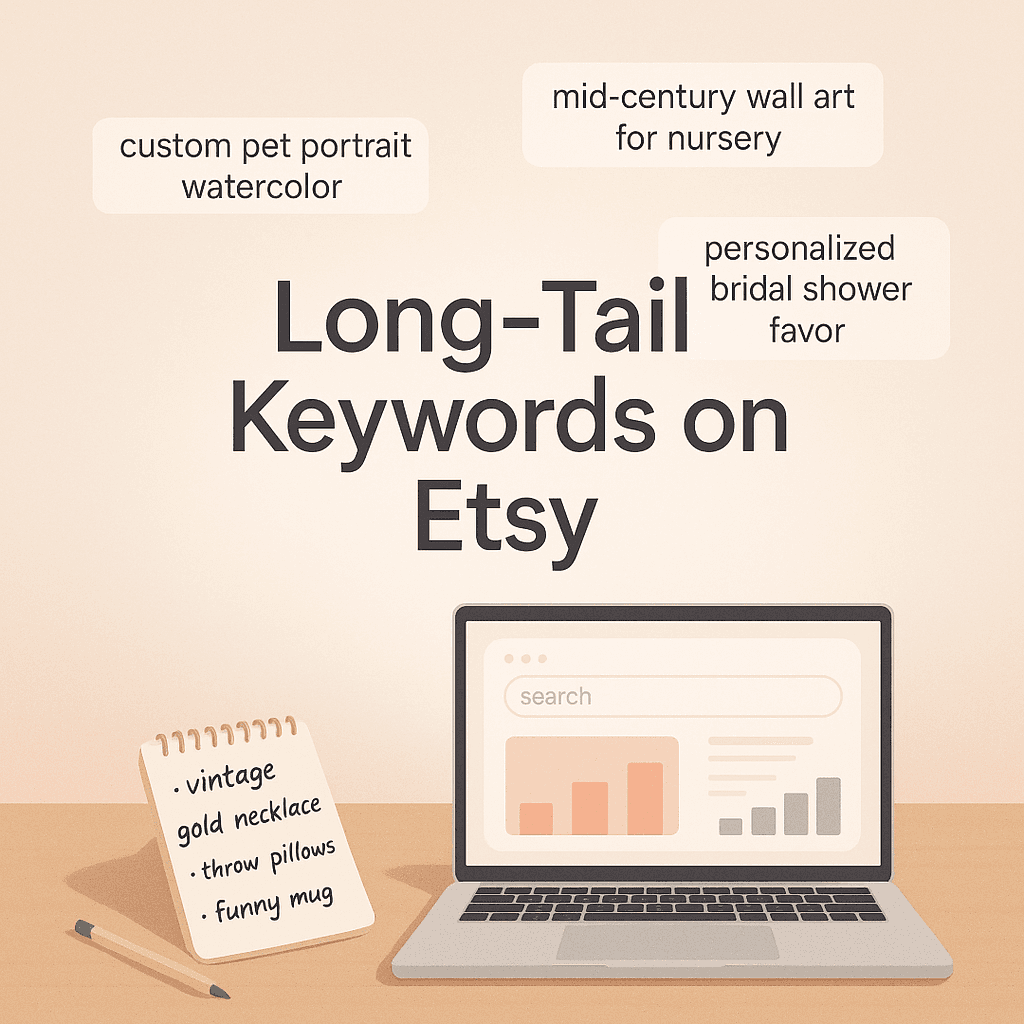
Long tail keywords are how you slip past that wall of competition. They are not magic, but they are close to the only thing that consistently works when you are not already a top shop.
Let’s break it down in a way you can actually use today.
What long tail keywords are (in Etsy terms)
A long tail keyword is a longer, more specific search phrase.
Instead of:
- “t shirt”
- “wall art”
- “sticker”
- “baby gift”
You use something like:
- “funny cat dad tshirt for men”
- “minimalist line art print black and white”
- “waterproof laptop sticker for college”
- “personalized baby name announcement sign”
Long tail keywords usually do three things better:
- They match real search intent. The buyer already knows what they want.
- They have less competition, so you can actually rank.
- They convert better, because the product fits the search more closely.
On Etsy, long tail keywords are especially important because Etsy is basically a search engine with a checkout button.
Why Etsy rewards long tail keywords (even if your shop is new)
Etsy wants buyers to find something they will buy. Fast.
So when someone searches “retro halloween sweatshirt oversized,” Etsy is not trying to show them a generic “sweatshirt.” It is trying to show the best match for that exact phrase, from listings that look relevant and have a decent chance of converting.
Long tails help you signal relevance. It is a direct “this listing is for that person” message.
Also, Etsy search is crowded. Print on demand made it worse, honestly. There are thousands of similar products. The only way to stand out is to be more specific than the average listing.
The basic rule: match how people actually search
Etsy buyers do not search like marketers. They search like normal humans who are in a hurry.
They type things like:
- who it is for: “for mom”, “for boyfriend”, “for teacher”
- the occasion: “birthday”, “christmas”, “new baby”, “bridesmaid proposal”
- the style: “minimalist”, “boho”, “retro”, “goth”, “cottagecore”
- the feature: “personalized”, “custom name”, “with photo”, “digital download”
- the material or format: “svg”, “printable”, “embroidered”, “ceramic”, “unframed”
- the vibe: “funny”, “cute”, “sarcastic”, “sweet”, “meaningful”
Long tail keywords are usually just a few of those stacked together in a natural order.
Example formula:
[style or vibe] + [product] + [for who/occasion] + [feature]
Like:
“funny retirement mug for coworker personalized”
That is a buyer. Not a browser.
How to find long tail keywords on Etsy (the practical ways)
You do not need a fancy tool to start. You can, but you do not have to.
1. Etsy search bar autosuggest (still the fastest method)
Go to Etsy, start typing your main keyword, and pay attention to what Etsy suggests.
Type “teacher shirt” and you might see:
- teacher shirt first day of school
- teacher shirt kindergarten
- teacher shirt funny
- teacher shirt custom name
Those suggestions are coming from real searches. Etsy is literally handing you keyword ideas.
Do this with variations:
- product first: “sweatshirt…”
- audience first: “gift for mom…”
- occasion first: “new baby…”
Write the good ones down. Keep going until you have a list.
2. Use competitor listings, but steal patterns not copies
Click a few top listings in your niche and look at:
- their titles
- their tags (you cannot see tags directly, but the title and description are clues)
- the phrases they repeat
- what they put early in the title
You are not trying to copy “exact text.” You are trying to notice patterns like:
- they include size or format
- they mention “personalized”
- they use “gift for” language
- they include niche styles like “mid century” or “western”
You can also scroll to the bottom of Etsy listing pages and look at “Explore related searches.” That section is full of long tail phrases.
3. Read reviews and messages (this is underrated)
People will literally tell you how they think.
Reviews often include phrases like:
- “bought this for my sister’s birthday”
- “perfect gift for my boyfriend who loves fishing”
- “exactly what I wanted for my nursery”
Those are keyword phrases. They are also product positioning ideas.
If you are doing print on demand, this matters even more because a small wording tweak can define your whole niche.
4. Use real-world language, not internal product language
If you call something “unisex garment-dyed tee,” buyers might just type “oversized soft tshirt.”
You can include the technical term somewhere, sure. But your long tail keywords should mostly be what buyers type.
Where to place long tail keywords in your Etsy listing (so Etsy actually uses them)
Etsy indexes keywords from several places. Not all are equal.
1. Title (big signal, but do not make it unreadable)
Put your main long tail phrase near the beginning of the title. Not at the end.
Example:
Bad:
“Custom Shirt, Teacher Gift, Back to School Tee, Funny Teacher Tee, Personalized, Cute”
Better:
“Funny Teacher Shirt First Day of School, Personalized Teacher Tee, Back to School Gift”
Notice what changed. The better one starts with a phrase someone would actually search.
A good approach is:
- first 40 to 60 characters: your best long tail keyword
- after that: secondary long tails and variations
And yeah, the title can be long. Etsy allows it. But if it reads like a keyword dump, it can hurt clicks. Which can hurt ranking. So keep it human-ish.
2. Tags (you get 13, use them like a keyword bank)
Etsy tags are limited to 20 characters each. That means you cannot always fit one big long tail phrase.
So you break long tails into chunks that still make sense.
Let’s say your target phrase is:
“personalized dog mom sweatshirt”
Your tags might be:
- personalized dog mom
- dog mom sweatshirt
- custom pet sweatshirt
- dog lover gift
- pet mom sweater
You are giving Etsy multiple ways to match the search.
Also important: Etsy mixes and matches tags. So “dog mom” + “sweatshirt” can still help you show for “dog mom sweatshirt” even if you do not have that exact tag.
Use all 13 tags. Always.
3. Categories and attributes (quiet ranking boosters)
When you pick a category, Etsy automatically assigns some hidden attributes. Then you can add more like:
- occasion
- recipient
- color
- room
- holiday
- style
- material
- personalization
These function like extra tags.
If you skip them, you are basically leaving ranking potential on the table.
4. Description (less powerful than it used to be, but still useful)
Descriptions help with buyer confidence and can still reinforce relevance.
Do not spam. Just naturally include your main phrase once or twice in the first few lines.
Something like:
“Looking for a funny teacher shirt for the first day of school? This personalized teacher tee is a perfect back to school gift…”
That is readable. And keyword-rich. Easy.
A simple long tail keyword strategy that works for most Etsy shops
Here is the part most sellers miss.
You do not need one keyword. You need a small cluster.
Pick:
- 1 primary long tail keyword (your main target)
- 3 to 6 secondary long tails (close variations)
- a few broad support keywords (the general product)
Example for a print on demand mug:
Primary:
- “funny coworker retirement mug”
Secondary:
- “retirement gift for coworker”
- “funny retirement mug”
- “retirement mug for boss”
- “office retirement gift”
- “custom name retirement mug” (if applicable)
Broad support:
- “retirement gift”
- “coffee mug”
Then place them like this:
- Title: primary + a couple secondary
- Tags: all secondary + broad + a couple feature tags
- Attributes: retirement, coworker, funny, etc
- Description: primary once, secondary naturally
That is it. That is the system.
What not to do (because it is tempting)
Do not target keywords that describe you, not the buyer
“high quality mug” is not a search phrase that converts.
People search for moments. People. Occasions.
Do not use tags that repeat the exact same phrase
If you have:
- “teacher shirt”
- “teacher shirts”
- “shirt teacher”
You are wasting tags.
Use variety. Use intent.
Do not ignore seasonality
Long tail keywords change with the calendar.
“teacher appreciation gift” spikes at a certain time. “first day of school teacher shirt” spikes at a different time.
If you sell year round products, rotate your listings and update keywords before the season hits. Do it early.
How this ties into print on demand (and why automation helps)
Print on demand shops live and die by listing volume and relevance.
Because you are not just selling one product. You are selling a design across multiple products, in multiple niches, for multiple audiences.
That is where long tail keywords become less of a “nice SEO thing” and more like your entire growth lever.
And honestly, the annoying part of Etsy is the repetitive setup:
- writing titles that are not trash
- generating mockups
- filling out tags and attributes
- publishing consistently
- then fulfilling orders fast
This is where something like NinjaSell fits naturally into the workflow.
NinjaSell is an AI print on demand company that helps you launch and scale by automating the parts that usually slow sellers down. You upload your designs, and it can automatically create optimized Etsy listings, generate mockups, and fulfill print on demand orders with white label shipping.
So instead of spending your whole Sunday writing 30 slightly different titles, you can spend it doing keyword research properly. Or designing. Or just, you know. Taking a break.
Automation does not replace the strategy, though. You still want to feed it good long tail keyword direction. That part is on you.
A quick example: turning one design into multiple long tail keyword listings
Let’s say you have a simple design: a minimalist line drawing of a face.
If you list it as:
- “line art print”
You are dead in the water.
But you can split it into niches:
- “minimalist line art print black and white”
- “modern line art wall art for living room”
- “abstract face line drawing printable”
- “neutral boho line art wall decor”
- “single line portrait art minimal”
Same design. Different intent. Different long tails.
Now you can create multiple listings (or variations) that actually match how people search.
This is also how you avoid being a generic POD shop. You are not selling “art.” You are selling “neutral boho wall decor for a small apartment living room.” That kind of thing.
How to tell if your long tail keywords are working
Give Etsy time. But do not wait forever.
Check these inside Etsy stats:
- Search terms bringing traffic
- Impressions vs visits
- Listing conversion rate (visits to orders)
If you are getting impressions but no clicks, the keyword may be relevant but the main photo or price is not competitive.
If you are getting clicks but no orders, the keyword may be too broad, or the listing is not matching the promise. Like “personalized” in the keyword but personalization is unclear.
If you are getting no impressions, you are either too competitive or you are not indexed well (wrong tags, weak title, missing attributes).
Also, do not judge in 24 hours. Etsy needs some time to test your listing.
A decent rule of thumb:
- wait 7 to 14 days for early signals
- then refine tags and title based on what you see
- keep the product the same, change the targeting first
A simple checklist you can use before publishing any Etsy listing
Before you hit publish, check:
- My first title phrase is a real long tail keyword someone would type
- I used all 13 tags with variation, not duplicates
- My attributes are filled out and match the buyer intent
- My description mentions the main phrase naturally near the top
- My photos match the keyword promise (style, audience, occasion)
- I am not trying to rank for a one word keyword that 200,000 listings already own
If you do that consistently, your shop starts to stack small wins.
And Etsy is a snowball platform. One listing starts selling, it lifts the shop. Then the next one ranks faster. Then you have momentum.
Wrapping it up
Long tail keywords on Etsy are not about being clever. They are about being specific.
Stop targeting “t shirt” and start targeting “funny dog dad shirt golden retriever.” Or whatever your niche is. You want the buyer who already decided.
Do the research in Etsy search, build a small keyword cluster, place it in your title and tags cleanly, fill out attributes, and then publish consistently.
And if you are running print on demand, consider using automation like NinjaSell to handle the repetitive listing creation, mockups, and fulfillment, so you can stay focused on the part that actually moves the needle. Keyword strategy, product angles, and designs people want.
That is the game. Not hacks. Just tight targeting, over and over.
FAQs (Frequently Asked Questions)
What are long tail keywords and why are they important on Etsy?
Long tail keywords are longer, more specific search phrases that match real buyer intent, have less competition, and convert better because the product fits the search more closely. On Etsy, using long tail keywords helps your listings stand out in a crowded marketplace and improves your chances of ranking higher in search results.
How does Etsy reward listings with long tail keywords even if the shop is new?
Etsy aims to show buyers the best match for their exact search phrase quickly. Listings that use specific long tail keywords signal relevance directly to Etsy’s search algorithm, increasing the chance of being shown. This is especially helpful for new shops because it allows them to compete by being more specific than generic listings.
What is a good formula for creating effective long tail keywords on Etsy?
A practical formula for long tail keywords is: [style or vibe] + [product] + [for who/occasion] + [feature]. For example, ‘funny retirement mug for coworker personalized’ combines style, product type, audience, occasion, and feature naturally to match buyer searches.
How can I find long tail keywords to use in my Etsy listings without fancy tools?
You can find long tail keywords by using Etsy’s search bar autosuggest feature—type your main keyword and note the suggested phrases. Also, analyze competitor listing titles and descriptions to identify common patterns. Reading customer reviews and messages can reveal natural language buyers use. Finally, focus on real-world language buyers type rather than internal product jargon.
Where should I place long tail keywords in my Etsy listing for maximum impact?
Etsy indexes keywords from several places in your listing, but not all carry equal weight. The title is a big signal area where you should include important long tail keywords without making it unreadable. Incorporate them naturally in your tags and description as well to improve your listing’s visibility and relevance.
Why do many Etsy listings get few views despite using popular keywords?
Many sellers pick the same big obvious keywords that everyone else uses, leading to high competition and low visibility. Without using specific long tail keywords that match buyer intent more closely, listings get lost among thousands of similar products. Using unique and detailed keyword phrases helps bypass this competition wall and attracts buyers actively searching for exactly what you offer.