Etsy visibility is one of those things that feels mysterious until you’ve sat with it long enough.
One week a listing is getting views, favorites, maybe even a couple sales. Then it goes quiet. You change the photos. Nothing. You tweak the title. Still nothing. And you start wondering if Etsy is just… random.
It’s not random. It’s just picky.
Etsy’s search engine is basically trying to do one job: show the shopper the most relevant thing they’re most likely to buy. So if you want maximum visibility, you’re not really “gaming the algorithm”. You’re making it incredibly easy for Etsy to understand what you sell, and incredibly easy for a buyer to say yes.
Let’s walk through it, step by step. The stuff that actually moves the needle.
What Etsy actually cares about (in plain English)
Etsy doesn’t publish a neat checklist, but you can reverse engineer it from how the platform behaves:
- Relevance: Do your title, tags, categories, and attributes match what someone typed?
- Listing quality: When people see your listing, do they click it? Do they favorite it? Do they buy it?
- Customer and shop experience: Reviews, completed policies, shipping reliability, message response rate. All that boring adult stuff.
- Recency and consistency: New listings and updated listings can get a small boost. Shops that keep listing tend to stay “alive”.
- Price and shipping competitiveness: Etsy wants happy buyers. If your shipping is slow, expensive, or unclear, it can hurt conversion. And conversion is the whole game.
So the goal is simple: make highly relevant listings that convert.
That’s it. That’s the job.
Start with keyword research that isn’t guesswork
Most Etsy SEO advice starts with “use keywords”. Sure. But which ones?
You want keywords that are:
- what real buyers type
- specific enough to show intent
- not so competitive that you get buried instantly
A quick way to find buyer keywords
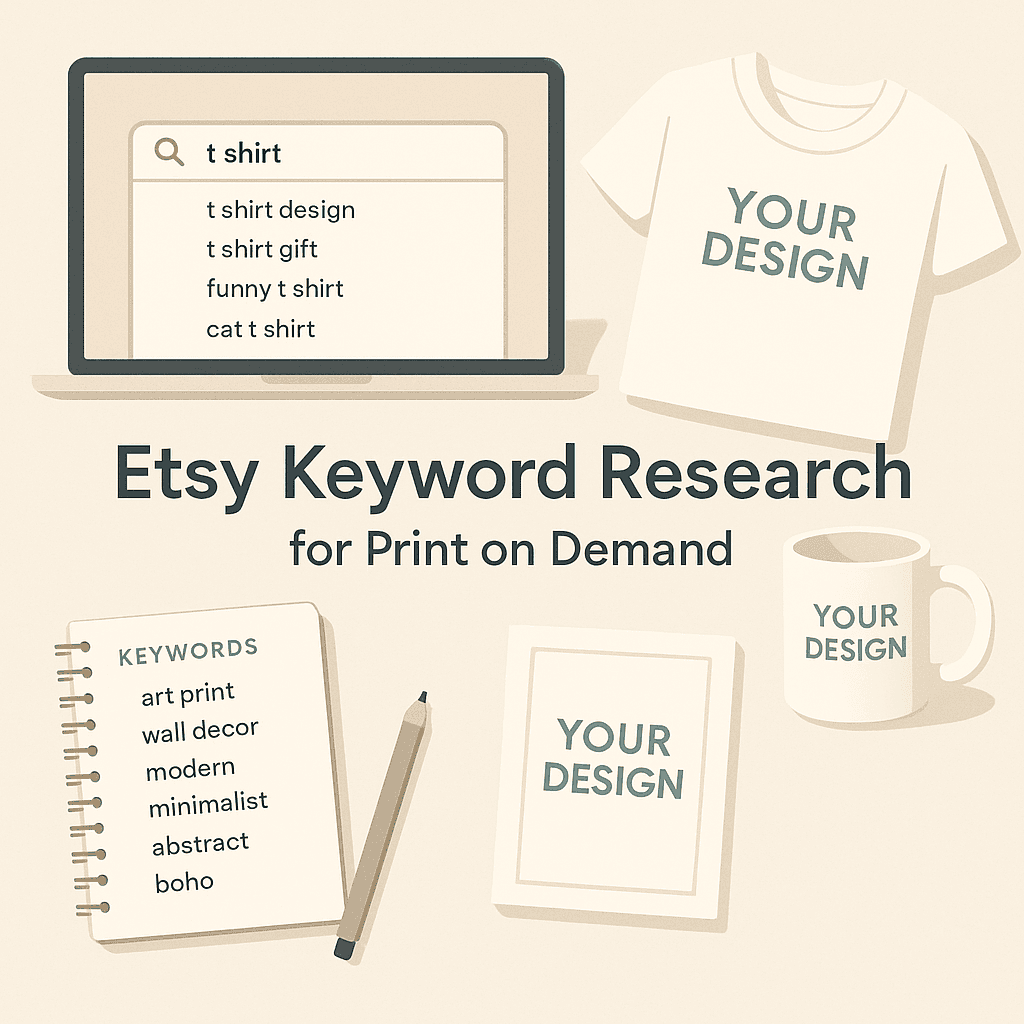
Open Etsy and type your core product phrase. Example: “funny dad shirt”.
Then look at:
- Autocomplete suggestions
Those are real searches. Etsy is literally telling you what people type. - Top ranking listings on page one
Read their titles and see patterns. Not copy paste, but patterns. - Filters on the left (when you search)
Those are basically attributes buyers care about. Style, material, occasion, etc.
Now, write down keyword variations in a messy list. No formatting needed yet. Just capture them.
Example for a POD shirt could become:
- funny dad shirt
- dad joke t shirt
- fathers day shirt funny
- new dad gift shirt
- dad life tee
You’ll clean this up later. For now, collect.
One important mindset shift
Don’t optimize for “t shirt”. Optimize for the person.
“T shirt” is vague. “Funny dad shirt for Father’s Day” is a buyer with a mission.
Specific phrases usually convert better. And listings that convert tend to rise over time.
Your title is not a sentence. It’s a search map.
Etsy titles still matter a lot for visibility. But the biggest mistake people make is writing titles like they’re writing for humans only, or worse, like they’re writing for robots only.
You need both.
A good Etsy title structure
Put the main keyword first, then add close variations and buyer intent. Keep it readable.
Example:
Funny Dad Shirt, Dad Joke T Shirt, Fathers Day Gift for Dad, Dad Life Tee, Unisex Graphic Shirt
That’s not poetry. But it’s clear, and it covers multiple searches without going totally spammy.
A few rules that keep you out of trouble
- Don’t repeat the same keyword phrase five times.
- Don’t add unrelated trending keywords. It can hurt conversion and relevance.
- Prioritize phrases that match what’s actually on the product. If it’s a hoodie, don’t try to rank for shirt.
And yes, Etsy often truncates titles in some views. Still, the first chunk matters the most. Lead with the best phrase.
Tags: you get 13. Use all 13 like you mean it.
Tags are where most listings quietly fail.
People either use 4 tags and stop, or they use 13 tags that are basically the same thing with tiny changes.
You want a mix:
- primary keyword
- close variations
- occasion (Father’s Day, birthday, Christmas)
- recipient (dad, husband, new dad)
- style (retro, minimalist, vintage)
- product type (graphic tee, unisex shirt)
- niche phrases (dad jokes, grilling dad, golf dad)
Tag best practices (simple version)
- Use multi word tags whenever possible. They’re more specific.
- Avoid repeating words across too many tags if you can cover more ground.
- Don’t waste a tag on something Etsy already knows from attributes, unless it’s a high value phrase you really want to rank for.
And use all 13 tags. Always.
Categories and attributes are basically hidden SEO fields
This part is weird because it feels like admin work. But categories and attributes are huge for Etsy SEO because they act like structured keywords.
If you choose the wrong category, you can sabotage the listing even if your title and tags are perfect.
Do this every time
- Choose the most specific category possible.
Not “Clothing” if “Unisex Adult Clothing > Shirts > Graphic Tees” exists (example path, Etsy changes these). - Fill out every attribute Etsy gives you that actually applies.
Color, occasion, holiday, sleeve length, fit, material, etc.
Even if buyers don’t filter by these, Etsy still uses them to understand your listing.
Photos are not just for conversion. They help you get visibility.
Etsy measures what people do when they see your listing.
If impressions are high but clicks are low, Etsy learns “people don’t like this”. If clicks are high but purchases are low, Etsy learns “people were curious but didn’t buy”.
Both can reduce future visibility.
So yes, your photos are part of SEO. Because conversion behavior feeds visibility.
What high converting Etsy photos usually include
- A clear first image with the design easy to see
Not tiny, not far away, not hidden in wrinkles. - Lifestyle mockup that matches the buyer
If you’re selling a “new dad” shirt, show a dad vibe. Not a random model that doesn’t fit. - Close up of print area
People want to inspect. - Size and fit guidance (graphic image is fine)
Cuts down returns, increases confidence. - Color options (if you offer them)
Keep it clean, not cluttered.
For print on demand, mockups are everything. They’re doing the work your product can’t do yet, because buyers can’t touch the item.
Description: stop writing fluff. Answer questions and remove doubt.
Descriptions don’t carry the same direct SEO weight as titles and tags, but they matter a lot for conversion. And conversion feeds ranking over time.
A good description does three things:
- confirms what the product is
- answers the obvious questions
- reassures the buyer about shipping, quality, and what happens next
A simple description layout that works
First 2 lines: What it is + who it’s for + why it’s special.
Then:
- Features: material, fit, printing method (only if accurate), comfort notes
- Sizing: how to choose size, include size chart reference
- How to order: pick size, pick color, checkout
- Shipping: processing time, delivery estimates, holiday note
- Care instructions: wash cold, inside out, etc
- Returns/exchanges: keep aligned with your shop policy
Keep it skimmable. People read like they’re scanning a menu.
Pricing and shipping: boring, but it can quietly win you the click
On Etsy search results, buyers see price and shipping right away.
If your competitors are at $19.99 with “FREE shipping” and you’re at $18.50 plus $6.99 shipping, you might lose the click even if your design is better.
This doesn’t mean race to the bottom. It means be intentional:
- test free shipping baked into price (if margins allow)
- keep processing times realistic
- don’t surprise people at checkout
Surprises kill conversion. Etsy notices.
Reviews, policies, and shop trust are part of visibility
Etsy wants buyers to have a good experience. So your shop health matters.
Make sure you have:
- completed shop policies
- a solid About section (doesn’t need to be a novel)
- message response notifications on, so you don’t ghost customers by accident
- clear processing times
And if you’re doing print on demand, be extra careful about shipping estimates. It’s better to under promise and over deliver. Every time.
The “freshness” factor: consistent listing beats random bursts
New listings tend to get a small push. Renewed listings can also get some attention. But the real power is consistency.
If you can add a few new listings per week, Etsy starts to see your shop as active. Active shops tend to keep getting tested in search.
Also, more listings means more “doors” customers can walk in through. One listing rarely carries a whole store, especially in print on demand.
Optimize for one niche at a time (this is where people mess up)
If your shop sells:
- wedding signs
- cat mugs
- nurse shirts
- wall art quotes
- baby onesies
… Etsy has a hard time understanding who your shop is for. Customers too.
Niche down. At least per collection.
A tight niche helps because:
- your keywords cluster together
- your shop builds topical relevance
- buyers browse more listings, boosting engagement
You can expand later. But early on, focus is visibility.
Print on demand specific tips that matter more than people admit
POD is brutally competitive on Etsy. You’re not just competing on design. You’re competing on presentation, trust, and speed.
A few POD specific visibility levers:
- Mockups that don’t look like everybody else’s
If your first photo looks identical to 50 other listings, buyers scroll past. Etsy sees low click through rate. - Design clarity
If the design is readable only when zoomed, it’s a conversion killer. - Variant organization
If buyers get confused choosing size/color, they bounce.
The goal is less friction. Always.
Where NinjaSell fits in (and why it matters for visibility)
Here’s the part most guides skip, because they assume you’re manually doing everything.
If you’re running print on demand, optimization becomes a production line problem. You can know all the right SEO moves and still lose because you’re tired, rushing, or uploading at 1 am and forgetting half the attributes.
That’s where a tool like NinjaSell can help.
NinjaSell is an AI print on demand company built around Etsy automation. The point is pretty straightforward:
- you upload your designs
- NinjaSell automatically creates optimized Etsy listings
- it generates mockups
- and it fulfills POD orders with white label shipping
So instead of spending hours per listing doing the same repetitive steps, you can focus on the parts that actually differentiate you. Better designs, better niche research, better positioning.
Also, consistency becomes easier. Which is a big deal on Etsy.
Automation does not magically guarantee rankings, obviously. But it removes the sloppy human bottlenecks that quietly hurt visibility. Missing tags. Weak titles. Forgetting attributes. Inconsistent mockups. That kind of stuff adds up.
A practical optimization checklist you can use today
When you’re about to publish a listing, run through this quickly:
- Title starts with the best keyword phrase
- Title includes 2 to 4 close variations, still readable
- All 13 tags used, no wasted one word tags unless necessary
- Correct category and the most specific one available
- All attributes filled that apply
- First image is clear, readable, and high contrast
- Photos include: lifestyle, close up, sizing, options
- Description answers: what it is, sizing, shipping, care
- Price and shipping don’t look weird compared to competitors
- Policies are complete and processing time is realistic
Do that, and you’re already ahead of a lot of listings.
What to do after you optimize (because Etsy takes time)
Optimization isn’t one and done. Etsy needs data.
After you publish:
- give it time to index (usually a day or two, sometimes longer)
- watch views vs visits vs conversion
- if you get impressions but no clicks, fix the first photo and title
- if you get clicks but no sales, fix the offer (photos, price, description clarity, shipping, reviews)
And don’t change everything at once. You want to know what caused the improvement.
Small controlled tweaks.
Wrapping it up
Maximum visibility on Etsy is mostly a game of being clear and consistent.
Clear keywords. Clear photos. Clear categories. Clear expectations. Then you give Etsy enough conversion data to trust you, and you keep adding listings so your shop stays active.
If you’re doing print on demand, the workload multiplies fast. Tools like NinjaSell can take over the repetitive parts by automatically creating optimized Etsy listings, generating mockups, and handling fulfillment with white label shipping. That frees you up to do the parts that actually make your store stand out.
Because at the end of the day, the algorithm is not your enemy.
A confused buyer is.
FAQs (Frequently Asked Questions)
Why does my Etsy listing suddenly stop getting views and sales?
Etsy’s search algorithm isn’t random; it prioritizes relevance and conversion. If your listing stops getting views or sales, it might be because it’s not matching buyer searches well, or it’s not converting visitors into buyers. Updating photos or tweaking titles alone may not help unless you improve how easy it is for Etsy to understand what you sell and for buyers to say yes.
What factors does Etsy consider to rank listings in search results?
Etsy cares about several key factors: relevance (matching your title, tags, categories, and attributes to search terms), listing quality (clicks, favorites, purchases), customer and shop experience (reviews, policies, shipping reliability), recency and consistency (new or updated listings get a small boost), and price plus shipping competitiveness. Focusing on these helps increase visibility.
How can I find effective keywords for my Etsy listings?
Start with keyword research based on actual buyer behavior. Use Etsy’s autocomplete suggestions by typing your core product phrase, analyze top-ranking listings for title patterns, and review filters buyers use on the left side of search results. Collect specific keyword variations that show buyer intent rather than vague terms to improve conversion chances.
What is the best way to structure an Etsy listing title?
Your title should act as a search map: begin with the main keyword followed by close variations and phrases showing buyer intent. Keep it readable but comprehensive enough to cover multiple relevant searches without keyword stuffing. For example: ‘Funny Dad Shirt, Dad Joke T Shirt, Fathers Day Gift for Dad, Dad Life Tee, Unisex Graphic Shirt.’ Avoid repeating keywords excessively or adding unrelated trending terms.
How should I use tags effectively on Etsy?
Use all 13 tags strategically by mixing primary keywords, close variations, occasions (like Father’s Day), recipients (dad, husband), styles (vintage, minimalist), product types (graphic tee), and niche phrases (dad jokes). Prefer multi-word tags for specificity and avoid repeating similar words across too many tags. Don’t waste tags on information already covered by attributes unless it’s a high-value phrase.
Why are categories and attributes important for Etsy SEO?
Categories and attributes function like hidden SEO fields that help Etsy understand your product better. Choosing the most specific category available ensures your listing appears in relevant searches. Filling out every applicable attribute—such as color, occasion, sleeve length—adds structured keywords that improve your listing’s discoverability even if buyers don’t directly filter by them.