Etsy is one of those platforms that looks simple from the outside. Cute mugs, aesthetic shirts, wedding signs, boom. But when you actually try to build a print on demand store that consistently sells, you realize there are like… ten moving parts. Niche research. Designs. Mockups. SEO. Pricing. Customer service. Keeping listings fresh. Not getting buried on page 12.
The good news is that print on demand is still a very real opportunity on Etsy if you treat it like a business. Not a side quest you poke at once a week.
This is the exact approach I would take if I were starting from zero today.
1. Pick a niche that’s actually buyable (not just “popular”)
Most beginners pick niches based on vibes.
“Cats.”
“Motivation.”
“Gym.”
“Minimalist quotes.”
Those can work, sure. But they’re broad, and broad usually means you’re competing with people who already have 10,000 sales, a recognizable style, and listings that Etsy already trusts.
A better way is to go narrower and more specific. You want something with:
- Clear customer identity (who is buying this)
- Clear gifting intent (why they’re buying it now)
- Enough depth for 30 to 100 product ideas without repeating yourself
A few examples of “narrow but expandable” niches
- Gifts for new nurses (graduation, first job, night shift humor)
- Dog breeds, but specific (dachshund moms, border collie agility people)
- Teachers, but by subject (art teachers, music teachers, kindergarten)
- Hobbies with vocabulary (pickleball, crochet, hiking, booktok, golf)
- Life events (bridesmaids, new baby, new home, retirement)
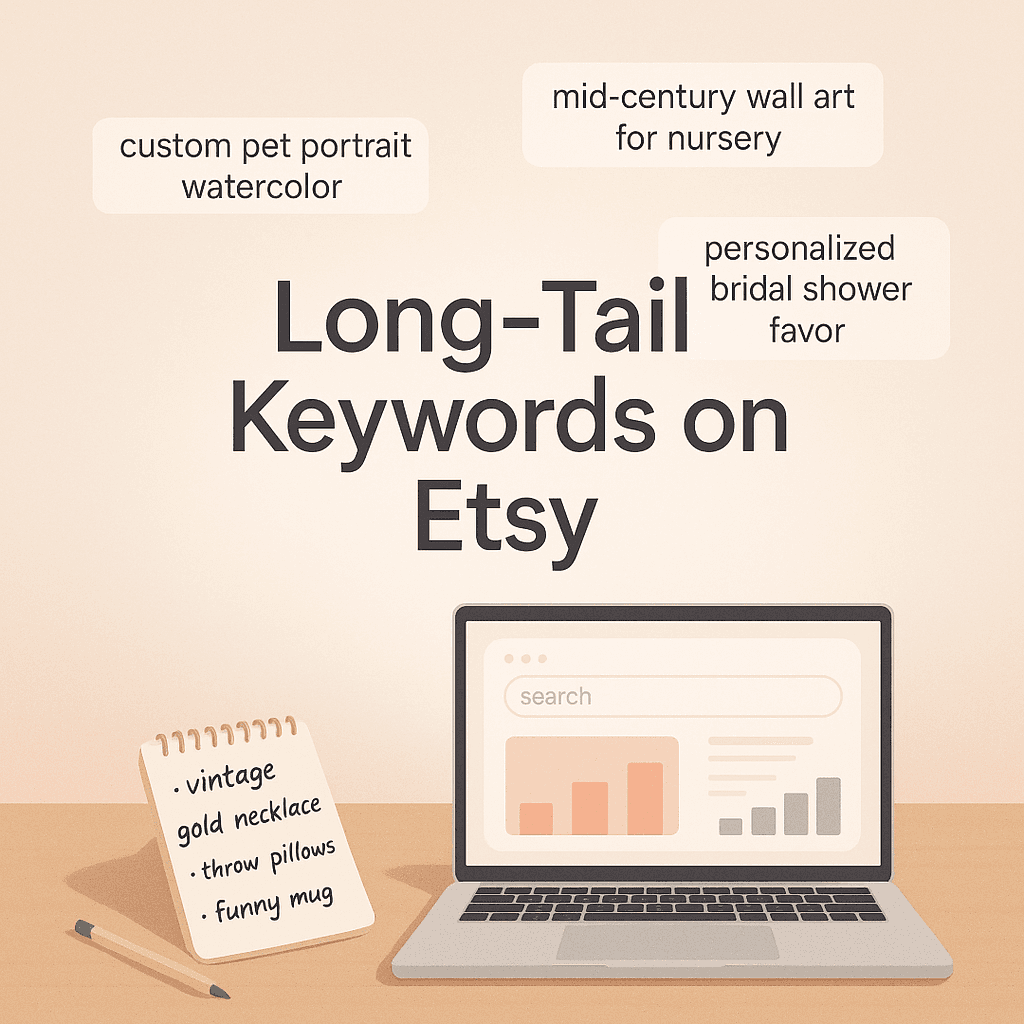
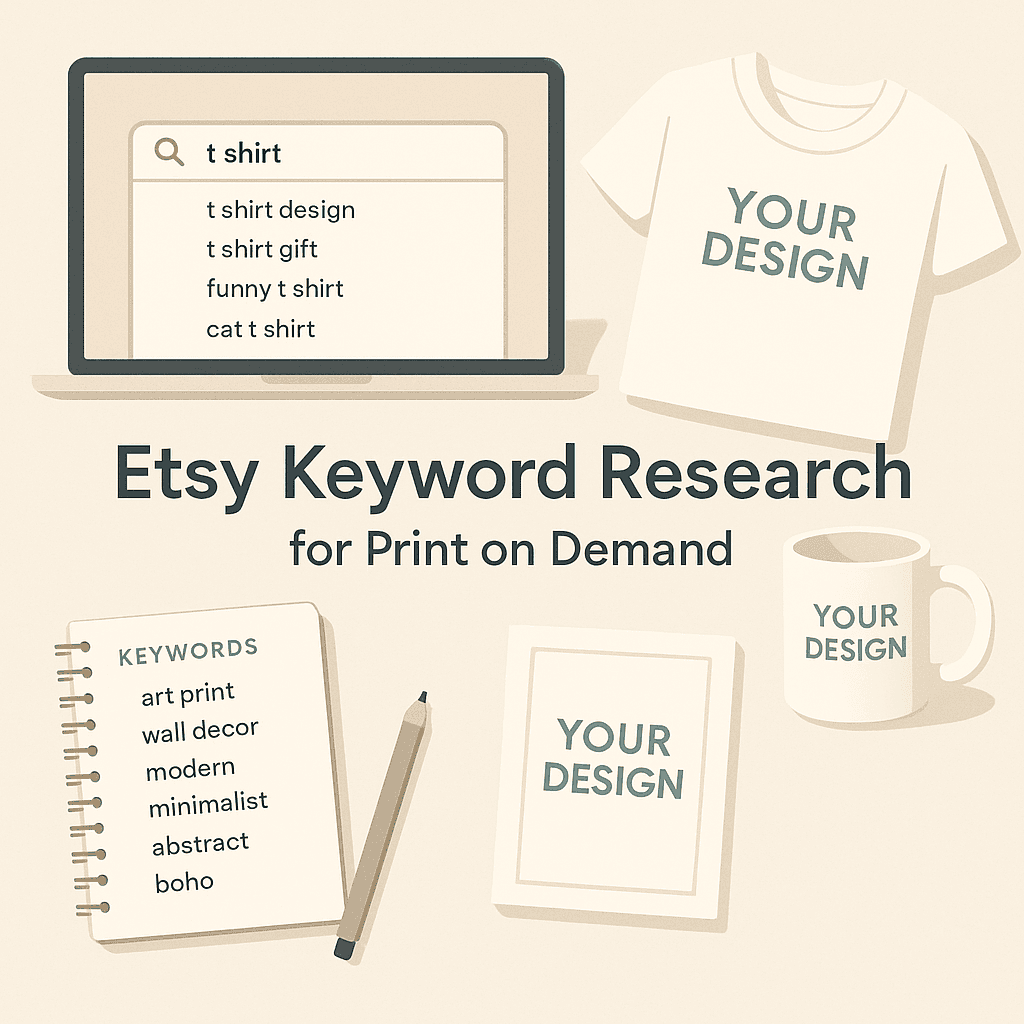
Quick trick. Go on Etsy and search a niche keyword, then scroll the autosuggest dropdown. Those suggestions are basically Etsy saying, “People type these phrases a lot.”
If the suggestions are rich and specific, good sign.
2. Validate demand by looking at what’s already selling
This step is boring. It’s also where you avoid wasting weeks.
When you search Etsy, don’t just look for pretty listings. Look for proof.
What counts as proof?
- Listings with lots of reviews, especially recent ones
- Shops where multiple items in the niche have reviews (not just one viral hit)
- Consistent style across listings (means branding matters in that niche)
- Products that have variations (sizes, colors, personalization)
Click into the best sellers and study three things:
- What exact product is it? (shirt, crewneck, tote, mug, poster)
- What angle is it? (humor, identity, job pride, aesthetic, gift)
- What keywords do they repeat? (in the title, tags, description)
You’re not copying. You’re mapping the market. Big difference.
If you can’t find any listings with meaningful traction in your niche, that’s not automatically bad, but it usually means one of these is true:
- Nobody is searching for it
- The niche buys elsewhere (Amazon, Shopify stores)
- The niche is too fragmented to target
3. Choose the right products for Etsy print on demand
Some POD products look great in theory and then become annoying in practice. Returns, sizing complaints, shipping costs, production times. Etsy customers have expectations.
If you’re starting out, go with products that are:
- Easy to understand
- Easy to photograph with mockups
- Commonly purchased on Etsy
- Reasonably priced after shipping
Solid starter list
- Unisex t-shirts
- Crewneck sweatshirts and hoodies
- Tote bags
- Mugs (white ceramic still sells, always)
- Posters and art prints
- Stickers (not always POD friendly, depends on supplier)
I usually tell people not to start with five product categories at once. Pick one main category, then expand when you have a style that’s working.
Because if you try to do mugs, shirts, canvas prints, and phone cases from day one, your shop starts to look like a random catalog. Etsy shoppers notice that.
4. Create designs that aren’t generic
Here’s the uncomfortable truth. Etsy is flooded with boring designs.
And you can’t “SEO” your way out of boring forever.
So the goal is not perfection. It’s distinctiveness. Something that looks like it belongs to a specific person, not “everyone.”
What tends to sell on Etsy
- Designs that signal identity: “I’m a ____ kind of person”
- Designs that make a good gift: “My sister would love this”
- Simple but intentional typography (not 10 fonts fighting)
- One strong concept per design (not a collage)
- Seasonal timing (but done with a niche twist)
If you’re using AI to help generate ideas, great. But you still need taste and editing. AI can brainstorm 50 slogans in 30 seconds. It cannot reliably tell you which 3 are actually funny, non cringe, and printable.
Also, do a basic trademark check. Don’t build a shop around phrases that will get you in trouble. This part matters more than people think.
5. Branding your Etsy shop (so you don’t look like a copy-paste store)
Branding sounds like a fancy word but it’s really just cohesion.
- Shop name that matches the niche (or at least doesn’t confuse people)
- Banner and logo that feel consistent
- Listing mockups that look like they belong together
- A repeatable design style (same vibe across items)
Etsy rewards shops that look trustworthy. Customers do too.
And it helps conversion a lot. If someone clicks one listing and then visits your shop, you want them to feel like, “Oh, this shop specializes in this.” Not “This is random.”
6. Etsy SEO that actually works in 2026 (still mostly the basics, honestly)
Etsy SEO gets overcomplicated. You don’t need magic. You need relevance.
Etsy is trying to match a buyer’s search with the listing most likely to satisfy them. Your job is to help Etsy understand what your item is.
That means:
- Use the phrases people actually type
- Be specific
- Don’t stuff keywords that don’t match
Title structure that tends to work
Start with the main search phrase, then add secondary phrases.
Example (not perfect, just clear):
“Funny Night Shift Nurse Shirt, RN Gift, Nursing Student Graduation Tee, Hospital Nurse Life T-shirt”
Not glamorous, but it tells Etsy exactly what’s going on.
Tags
Use all tag slots. Avoid repeating the exact same phrase. Think in clusters:
- Profession (nurse, rn, nursing student)
- Occasion (graduation gift, nurse week)
- Style (funny, cute, minimalist)
- Product type (shirt, tee, t-shirt)
- Audience (women, men, coworkers)
Description
Etsy descriptions matter for conversion. People skim. So write like a human.
- First 2 lines should explain what it is and who it’s for
- Then bullet points: fit, fabric, sizing notes, shipping times
- Care instructions (brief)
- A friendly line at the end (helps trust)
7. Mockups matter more than you want them to
Etsy is visual. Your main image is your ad.
If your mockup looks fake, low-res, or messy, you will lose clicks even if your design is good.
A few practical rules:
- Use bright, clear mockups
- Show the design large enough to read on mobile
- Use consistent background style across your shop
- Add at least one close-up image
- Add a size chart image for apparel (seriously, do it)
For apparel, lifestyle mockups usually outperform flat lays, but test both. Some niches like clean flat lays. Some want cozy lifestyle shots.
8. Pricing POD products without sabotaging yourself
Pricing is tricky because Etsy customers love deals, but POD has real costs.
Your price must cover:
- Base product cost
- Printing cost
- Shipping (or free shipping baked in)
- Etsy fees
- Ad spend (optional, later)
- Profit
If you price too low, you’ll get sales and still lose money. Or you’ll be stuck unable to run discounts later.
If you price too high with no brand, you won’t convert.
So start with “market aware” pricing. Search Etsy for your product type and niche and see the common price range. Then position yourself:
- If your mockups and branding are clean, you can be mid to upper range
- If you’re brand new, it’s okay to be slightly under the midpoint, but not bargain-basement
And please. Build room for discounts. Etsy loves sales. Customers love sales. You’ll want that option.
9. Operations: how you fulfill orders without losing your mind
This is where print on demand can feel either effortless or chaotic.
When you’re doing POD manually, the workflow looks like this:
- Customer orders
- You confirm variant and personalization (if any)
- You place order with POD supplier
- You upload tracking back to Etsy
- You handle support if anything goes wrong
That’s fine at 5 orders a week.
At 10 orders a day, it becomes a job.
Where automation becomes a real advantage
If you’re building a serious Etsy POD store, the repetitive tasks will eventually slow you down more than design creation. And that’s why tools built for Etsy automation are starting to matter.
For example, NinjaSell is an AI print on demand company focused on Etsy. The pitch is pretty straightforward:
- You upload your designs
- NinjaSell automatically creates optimized Etsy listings
- Generates mockups
- And fulfills POD orders with white-label shipping
So instead of spending hours doing listing setup, mockup generation, and fulfillment admin, you’re spending that time on the parts that actually move revenue: researching, designing, improving your shop, launching new collections.
If you’re the type who can design but gets stuck on “ugh, now I have to create 40 listings,” automation can be the difference between a store that launches and a store that stays a folder of PNGs.
10. Customer experience: how to get reviews without begging
Reviews are oxygen on Etsy. They influence ranking, conversion, and trust.
But you don’t get reviews by asking 10 times. You get reviews by reducing friction.
Do this instead
- Set clear processing and shipping expectations in the listing
- Include a friendly order confirmation message (short, not spammy)
- Make sure sizing guidance is obvious
- Handle issues fast and politely (even when you’re right)
If someone has a problem and you solve it quickly, they often leave a review anyway. Sometimes a better one than if everything went perfectly.
Also, don’t ignore packaging. Even with POD, you can still deliver a branded feel through:
- Strong mockups and listing clarity (expectation management)
- White-label shipping where possible
- A consistent shop tone (messages, FAQs, policies)
11. Launch strategy: don’t drip 3 listings and hope
Etsy favors shops that look active and full. And customers prefer browsing.
A better launch plan is:
- Create 20 to 40 listings in one niche first
- Keep them consistent in style
- Spread across a few product types or color variants, but not too many
- Then add new designs every week
I like the “collection” approach.
Example: instead of random nurse shirts, do:
- Night shift humor collection (10 designs)
- Nursing student graduation collection (10 designs)
- Labor and delivery niche collection (10 designs)
It makes your shop feel intentional. And it makes SEO easier too because your tags and keywords start clustering.
12. Scaling: what to focus on after you get your first sales
Once you have traction, your job changes.
Early stage is about creating enough listings to get data.
Scaling stage is about doubling down on winners.
What I would do at 50 to 200 sales
- Identify top 10 listings by revenue and views
- Create variations and spin-offs (same concept, new phrases)
- Expand winners into other products (shirt -> sweatshirt, mug, tote)
- Improve mockups for your best sellers first
- Add seasonal versions (Christmas gift for nurses, nurse week, etc.)
Ads?
Etsy Ads can help once you have listings that already convert. If your listing doesn’t convert organically, ads just burn money faster.
So run ads on proven listings, not experiments.
13. Common mistakes that quietly kill Etsy POD stores
This is the stuff that doesn’t feel dramatic, but it adds up.
- Making designs for yourself, not for buyers
- Using the same exact mockups everyone uses
- Not using all tags
- Titles that are either too short or stuffed with nonsense
- Spreading across 10 niches in one shop
- No size chart for apparel
- Pricing with zero profit margin
- Inconsistent processing times and supplier issues
- Not building a repeatable style
And a big one.
Giving up before Etsy has enough data to even test your listings. Etsy is not TikTok. It’s slower. You need volume and consistency.
Let’s wrap this up (a simple plan you can follow)
If you want a clean path, do it in this order:
- Pick a niche that’s specific and giftable
- Validate demand by studying what already sells
- Start with 1 or 2 POD products (like tees and crewnecks)
- Make 20 to 40 designs in a consistent style
- Build listings with solid titles, all tags, clear descriptions
- Use strong mockups that look good on mobile
- Price for profit, not just for sales
- Keep uploading new listings weekly
- Once you get traction, scale winners into variations and new products
- Consider automation (like NinjaSell) when listing creation and fulfillment starts eating your time
That’s it. It’s not easy, but it’s not mysterious either.
And if you do it consistently for a few months, you’ll be shocked how quickly Etsy starts sending you traffic. Not every day, not perfectly. But enough that you go, wait, this is real.
FAQs (Frequently Asked Questions)
What are the key factors to consider when choosing a niche for an Etsy print on demand store?
When selecting a niche, focus on one that is buyable rather than just popular. It should have a clear customer identity, gifting intent, and enough depth to create 30 to 100 unique product ideas without repetition. Narrow but expandable niches like gifts for new nurses or specific dog breeds work well.
How can I validate demand for my chosen niche on Etsy?
Validate demand by researching existing listings with lots of recent reviews, multiple reviewed items in the niche, consistent branding styles, and products offering variations. Study best sellers to understand the exact product types, marketing angles, and frequently used keywords to map the market effectively.
Which print on demand products are best suited for selling on Etsy?
Start with products that are easy to understand and photograph, commonly purchased on Etsy, and reasonably priced after shipping. Good options include unisex t-shirts, crewneck sweatshirts and hoodies, tote bags, white ceramic mugs, posters and art prints, and sometimes stickers depending on your supplier.
How can I create distinctive designs that stand out on Etsy?
Aim for designs signaling identity or gifting appeal with simple yet intentional typography focusing on one strong concept per design. Avoid generic or overly complex collages. Seasonal designs with a niche twist also perform well. Use AI tools for brainstorming but apply personal taste and editing to ensure quality and originality.
Why is branding important for an Etsy print on demand shop and how do I build it?
Branding provides cohesion across your shop which builds trust with customers and improves conversion rates. Create a shop name aligned with your niche, consistent banners and logos, uniform listing mockups, and maintain a repeatable design style so your shop looks professional rather than like a random catalog.
What common mistakes should I avoid when starting an Etsy print on demand business?
Avoid picking overly broad niches based solely on popularity without clear customer targeting. Don’t launch too many product categories at once as it can confuse shoppers. Steer clear of generic designs that don’t stand out. Also, neglecting branding or ignoring trademark checks can harm your shop’s reputation and legal standing.