
Etsy keyword research for print on demand sounds like one of those tasks you should be able to do in an hour. Then you sit down, open Etsy, type a few things like “funny shirt” and… yeah. Suddenly you’re 3 pages deep, looking at 50 listings that all look kinda similar, and you still have no idea what keyword you should target.
The truth is Etsy SEO is not mysterious. It’s just picky.
And for print on demand, it’s even more specific because you’re not just selling “a t shirt”. You’re selling a t shirt for a certain person, for a certain vibe, for a certain moment. That’s where keywords make you money.
So here’s a practical, slightly messy, real world way to do Etsy keyword research for POD. No fluff. Just what to look for, how to build keyword lists, and how to turn them into listings that actually rank.
First, what “keyword research” means on Etsy (for POD)
On Etsy, keywords are basically the bridge between what someone types and what Etsy decides to show them.
Your job is to figure out:
- What your buyer actually types into search
- Which of those searches you can realistically compete for
- How to match your design to the exact intent behind that search
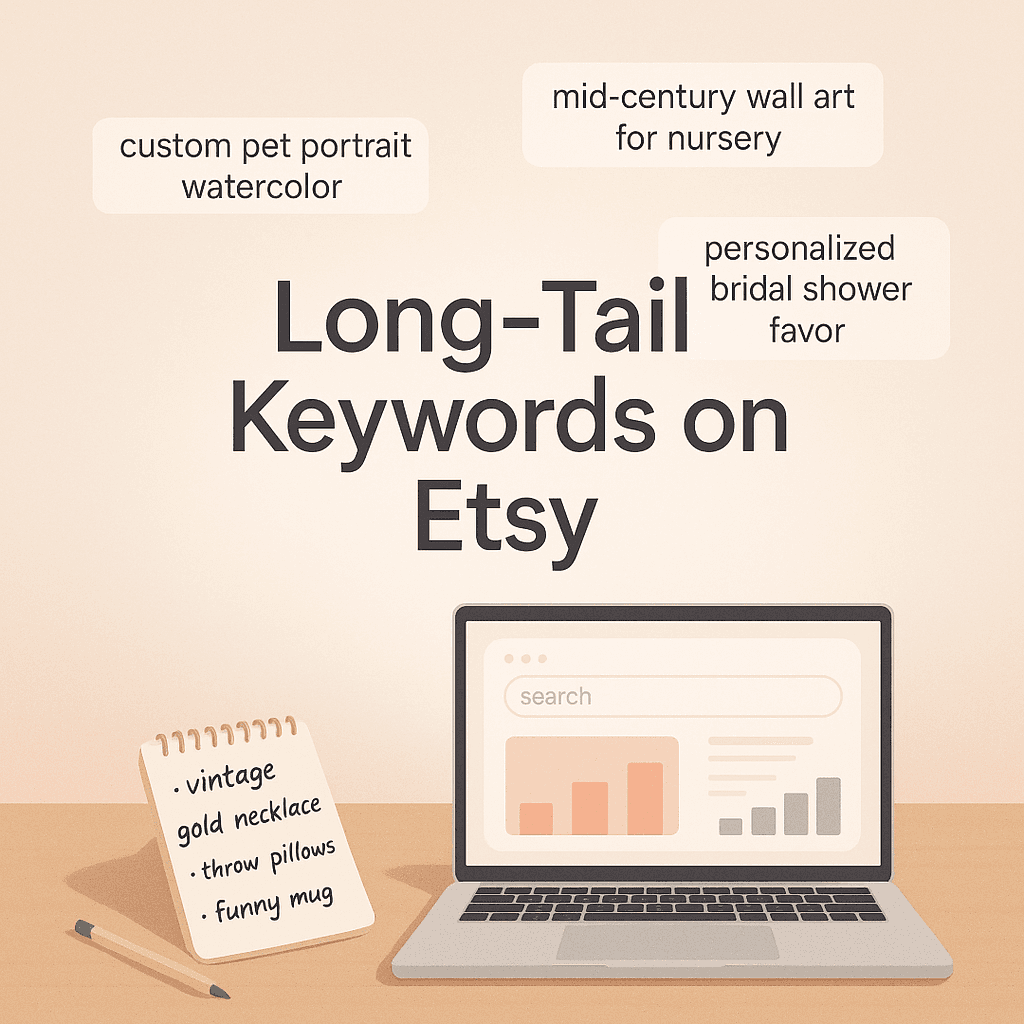
For print on demand, the best keywords are usually longer and more specific. Not always, but usually.
Like:
- “t shirt” (too broad, too competitive)
- “funny t shirt” (still broad)
- “funny accountant t shirt” (now we’re getting somewhere)
- “funny accountant gift shirt” (even better because it’s purchase intent)
And Etsy gives you a big hint. Etsy literally tells you what people search. You just have to collect it and organize it in a way that’s useful.
The Etsy SEO pieces you’re doing this for
Quick map of where keywords matter most:
- Title: still huge for relevance
- Tags: Etsy uses these heavily
- Categories + attributes: quietly powerful (and people ignore them)
- Description: less direct than it used to be, but still helps match intent and convert
- First photo + price + reviews: not keywords, but they impact click through and conversion, which impacts ranking
We’re focusing on keywords, but keep in mind. Keyword research is pointless if your listing looks like a random template. Etsy is a marketplace, not Google.
Step 1: Pick a niche angle before you pick keywords
If you start with keywords like “custom shirt”, you’ll drown.
Start with a niche angle. Something like:
- Teacher humor
- New dad gifts
- Dog mom shirts
- Minimalist wedding signs
- Bookish tote bags
- Bachelorette weekend merch
- Gym motivation quotes
- Zodiac stuff
- Nurse life
You don’t need to marry the niche forever. But you need one lane so your keyword research doesn’t become a pile of unrelated phrases.
A simple way to think about niche for POD:
Person + vibe + occasion
Examples:
- “teacher” + “funny” + “end of year gift”
- “new mom” + “minimal” + “first mother’s day”
- “golden retriever owner” + “cute” + “birthday gift”
This matters because Etsy search is intent based. People aren’t just searching products. They’re searching solutions.
Step 2: Use Etsy autocomplete (it’s free, and it’s gold)
Go to Etsy. Start typing your base phrase and do not hit enter yet.
Example base phrase:
“teacher shirt”
Etsy will suggest stuff like:
- teacher shirt funny
- teacher shirt first grade
- teacher shirt kindergarten
- teacher shirt gift
- teacher shirt women
Now do the same thing with variations:
- “funny teacher”
- “teacher gift”
- “kindergarten teacher”
- “first grade teacher”
- “teacher tote”
- “teacher sweatshirt”
Write down the suggestions. Those are real searches.
Small tip: also try adding a letter after your phrase, like:
- “teacher shirt a”
- “teacher shirt b”
- “teacher shirt c”
This pulls more suggestions sometimes.
You can do this for 20 minutes and end up with 100 phrases that are already validated by the platform.
Step 3: Steal keywords from page 1 competitors (the right way)
Once you have a few promising phrases, search them on Etsy and open the top listings.
You’re looking for patterns, not copying one seller.
Here’s what to collect:
1) Common words in titles
If 7 out of 10 top listings include “teacher appreciation” or “teacher life”, that’s a clue.
2) Tags (sort of)
Etsy doesn’t show tags directly anymore in the obvious way it used to, but you can still learn a ton from:
- the title wording
- the categories and attributes they picked
- the repeated phrases across multiple listings
- sometimes the “explore related searches” areas
3) The product type and attribute alignment
For POD, this is huge.
If the top results for “teacher sweatshirt” are all crewnecks and your design is on a tank top, Etsy might not love that mismatch. Keyword research includes matching the dominant product format.
So don’t just ask “what keywords”. Ask “what product do buyers expect when they type this”.
Step 4: Build a keyword list in 3 layers (this is the part most people skip)
You want a mix. Etsy rankings get weird when you only target ultra broad or ultra long tail.
Here’s a simple 3 layer system:
Layer A: Core keyword (1 to 3 words)
Broad-ish, defines the item.
- teacher shirt
- nurse sweatshirt
- book tote bag
- wedding sign
Layer B: Modifier keyword (style, audience, vibe)
- funny
- minimalist
- retro
- boho
- vintage
- custom
- matching
- aesthetic
Layer C: Intent keyword (gift, occasion, role, event)
- gift for teacher
- teacher appreciation
- end of year teacher gift
- mother’s day
- new dad
- bachelorette party
Then you combine them into long tails that sound like real searches:
- funny teacher shirt
- teacher appreciation shirt
- end of year teacher gift shirt
- retro teacher sweatshirt
- gift for kindergarten teacher
You don’t need to use every combination. But building it this way makes it easier to create listings that are tightly focused.
Step 5: Spot the difference between “traffic keywords” and “buyer keywords”
Not all searches are equal.
Some searches bring browsers. Some bring buyers who are ready to click and purchase.
Traffic keywords (often vague)
- cute shirt
- funny sweatshirt
- aesthetic tote
- wall art printable
Buyer keywords (specific and intent heavy)
- funny accountant gift shirt
- bridesmaid tote bag personalized
- custom pet portrait sweatshirt
- first mother’s day shirt
- matching family christmas shirts
If you’re new, go heavier on buyer keywords. It’s usually easier to convert, easier to compete, and you get real sales data faster.
Step 6: Check competition quickly (without overthinking it)
Etsy doesn’t show a perfect “keyword difficulty” score. So you need a simple filter.
When you search a phrase, look at:
- how many results show up (rough competition)
- whether page 1 looks dominated by giant shops with thousands of reviews
- whether the listings are all super similar or there’s room for a unique angle
Rules of thumb, not laws:
- If you search “teacher shirt” and see hundreds of thousands of results, that’s a long game.
- If you search “funny kindergarten teacher shirt” and see a smaller pool, that’s more playable.
- If you search “retro teacher shirt first grade” and the results are scattered, you might have a chance to own that micro term.
Also. If page 1 looks weak. Bad photos, sloppy titles, weird mockups. That’s an opportunity even if competition isn’t tiny.
Step 7: Turn your best keyword into a listing plan
Before you write a title, decide what the main keyword is.
For POD, I like doing 1 listing = 1 main keyword cluster.
Example cluster:
Main: teacher appreciation shirt
Secondary: funny teacher shirt, teacher gift, end of year teacher gift, teacher life shirt
Now design and listing assets should match that idea. Not kinda. Actually match.
So if the keyword is teacher appreciation, your design should look like an appreciation gift. Not a random teacher joke that doesn’t fit the occasion.
This is where a lot of POD stores get stuck. They do keyword research, then upload a design that doesn’t match the search intent. Etsy notices through conversion signals. Even if you rank, you won’t stay there.
Step 8: Write titles like a human, but pack them with search phrases
Etsy titles can be long. People abuse that and write garbage.
Don’t.
A good Etsy POD title usually looks like:
- Primary phrase first
- Secondary phrases after
- Commas are fine
- Readable, not spammy
Example (not perfect, but solid):
Teacher Appreciation Shirt, Funny Teacher Gift, End of Year Teacher Shirt, Cute Teacher Life Tee
Notice what’s happening. We’re stacking related phrases people search. But we’re not doing “teacher shirt teacher gift teacher appreciation teacher tee shirt”. That’s just noise.
Also, put the strongest phrase at the beginning. Etsy weighs early words more.
Step 9: Fill tags with long tails and close variations
You get 13 tags. Use them like a keyword net.
A simple tag approach:
- 3 to 5 tags = close match to your main keyword
- 4 to 6 tags = variations and synonyms
- 2 to 4 tags = intent and audience
Example for “teacher appreciation shirt”:
- teacher appreciation
- teacher shirt
- teacher gift
- end of year gift
- funny teacher shirt
- teacher life
- gift for teacher
- kindergarten teacher
- teacher tee
- teacher thank you
- educator shirt
- teacher outfit
- school teacher gift
You do not need single word tags like “shirt” unless you’re out of ideas. Long tail tags tend to perform better in POD because buyers are searching with context.
Step 10: Categories and attributes are hidden keywords (seriously)
When you select the right category like:
Clothing -> Women -> Tops -> T shirts
And then you choose attributes like:
- occasion
- sleeve length
- neckline
- color
- style
- material
Etsy uses that to match searches with filters and relevance.
This is free ranking help. People skip it because it’s boring.
If you want an edge, don’t skip it.
Step 11: Don’t guess. Use a simple keyword tracker sheet
You do not need a fancy tool to start.
Make a Google Sheet with:
- Listing name
- Main keyword
- Secondary keywords
- Date published
- Views (weekly)
- Favorites (weekly)
- Orders (weekly)
- Notes (what you changed)
After 2 to 4 weeks, patterns show up.
Some keywords get views but no sales. That’s either wrong intent or weak listing.
Some get few views but high conversion. Those are gold. You make more designs in that cluster.
Step 12: Where NinjaSell fits in (and why it matters for keyword research)
Here’s the thing. Keyword research is not just brainstorming. It’s execution.
And POD execution is annoying because you’re doing the same steps over and over:
- build listing
- write title
- write tags
- mockups
- publish
- fulfill orders
That’s where a tool like NinjaSell can change the pace.
NinjaSell is an AI print on demand company focused on Etsy automation for POD. You upload your designs, and it automatically creates optimized Etsy listings, generates mockups, and fulfills print on demand orders with white label shipping.
So instead of doing keyword research, then spending 45 minutes per listing building everything manually, you can move faster. Which matters because Etsy keyword research is partly volume. You need enough listings and enough tests to see what sticks.
Also, if you’re scaling, consistency becomes the battle. Same structure, same quality, less human error. Automation helps.
Just to be clear, you still need to feed it good inputs. Bad keyword targeting plus automation just creates a lot of bad listings quickly. But if your keyword research is solid, automation is basically a multiplier.
A simple Etsy POD keyword research workflow (use this every time)
If you want a repeatable process, do this:
- Pick a niche and product (ex: “nurse sweatshirt”)
- Use Etsy autocomplete to collect 30 to 50 phrases
- Search 5 to 10 of those phrases and study page 1
- Choose one main keyword cluster you can compete for
- Build title and tags around that cluster
- Publish, track for 2 to 4 weeks
- Double down on what converts, drop what doesn’t
That’s it. It’s not glamorous. But it works.
Common POD keyword mistakes (so you don’t waste a month)
1) Targeting broad keywords because they sound big
They are big. Big competition too.
2) Mixing unrelated keywords in one listing
“Cat shirt”, “Taylor inspired”, “teacher gift”, “retro aesthetic”. Pick a lane.
3) Ignoring seasonal intent
If you’re doing Christmas keywords, start early. Like months early. Etsy ramps.
4) Only using “cute” and “funny”
Those are not niches. They’re adjectives. Add the audience and occasion.
5) Not matching the product to the keyword
If buyers expect a sweatshirt and you’re selling a tee, you’ll feel it in conversion.
Wrap up (what to do next)
Etsy keyword research for print on demand is basically a loop: collect real search terms, pick a winnable cluster, build one focused listing, then let data tell you what to make next.
If you do nothing else after reading this, do this one thing. Open Etsy and start writing down autocomplete suggestions for your niche. Those suggestions are your market, speaking in plain language. And once you have that list, building listings becomes way less random.
Then when you’re ready to speed things up, tools like NinjaSell can help you publish and fulfill faster, since it automates optimized Etsy listings, mockups, and POD fulfillment with white label shipping.
But yeah. Start with the keywords. Always.
FAQs (Frequently Asked Questions)
What does keyword research mean on Etsy for print on demand (POD)?
On Etsy, keyword research for POD means identifying what your potential buyers type into the search bar, determining which of those searches you can realistically compete for, and matching your design to the exact intent behind that search. The best keywords are usually longer and more specific, helping you connect with buyers looking for a particular style or occasion.
Why is picking a niche angle important before doing keyword research for POD on Etsy?
Picking a niche angle helps focus your keyword research so it doesn’t become a pile of unrelated phrases. A niche combines person + vibe + occasion (e.g., ‘teacher’ + ‘funny’ + ‘end of year gift’), aligning your products with specific buyer intent. This focus improves relevance and makes it easier to find targeted keywords that convert.
How can I use Etsy autocomplete to find effective keywords for my print on demand listings?
Etsy autocomplete is a free and powerful tool where you start typing your base phrase (like ‘teacher shirt’) without hitting enter. Etsy suggests popular search phrases related to your base. By also adding letters after your phrase (e.g., ‘teacher shirt a’), you can uncover even more validated keyword ideas to build a strong list.
What should I look for when analyzing page 1 competitors on Etsy to improve my keyword strategy?
When studying top listings, look for common words in titles, repeated phrases across multiple listings, categories and attributes chosen, and product types aligned with the searched keywords. Identifying patterns helps you understand buyer expectations and tailor your keywords and product formats accordingly.
Where do keywords matter most in an Etsy listing for print on demand products?
Keywords are crucial in the title and tags of your listing since Etsy uses these heavily for relevance. Categories and attributes also play a quietly powerful role but are often ignored. While descriptions help match intent and convert buyers, the first photo, price, and reviews impact click-through rates and conversion, indirectly affecting ranking.
How should I build my keyword list for Etsy SEO in print on demand?
Build your keyword list in three layers: Layer A with core keywords (1 to 3 words), Layer B with medium specificity phrases combining niche elements, and Layer C with long-tail keywords showing strong purchase intent. This balanced mix avoids overly broad or overly narrow terms and improves your chances of ranking well and converting buyers.