If you have ever uploaded a listing to Etsy and thought, ok cool, now people will find it… and then nothing happens. Yeah. Same.
Most Etsy listings do not fail because the product is bad. They fail because Etsy cannot figure out what the item is, who it is for, and when to show it. And that all comes down to keywords.
Not “keywords” in a vague SEO way either. I mean the exact phrases real shoppers type into Etsy. The plain language stuff. The messy, specific stuff.
So in this guide, I am going to show you how to find the best Etsy keywords for your listings, how to pick the right ones (because not all traffic is good traffic), and how to actually place them in your listing without turning your title into a robot sentence.
And if you are doing print on demand, I will also show you how to make this scalable without losing your mind, because doing keyword research for 50, 100, 500 listings manually is… not fun.
What “best Etsy keywords” actually means (not the myth version)
The best Etsy keywords are the ones that:
- Match what a buyer is literally searching
- Fit your product exactly (or close enough that they will still buy)
- Have real demand
- Are not so competitive that you are instantly buried
That last one matters more than people admit.
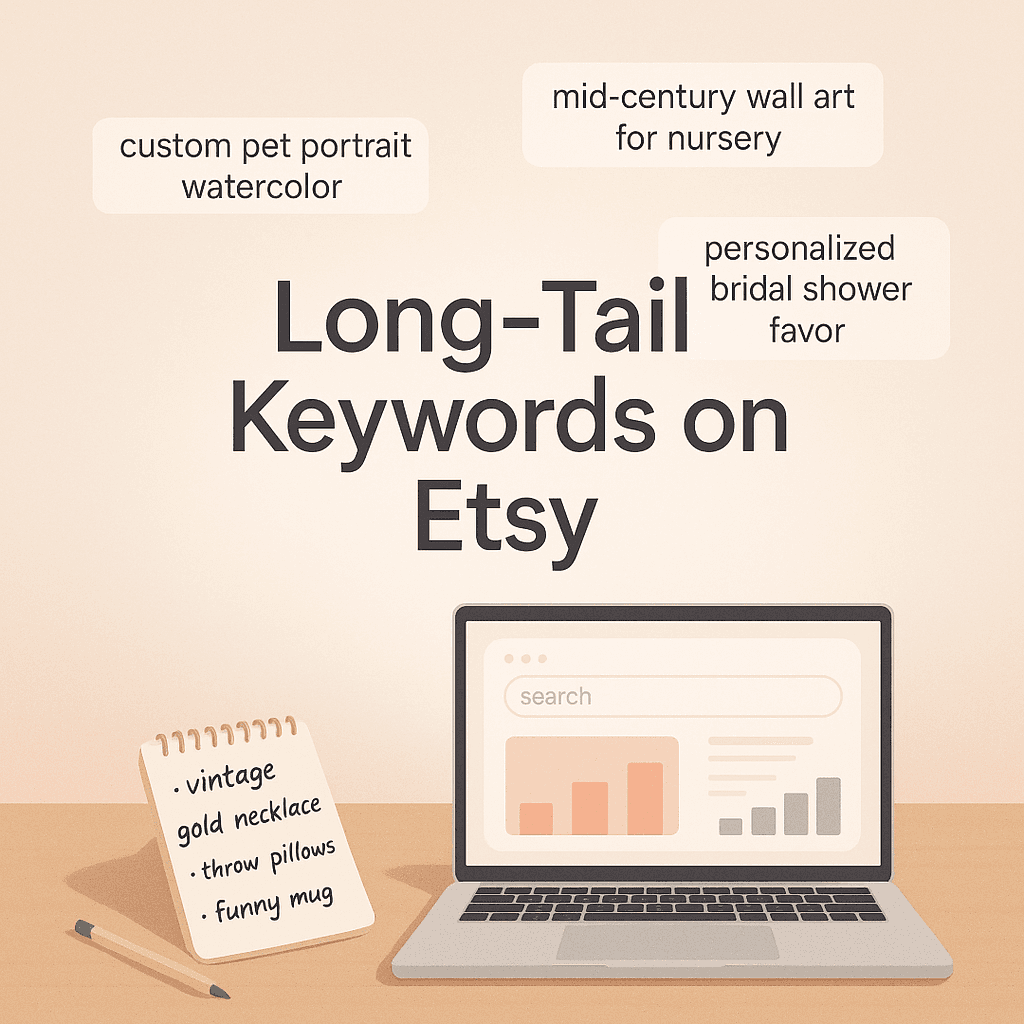
If you list a “t shirt” and use keywords like “shirt” or “gift” you are basically whispering into a stadium. Etsy has millions of listings. You need to be a little more specific than that.
So instead of “shirt”, you are aiming for things like:
- “retro cowboy western t shirt”
- “funny cat mom sweatshirt”
- “custom pet portrait mug”
- “minimalist line art face print”
- “teacher appreciation tote bag”
Longer. Clearer. More buyer intent.
Step 1: Start with your product, not the keyword tool
Before you open Etsy search or any tool, do this first. Describe your item like a buyer would.
Ask yourself:
- What is it?
- Who is it for?
- What style is it?
- What occasion is it for?
- What material or feature matters?
- What vibe does it have?
Example: you sell a print on demand hoodie with a minimalist mountain graphic.
Your raw keyword ingredients might be:
- hoodie
- mountain
- minimalist
- hiking
- outdoors
- nature lover
- unisex
- gift
Now you can combine those into buyer phrases later. But you need the ingredients first, otherwise you end up chasing random high volume terms that do not convert.
Quick note. Etsy is not Google. Etsy shoppers are usually looking to buy, not just browse. So “intent” is everything.
Step 2: Use Etsy autocomplete like a free keyword goldmine
Go to Etsy, start typing your base keyword, and do not hit enter.
Just watch what Etsy suggests.
Example: type “mountain hoodie” and you might see:
- mountain hoodie
- mountain hoodie men
- mountain hoodie women
- mountain hoodie aesthetic
- mountain hoodie sweatshirt
- mountain hoodie vintage
Those suggestions are not random. They are based on real searches.
Do this for a handful of variations:
- mountain shirt
- hiking hoodie
- minimalist hoodie
- nature lover gift
Write them down. Or paste them into a doc. You are building your keyword pool.
A simple trick that helps a lot
Try adding letters after your phrase.
Type:
- “mountain hoodie a”
- “mountain hoodie b”
- “mountain hoodie c”
Sometimes you will pull up different suggestions you would not see otherwise. It is a little tedious, but it works.
Step 3: Steal keyword language from the listings that already sell
This sounds dramatic but it is just research.
Search your main phrase on Etsy. Open the top listings that look like:
- They have lots of sales (you will usually see “in X carts” or big review counts)
- They match your style and price range
- They are not totally irrelevant
Now look at:
- Their title wording
- Their categories and attributes
- Their tags (you cannot see tags directly, but you can infer them from the title and how they repeat phrases)
- Their description headers sometimes
You are not copying. You are learning the language Etsy is already rewarding.
You will start seeing patterns. Like buyers do not search “minimal line art”. They search “line art print” or “abstract line art”.
That difference matters.
Step 4: Find the “buyer intent” modifiers that make keywords convert
A keyword like “hoodie” is too broad. A keyword like “mountain hoodie” is better. But the real conversion juice often comes from modifiers, like:
- Occasion: gift, birthday, anniversary, Christmas, Mother’s Day
- Recipient: mom, dad, boyfriend, girlfriend, teacher, nurse, coworker
- Style: vintage, retro, minimalist, boho, gothic, cottagecore
- Feature: embroidered, oversized, heavyweight, pocket, custom, personalized
- Niche: hiking, camping, national parks, rock climbing, outdoorsy
So instead of “mountain hoodie” you might target:
- “mountain hoodie gift for hiker”
- “national park hoodie retro”
- “minimalist mountain sweatshirt”
- “outdoor lover hoodie”
Even if the search volume is smaller, the buyer is closer to purchasing. And Etsy likes listings that get clicked and bought. That is how you climb.
Step 5: Think in clusters, not single keywords
Here is one of the biggest Etsy SEO mistakes. People try to find 1 perfect keyword.
Etsy does not work that way.
Etsy ranks listings based on relevance across multiple keyword matches. You want a cluster of closely related terms that all point to the same intent.
Example cluster for a “custom pet portrait mug”:
- custom pet mug
- pet portrait mug
- dog mug personalized
- cat mug custom
- pet lover gift
- dog mom mug
- cat mom coffee mug
Notice how all of those are different, but they are the same topic. That is good. That helps Etsy understand your product and match it to more searches.
Step 6: Use Etsy categories and attributes as “hidden keywords”
This part is underrated.
When you select a category like:
Home & Living → Kitchen & Dining → Drink & Barware → Mugs
Etsy treats that as relevance data. Same with attributes like:
- color
- occasion
- holiday
- material
- room
- style
You are basically giving Etsy extra context. And it can help you rank even if your title and tags are competitive.
So do not rush this part. Pick the most accurate category and fill in every attribute that genuinely applies.
Not “just because”. Etsy shoppers filter. If you pick the wrong attribute, you might show up in the wrong filtered results and get ignored.
Step 7: Turn your keyword pool into your actual Etsy tags (the right way)
Etsy gives you 13 tags, up to 20 characters each.
The goal is to cover as many relevant search phrases as possible without wasting space.
What to do
- Use multi word tags when possible
- Use different phrasing variations
- Use buyer intent where it fits
Example tags for “minimalist mountain hoodie”:
- mountain hoodie
- minimalist hoodie
- hiking sweatshirt
- nature lover gift
- outdoorsy hoodie
- mountain sweatshirt
- unisex hoodie
- camping gift
- hiking gift
- adventure hoodie
- national park hoodie
- minimalist sweatshirt
- mountain lover gift
What not to do
- Do not repeat the exact same word over and over if you can diversify
- Do not use single word tags like “hoodie” unless you truly have room
- Do not add irrelevant trending tags. It hurts conversion and can drag your listing down
Also, you do not need to repeat words exactly between tags. Etsy mixes and matches words across tags for some searches.
Step 8: Write titles for humans, but build them for Etsy
Etsy titles still matter a lot. Not because buyers read every word, but because Etsy uses the title as a major relevance signal.
A strong Etsy title usually looks like:
Primary keyword phrase first, then secondary phrases, then a few descriptive modifiers.
Example:
Minimalist Mountain Hoodie, Hiking Sweatshirt, Nature Lover Gift, Unisex Outdoor Pullover, Adventure Graphic Hoodie
Is that a beautiful sentence? No. But it is readable enough, and it covers a cluster.
A quick title checklist
- Put your main keyword in the first 40ish characters if you can
- Avoid keyword stuffing that becomes nonsense
- Do not use all caps
- Use commas or separators, keep it scannable
- Focus on what someone would type
Also, do not stress about repeating every tag inside the title. You want overlap, yes, but not a copy paste job.
Step 9: Use your description to support keywords without sounding like a dictionary
Descriptions matter less for Etsy search than they used to, but they still help with relevance and conversion. And they matter a lot if your listing gets indexed by Google.
What I do is simple:
- First 2 lines: a clean, buyer focused summary (with the main keyword naturally included)
- Then bullet points: size, material, fit, care, shipping
- Then gift intent language
- Then personalization instructions if needed
Example opening:
“Stay cozy on your next trail day with this minimalist mountain hoodie. A clean outdoor graphic, soft feel, and an easy unisex fit, makes it a solid gift for hikers and nature lovers.”
That hits keywords without trying too hard.
Step 10: Validate keywords by checking the search results page
This is a fast reality check.
Search your keyword on Etsy and look at the first page.
Ask:
- Are the top results similar to my product?
- Is Etsy showing the same product type?
- Are the styles aligned?
If you search “mountain hoodie” and Etsy shows mostly embroidered hoodies, and yours is a printed graphic hoodie, you might still compete. But if the entire first page is baby onesies, you have a mismatch. Pick a different phrase.
This step saves you from optimizing for a keyword that is technically popular but contextually wrong.
Print on demand keyword research, the part nobody wants to talk about
Print on demand is competitive on Etsy. Not impossible. But competitive.
So the keyword strategy that usually works best is:
- Go niche first (hyper specific audiences)
- Use style modifiers (retro, minimalist, gothic, etc)
- Use gift intent phrases (gift for mom, gift for hikers)
- Avoid mega broad terms unless you already have traction
Also, POD buyers care about:
- mockups looking real
- shipping clarity
- sizing accuracy
- design uniqueness
Keywords get the click. Your listing quality gets the sale. You need both.
How NinjaSell helps if you are building lots of Etsy listings
If you are running print on demand, you will eventually hit the wall where you have designs ready, but creating optimized listings takes forever.
This is where something like NinjaSell fits in nicely.
NinjaSell is an AI print on demand automation tool that helps you launch and scale an Etsy store by handling the repetitive parts:
- You upload your designs
- NinjaSell automatically creates optimized Etsy listings
- It generates mockups
- And it fulfills print on demand orders with white label shipping
The keyword angle here is obvious. When listing creation is automated, you can spend your energy where it actually moves the needle. Keyword research, niche discovery, testing new angles, improving conversion.
Because the truth is, most people do not fail at Etsy because they cannot design. They fail because they cannot execute consistently. They cannot get 5 good listings out every week for months.
Automation helps you keep going.
Still though. Even with automation, you want to review keyword choices, make sure the niche is right, and avoid generic listing output that looks like everyone else. Use the tool to go faster, not to go lazy.
A simple keyword workflow you can reuse (and not hate)
Here is a practical routine you can follow per product:
- Write your product “ingredient list” (what it is, who it is for, style, occasion)
- Pull 15 to 30 phrases from Etsy autocomplete
- Check top listings, copy down recurring phrasing patterns
- Pick 1 primary keyword, plus 4 to 6 close secondary phrases
- Build 13 tags using those phrases and variations
- Write a title that starts with the primary phrase, then supports the cluster
- Fill categories and attributes properly
- Re read your listing like a buyer for 10 seconds. Does it feel clear?
That is it. Nothing fancy. Just consistent.
Common Etsy keyword mistakes (quick, but important)
Using only broad keywords
Broad keywords bring broad traffic. Broad traffic does not buy.
Targeting keywords that do not match your product
You might get impressions, but your click through rate will be bad. Etsy notices.
Repeating the same keyword 10 times
You are wasting tag space and limiting reach.
Ignoring gift keywords
Etsy is basically a gift marketplace with a search bar. Use that.
Forgetting style language
A “retro” buyer and a “minimalist” buyer are two different people. Use their words.
What to do after you publish (because keyword research is not one and done)
Let the listing sit for a bit. Etsy needs time to test it.
Then check:
- views
- visits
- favorites
- conversion rate
- which listings get traffic
If you get views but no sales, it might be:
- keyword mismatch
- price mismatch
- weak mockups
- unclear sizing
- design not strong enough
If you get no views, it might be:
- keywords too competitive
- keywords too weird and no one searches them
- title and tags not aligned
- category mismatch
Tweak one thing at a time. Do not rewrite the entire listing every day. You will never know what actually helped.
Wrap up
Finding the best Etsy keywords is not about finding some secret tool or a magic tag.
It is about understanding how buyers describe what they want. Then building your listing around that language. In clusters. With intent.
Start with Etsy autocomplete. Study what sells. Use modifiers that show who it is for and why they are buying. Fill your categories and attributes like you mean it.
And if you are doing print on demand and trying to scale, consider using an automation tool like NinjaSell to speed up listing creation, mockups, and fulfillment, so you can focus on the parts that actually require your brain.
Keywords get you found. Clarity gets you clicks. A good product and a clean listing get you paid.
FAQs (Frequently Asked Questions)
Why do most Etsy listings fail to get found or sell?
Most Etsy listings fail not because the product is bad, but because Etsy cannot figure out what the item is, who it is for, and when to show it. This usually comes down to using the wrong keywords that don’t match what real shoppers are searching for.
What are the best Etsy keywords and how do I find them?
The best Etsy keywords are exact phrases that buyers literally search for, fit your product closely, have real demand, and aren’t so competitive that your listing gets buried. To find them, start by describing your product like a buyer would, use Etsy autocomplete suggestions, research top-selling listings for keyword language, and identify buyer intent modifiers like occasion or recipient.
How can I use Etsy autocomplete to improve my keyword research?
Etsy autocomplete suggests real searches based on what you type without hitting enter. By typing your base keywords and variations (including adding letters after your phrase), you can uncover a goldmine of specific keyword phrases that actual buyers use, helping you build a strong keyword pool for your listings.
What role do buyer intent modifiers play in Etsy SEO?
Buyer intent modifiers like occasion (e.g., gift, birthday), recipient (e.g., mom, teacher), style (e.g., vintage, minimalist), feature (e.g., personalized, embroidered), and niche (e.g., hiking, camping) help make your keywords more specific and conversion-friendly. Using these modifiers attracts buyers who are closer to making a purchase and improves your listing’s ranking on Etsy.
Why should I think in keyword clusters rather than single keywords for my Etsy listings?
Etsy ranks listings based on relevance across multiple related keyword matches rather than just one perfect keyword. By targeting clusters of closely related terms with similar buyer intent, you increase your chances of appearing in various relevant searches and attracting more buyers.
How can I scale keyword research if I have many print on demand listings?
For print on demand sellers with 50 or more listings, manual keyword research can be overwhelming. To scale effectively without losing your mind, focus on creating raw keyword ingredient lists based on product attributes first, then combine them into buyer-intent phrases systematically. Leveraging tools like Etsy autocomplete in batches and studying top sellers’ language can also streamline the process.