Etsy print on demand sounds like a cheat code when you first hear it.
You design something once. You list it on Etsy. And when someone buys, the product gets printed and shipped without you touching inventory, packing tape, or a spare bedroom full of boxes.
And yes, that’s basically how it works.
But also. There are a few parts nobody explains clearly in the beginning, like what you should sell first, how to price it so you are not working for free, how to avoid getting your shop flagged, and how to not waste a month designing things nobody is searching for.
So this is the full beginner guide. The boring stuff, the practical stuff, and the stuff people only learn after they have already uploaded 50 listings and still have zero sales.
Let’s do it.
What Etsy Print on Demand actually is
Print on demand is a fulfillment model.
You create a design (like a quote, illustration, pattern, logo style graphic, whatever). You upload it to a product template (t shirt, sweatshirt, mug, poster, tote bag). You publish that as an Etsy listing.
When a customer orders:
- The order gets sent to the print provider.
- They print it on the product.
- They ship it directly to the customer.
- You keep the profit margin (sale price minus production and shipping costs, and Etsy fees).
So you are basically running the storefront and doing the marketing and product decisions. The print provider handles the manufacturing and shipping.
No inventory. No upfront bulk purchases. But you do need to take it seriously like a real store, because on Etsy you are competing with real stores.
Is Etsy POD worth it in 2026?
It can be, yes. Etsy still has buyer intent. People open Etsy to buy something. Not to scroll for fun.
But. It is saturated in the lazy way.
Meaning, the market is full of listings that look the same. Same fonts, same mockups, same generic phrases, same clipart bundles. Which is good news if you are willing to be a little more specific and a little more thoughtful.
The winning formula is not “make 500 designs.” It is more like:
- pick a niche with real demand
- make products that fit the niche
- write listings that match what buyers type
- present it well (photos, mockups, clear info)
- price it like a business
- keep uploading consistently
And yes, automation helps a lot, because listing creation is the time drain.
Step 1: Pick a niche (please do not skip this)
Beginners usually pick “funny shirts” or “cute mugs.”
That is not a niche. That is a product type.
A niche is who it’s for and why they would buy it.
Good beginner niches tend to be:
- identity based (teacher, nurse, new mom, dog dad, golfer)
- events (bachelorette, baby shower, graduation, birthdays)
- hobbies (pickleball, hiking, baking, crochet)
- micro communities (booktok readers, plant lovers, DnD players)
- local pride (cities, states, small towns, inside jokes)
The reason niche matters is simple. Etsy SEO works better when your listing matches a specific search query.
“Funny shirt” is vague.
“Funny shirt for ICU nurse night shift” is a buyer.
So pick one or two niches and go deep.
Step 2: Choose your first POD products (keep it simple)
Some products are easier to sell and easier to design for.
Beginner friendly categories:
Shirts and sweatshirts
- consistent demand
- easy design placements
- but competitive, so your niche and messaging matters
Mugs
- great for gifting
- designs can be simpler
- usually lower AOV, so profit per sale can be smaller
Posters and prints
- can look premium fast
- shipping is easier for many providers
- needs good mockups because photos matter a lot
Tote bags
- solid gift product
- simple designs work
- trend sensitive, which can be good if you move fast
If you are starting from zero, I would pick one main product type first. Get the system working. Then expand.
Step 3: Understand the real costs (and why beginners underprice)
Your Etsy sale price is not your profit.
You will typically have:
- print provider base cost (product + printing)
- shipping (paid by you or customer, depends on your setup)
- Etsy listing fee (small, but it adds up)
- Etsy transaction fee and payment processing
- optional Etsy ads (not required but common later)
- your design and software costs (even if it’s just time)
A common beginner mistake is pricing a shirt at $19.99 because everyone else does, without realizing their actual margin might be like $3 to $6 after fees.
You want enough margin to:
- cover refunds or replacements sometimes
- run sales without going negative
- eventually afford ads or outsourcing
A simple way to start:
- aim for at least 30% margin after production costs and fees
- test pricing, do not lock it forever
- do not race to the bottom, because you cannot beat factories with $9 tees anyway
Step 4: Design basics that actually sell on Etsy
You do not need to be a professional designer. But you do need to make designs that look intentional.
A few rules that help a lot:
Make it readable at thumbnail size
Etsy search results show tiny thumbnails. If people cannot read it, they skip.
Match the niche’s taste
A minimalist black serif quote might work for “modern home office print.”
It probably won’t work for “cheer mom glitter sweatshirt.”
Avoid trademark problems
This is big. Etsy will remove listings, and shops can get suspended.
Avoid using:
- celebrity names
- sports team names
- movie titles
- brand slogans
- characters you do not own
Even if you see other people doing it. They might just not be caught yet.
If you are unsure, do not list it.
Build small collections
Instead of 50 random designs, make 10 designs for one theme.
Example: “Kindergarten teacher shirts” collection
- first day of school
- 100 days
- field trip
- teacher tired humor
- end of year
Collections make your shop look like a shop. Not a junk drawer.
Step 5: Etsy SEO for beginners (the stuff that matters)
Etsy SEO is not magic. It is mostly matching keywords and proving buyers like your listing.
Your job is to align:
- what buyers type
- with your title, tags, categories, and description
- and with your product photos and offer
Titles
Do not write poetry. Write search phrases.
A practical beginner structure:
Primary keyword + product type + recipient or use case + secondary keywords
Example: “Funny Nurse Sweatshirt, ICU Nurse Gift, Night Shift Crewneck, Hospital Nurse Pullover”
Not perfect, but it’s descriptive and searchable.
Tags
You get 13 tags. Use them.
Use:
- variations (nurse sweatshirt, nurse crewneck)
- gift intent (nurse gift, gift for nurse)
- occasion (nurse week gift)
- style (funny nurse shirt, cute nurse design)
- audience (icu nurse, er nurse)
Avoid repeating the exact same phrase 13 times. Cover different search angles.
Photos and mockups
Photos sell. Especially on Etsy.
You want:
- 1 clean main mockup (simple, readable)
- 1 close up for texture or print
- 1 size chart image
- 1 color options image
- 1 lifestyle mockup that fits the niche
Mockups that look too fake can hurt conversion. But also, you don’t need perfect. You need believable.
Step 6: Set up your shop like a real brand (even if it’s small)
These are not “nice to haves.” They affect trust.
- Shop banner and logo: simple is fine, just coherent
- About section: who the products are for, your style, your promise
- Policies: shipping, returns, personalization rules
- FAQs: sizing, care instructions, processing times
And please, fill out your production partner details accurately if you are using a POD provider. Etsy wants transparency.
Step 7: Order fulfillment workflows (manual vs automated)
This is where beginners start feeling overwhelmed.
Because when you are doing POD on Etsy, you are basically juggling:
- designs in your design tool
- mockups
- listing creation and SEO
- syncing products with a print provider
- tracking orders
- sending orders to production
- uploading tracking
- customer messages
Some people do this manually with a POD integration and a lot of copy paste. It works, but it is slow. And slow gets expensive, because you stop uploading listings.
Where automation tools fit (NinjaSell example)
There are tools now that focus specifically on Etsy print on demand automation.
For example, NinjaSell is an AI print on demand company built around Etsy workflows. The idea is:
- you upload your designs
- NinjaSell automatically creates optimized Etsy listings
- generates mockups
- and fulfills POD orders with white label shipping
That combination matters because beginners lose momentum during the listing grind. If you can reduce the time from “design done” to “live listing” without your titles and tags being a mess, you can scale faster and keep consistency.
Just keep your head on straight. Even with automation, you still want to review:
- keywords
- mockup quality
- personalization settings
- pricing
- production times
Automation is not a strategy. It is speed. You still pick the niche and the products and what you want to be known for.
Step 8: Customer service on Etsy (the unsexy part)
Etsy rewards shops that keep customers happy. And unhappy customers are very loud.
A few basics:
- respond to messages within 24 hours if possible
- be clear about processing times (POD is not Amazon)
- include sizing info everywhere
- have a simple replacement policy for misprints or damaged items
- if a customer made a sizing mistake, be kind, but follow your policy
Also, expect some “where is my order” messages even if tracking exists. People do not read.
A calm, copy paste friendly reply template saves your brain.
Step 9: How many listings do you need to get sales?
There is no magic number, but here’s the honest pattern:
- with 10 listings, you are mostly testing
- with 30 to 60, you start seeing what Etsy likes
- with 100+, you have enough data and entry points for traffic
The reason listing volume matters is because each listing is a hook in the water. Etsy can only rank what exists.
But do not upload 200 random designs. Upload 100 designs that make sense together.
Consistency beats intensity. Ten listings a week for 10 weeks is better than 100 listings in one weekend and then burnout.
Step 10: Beginner mistakes that quietly kill Etsy POD shops
Chasing trends with zero taste filter
Trends can work. But if you are late, you are just copying.
Using copyrighted or trademarked stuff
This is not a “growth hack.” It is a shop risk.
Bad mockups
If the design is hard to see, or the shirt looks like plastic, buyers hesitate.
Confusing shipping times
Say it clearly. Processing time plus shipping time.
Underpricing
You are not running a charity. Charge enough to survive.
Not testing niches
Some niches just do not buy POD items often. Or they buy on Amazon instead. Test and pivot.
A simple 7 day plan to start (for total beginners)
If you want a short plan so you are not stuck in research forever, here:
Day 1: Pick 1 niche, 1 product type, 1 style direction (minimal, cute, bold, etc).
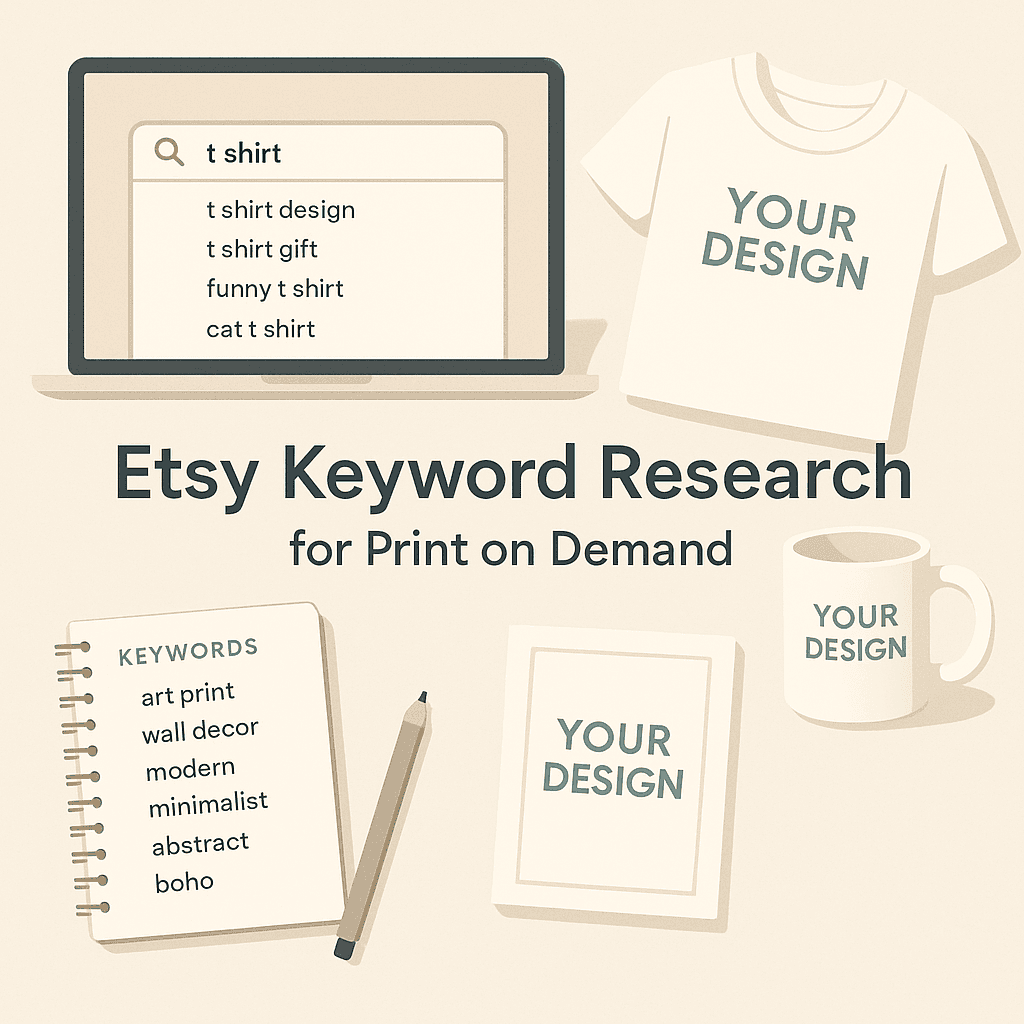
Day 2: Research Etsy keywords. Write down 30 phrases buyers actually type.
Day 3: Create 5 designs around one theme (a mini collection).
Day 4: Create mockups and size chart images.
Day 5: Publish 5 listings, fully optimized titles and tags.
Day 6: Create 5 more designs, same niche, different angles.
Day 7: Publish 5 more listings, then review what got views and favorites.
Then repeat weekly. That’s the game.
If you are using an automation tool like NinjaSell, the publishing days can be way faster, which helps you stay consistent without spending your whole life writing titles and generating mockups.
Final thoughts
Etsy print on demand is not “set and forget.” It is more like building a tiny product studio that happens to ship through a partner.
You win by being specific. By making designs for real people, not for “everyone.” By writing listings that match real searches. By showing the product clearly. And by not quitting before Etsy even has enough data to understand your shop.
Start narrow. Upload consistently. And if you decide to speed up the boring parts with automation, do it. Just keep control over the strategy.
That’s how beginner POD shops turn into real Etsy stores.
FAQs (Frequently Asked Questions)
What is Etsy Print on Demand and how does it work?
Etsy Print on Demand (POD) is a fulfillment model where you create a design, upload it to a product template like t-shirts or mugs, and list it on Etsy. When a customer orders, the print provider prints and ships the product directly to the customer, while you keep the profit margin after deducting production, shipping, and Etsy fees. You manage the storefront and marketing without handling inventory or shipping.
Is Etsy Print on Demand still worth pursuing in 2026?
Yes, Etsy POD can be profitable in 2026 because buyers visit Etsy with purchase intent. However, the market is saturated with generic designs. Success comes from choosing a specific niche with real demand, creating targeted products, writing SEO-friendly listings, presenting your products well, pricing strategically, and consistently uploading new designs.
How do I choose the right niche for my Etsy POD shop?
Avoid broad categories like ‘funny shirts’ or ‘cute mugs.’ Instead, pick niches based on who your customers are and why they’d buy your products. Good niches include identity groups (teachers, nurses), events (baby showers, graduations), hobbies (hiking, baking), micro-communities (booktok readers), or local pride themes. Specific niches improve Etsy SEO by matching buyer search queries.
Which Print on Demand products are best for beginners on Etsy?
Beginner-friendly POD products include shirts and sweatshirts (high demand but competitive), mugs (great gifts with simpler designs), posters and prints (premium look requiring good mockups), and tote bags (simple designs but trend-sensitive). It’s best to start with one main product type to streamline your process before expanding.
How should I price my Etsy POD products to ensure profitability?
Your sale price must cover print provider costs, shipping, Etsy listing and transaction fees, optional ads, and your design time. Beginners often underprice by copying competitors. Aim for at least a 30% profit margin after all costs. This margin helps cover refunds, run sales without losses, and invest in advertising or outsourcing later. Test pricing regularly rather than fixing it permanently.
What design tips help create successful Etsy POD listings?
Make sure your design is readable at thumbnail size since Etsy search results show small images. Match the design style to your niche’s taste—for example, minimalist for modern office prints versus glittery for cheer mom sweatshirts. Avoid trademarked content like celebrity names or brand slogans to prevent listing removal or shop suspension. Build small themed collections instead of many random designs to attract focused buyers.