Etsy SEO is one of those things that sounds boring until you realize it is basically the difference between “a few random sales” and “oh wow this is actually working”.
And for print on demand sellers, it matters even more. Because you are usually competing with people selling the same types of products, same blanks, sometimes even similar designs. So the advantage is not just the art. It is how your listing gets found, clicked, and purchased.
This guide is how I would explain Etsy SEO to a friend who is starting or trying to scale. Not fluffy. Not theory only. Just the stuff that moves listings.
How Etsy SEO actually works (in normal human terms)
Etsy has two big jobs:
- Figure out what a shopper is searching for.
- Decide which listings are the best match, and which ones are most likely to sell.
So Etsy looks at two categories of signals:
1) Relevance signals (what your listing is about)
This is mainly:
- Your title
- Your tags
- Your categories and attributes
- Your description (less important than people think, but not nothing)
- Your listing language and location context
2) Performance signals (how shoppers react)
This is the part people skip, then wonder why they are stuck on page 9.
- Click through rate from search (CTR)
- Favorites
- Add to cart
- Conversion rate (sales per views)
- Reviews and customer experience
- Shipping price and speed expectations
- Listing quality score over time (Etsy does not call it that publicly, but the behavior is obvious)
Here is the key idea: you can nail keywords and still not rank if your photos look weak or your price is off. Etsy wants buyers to buy.
So yes, we do keywords. But we also do “make the listing perform”.
Start with one product, one buyer, one intent
The fastest way to get Etsy SEO right is to stop thinking “I sell print on demand shirts” and start thinking:
Who is buying this. For what situation. What would they type.
Example:
- “Funny t-shirt” is vague. Too broad.
- “Funny introvert bookish shirt” is a buyer.
- “Book lover introvert tshirt” is closer to how people actually search.
For print on demand, your designs usually map to:
- A niche identity (teacher, nurse, golfer, dog mom)
- A moment (birthday, wedding, new baby, graduation)
- A style (minimalist, retro, y2k, gothic)
- A specific phrase or meme (careful with IP)
- A gift intent (“gift for dad who fishes”)
Intent is what turns keywords into sales.
Keyword research that does not melt your brain
You do not need a fancy tool to start. Etsy literally tells you what people search.
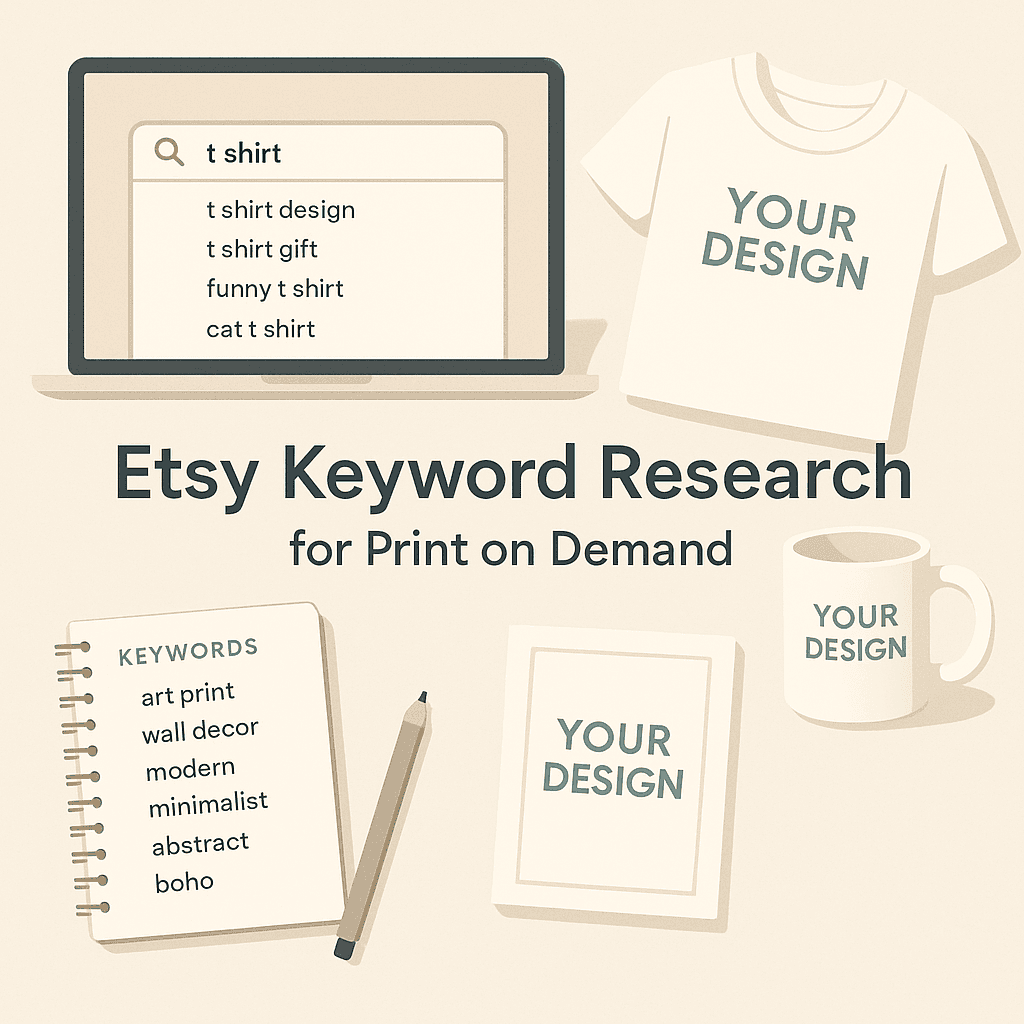
Step 1: Use Etsy search suggestions
Go to Etsy and type the start of your phrase. Example:
- “teacher shirt” Etsy might suggest:
- teacher shirt funny
- teacher shirt kindergarten
- teacher shirt first day of school
- teacher shirt comfort colors
Those suggestions are demand. Etsy is not guessing. It is reflecting what people type.
Write them down. Build a list.
Step 2: Click top listings and look for patterns (not copying)
Open the first page results and look at:
- Repeated words in titles
- Common tags (you cannot see tags directly, but you can infer from titles and categories)
- Product types and attributes used (unisex tee, comfort colors, sweatshirt)
- Photo style and mockups
- Price range and shipping
You are looking for the language buyers respond to.
Step 3: Build keyword clusters, not single keywords
Etsy is better at matching phrases than single words. So create clusters like:
Primary phrase
- bookish shirt
Secondary variations
- book lover shirt
- reader shirt
- bookstore shirt
- bookworm shirt
Long tail buyer intent
- gift for book lover
- introvert book lover shirt
- cozy reading shirt
Now each listing can focus on one primary phrase, with supporting phrases in tags and title.
If you try to target 12 different unrelated phrases in one listing, Etsy gets confused and you rank for none of them well.
Titles: what to write, and what to avoid
Etsy titles still matter a lot. But the goal is not “stuff as many keywords as possible”. The goal is:
- Lead with the best exact phrase
- Add a few close variations
- Keep it readable enough that a human wants to click
A solid Etsy POD title structure looks like this:
Primary keyword phrase + who it is for + style/material + gift intent
Example:
Book Lover Shirt, Cozy Reader Tee, Bookish Gift for Her, Literary Graphic T Shirt, Unisex Softstyle Tee
Is it a little clunky. Yes. Does it work. Usually, yes.
A few title rules that keep you out of trouble:
- Put your main keyword in the first 40ish characters if possible.
- Use commas or pipes. Do not overthink it.
- Do not repeat the exact same word 6 times.
- Avoid keyword spam that reads like a robot wrote it. Etsy shoppers bounce.
Also, do not put trademarks in titles. Not even “inspired by”. Etsy does not play.
Tags: the quiet ranking engine
You get 13 tags. Use them. All of them.
What matters most:
- Tags should be specific phrases, not single words.
- Mix: primary keywords, synonyms, buyer intent, and attributes.
Example for a “teacher retro sweatshirt” listing:
- teacher sweatshirt
- retro teacher shirt
- teacher crewneck
- teacher gift
- back to school top
- kindergarten teacher
- elementary teacher
- comfy teacher outfit
- school spirit wear
- educator shirt
- fall teacher sweatshirt
- first day of school
- teaching life
Notice how those are not random. They are all connected to the same buyer and context.
Tag tips that save you time
- You do not need plurals if you already used singular (Etsy understands close variants).
- You do not need to repeat words across tags obsessively, but some repetition is fine if the phrases are different.
- Misspellings are not necessary anymore. Etsy has improved there.
- Use multi word tags whenever possible. You have 20 characters per tag. Use them.
Categories and attributes: SEO you get “for free”
This is the part POD sellers rush through, then wonder why they rank weirdly.
When you choose a category like: Clothing and Shoes > Women > Tops and Tees > T-shirts
Etsy automatically assigns related attributes behind the scenes. Then you can also fill in:
- Type (t-shirt, sweatshirt, hoodie)
- Occasion (birthday, Christmas, etc)
- Color
- Sleeve length
- Neckline
- Material
- Fit (if available)
These attributes act like extra tags. Sometimes they matter as much as your tags because shoppers filter by them.
So do not skip them. Fill out every relevant attribute.
Descriptions: not a ranking lever, but a conversion lever
Descriptions probably do not boost ranking dramatically by themselves. But they absolutely affect sales. And sales affect ranking.
For POD, your description should answer:
- What is it (exact garment, print method)
- How it fits (unisex, true to size, size chart)
- How to order (choose size, color)
- Processing and shipping times
- Care instructions
- Returns and exchanges (especially important for POD)
Keep the first 2 lines strong because Etsy shows a preview on some devices.
Example opening: “Cozy unisex sweatshirt for teachers who live on coffee and lesson plans. Printed to order on a soft fleece blend, perfect for back to school season.”
Then go into bullets. People skim.
Photos and mockups: SEO’s best friend
Etsy is a marketplace. Shoppers decide in 1 second.
For print on demand listings:
- Use clean mockups that match your niche vibe.
- Show at least one close up.
- Show a size chart image.
- Use lifestyle images when possible.
- Make sure the first image is not cluttered. One clear product, readable design.
Higher CTR and higher conversion means Etsy learns “this listing satisfies searches” and it climbs.
This is why two listings with similar keywords can rank wildly differently.
Pricing and shipping: yes, it affects ranking indirectly
Etsy wants happy buyers. High shipping or surprise costs hurt conversion.
For POD sellers:
- Consider baking some shipping cost into price and offering “free shipping”. It can help conversion in some niches.
- Keep delivery expectations clear. Etsy penalizes shops that create bad experiences.
You do not have to race to the bottom. But you do have to be realistic. If the market is $19.99 and you are $34.99 with generic mockups, SEO will not save you.
Listing strategy that scales for print on demand
A common POD mistake is launching 200 designs with weak keyword focus.
A better strategy:
- Start with 20 to 40 listings in one niche
- Each listing targets one primary phrase
- You cover variations across the set
Example niche: “nurse humor” You create listings targeting:
- nurse shirt funny
- ICU nurse shirt
- ER nurse shirt
- nurse life shirt
- night shift nurse shirt
- labor and delivery nurse
Same buyer family. Different intents.
This builds topical authority inside Etsy search. Not an official term, but again, the behavior is real. Shops that consistently sell in a niche tend to get traction faster in that niche.
What about automation tools like NinjaSell (and why it matters for SEO)
If you are doing POD, the grind is not just design. It is:
- Creating listings
- Writing titles and tags
- Generating mockups
- Fulfilling orders correctly and on time
And those operational things feed back into SEO. Because better listings and faster fulfillment usually means better conversion and reviews.
NinjaSell is an AI print on demand company positioned around Etsy automation. The simple version is:
You upload your designs, NinjaSell automatically creates optimized Etsy listings, generates mockups, and fulfills print on demand orders with white label shipping.
So instead of you spending hours doing the “SEO formatting” parts manually, you can systemize it. The important part though is still the inputs. Even with automation, you want to:
- Feed it the right keyword cluster per design
- Keep each listing focused on one intent
- Check that the generated title is readable, not just stuffed
- Make sure attributes are filled properly
Automation does not replace strategy. It just makes it possible to scale strategy without burning out.
Tracking: how to know if Etsy SEO is working
Inside Etsy Stats, look at a few things weekly:
- Search terms: Are you getting impressions for the phrases you targeted?
- CTR: If impressions are high but clicks are low, your photos or title are not pulling weight.
- Conversion rate: If clicks are decent but sales are low, fix price, mockups, personalization clarity, or description.
- Favorites to sales: Lots of favorites but no sales can mean “cool design, not sure what I get” or price mismatch.
Give Etsy time to learn. But also, do not wait 60 days to fix obvious problems.
Quick fixes that usually improve ranking within a couple weeks
If a listing is stuck, try this order:
- Replace the first image with a clearer mockup.
- Tighten the title so the first phrase is exactly what people search.
- Rewrite tags to be more specific and less generic.
- Update attributes and make sure category is correct.
- Adjust price or shipping presentation.
- Improve the description opening and add a clean size chart image.
Then wait. Changing everything daily resets Etsy’s learning and you never get clean data.
The big mistakes POD sellers make with Etsy SEO
These show up constantly:
- Targeting super broad keywords like “shirt” or “gift”.
- Using the same tags on every listing, even when designs are different.
- Listing in the wrong category (hoodie listed as t-shirt, etc).
- Ignoring attributes.
- Poor mockups that tank CTR.
- Titles that look like spam, so humans do not click.
- Chasing trends that are actually protected IP.
And yeah, the harsh one. Uploading hundreds of designs with no keyword plan, hoping Etsy magically sorts it out.
Simple Etsy SEO checklist (save this)
Before you publish a POD listing:
- One clear niche and intent
- Primary keyword phrase in the first part of the title
- Title includes 2 to 4 close variations, readable
- All 13 tags used, mostly multi word phrases
- Correct category and all relevant attributes filled
- First photo is clean, high contrast, easy to understand
- Size chart image included
- Description includes garment details, shipping, care, and returns policy
- Price and shipping are competitive for the niche
If you do that consistently, Etsy has enough information to place you correctly. Then performance takes over.
Wrap up (what I would do if I was starting today)
I would pick one niche, make 30 strong listings, and obsess over making them click worthy. Not just keyword stuffed. Actually good.
Then I would scale what sells. More variations, more phrases around the same buyer. And I would probably automate the repetitive parts, especially listing creation, mockups, and fulfillment, because doing that manually is where most POD sellers burn out. That is also where a tool like NinjaSell can fit, since it is built to create optimized Etsy listings, generate mockups, and fulfill orders with white label shipping.
Etsy SEO is not a one time trick. It is a loop.
Keyword targeting gets you shown. Good listings get you clicked. Great buying experience gets you sales. Sales tell Etsy to show you more.
That is the game.
FAQs (Frequently Asked Questions)
What is Etsy SEO and why is it crucial for print on demand sellers?
Etsy SEO is the process of optimizing your Etsy listings so they appear higher in search results, leading to more visibility and sales. For print on demand sellers, it’s especially important because you often compete with others selling similar products and designs. Effective Etsy SEO ensures your listings get found, clicked, and purchased, turning random sales into consistent success.
How does Etsy’s search algorithm decide which listings to show?
Etsy’s algorithm focuses on two main categories of signals: relevance and performance. Relevance signals include your listing’s title, tags, categories, attributes, description, language, and location context—essentially what your listing is about. Performance signals involve how shoppers interact with your listing, such as click-through rate (CTR), favorites, add to cart actions, conversion rate, reviews, shipping price and speed, and overall listing quality over time.
How should I approach keyword research for my Etsy print on demand listings?
Start simple by using Etsy’s own search suggestions. Type phrases related to your product into Etsy’s search bar and note the autocomplete suggestions—they reflect real buyer demand. Then analyze top listings for common keywords, tags, photo styles, prices, and shipping options. Finally, build keyword clusters combining primary phrases with related variations and buyer intent phrases to optimize your listings effectively.
What is the best way to craft an effective Etsy listing title?
Your title should lead with the best exact keyword phrase followed by who the product is for, style or material details, and gift intent if applicable. Keep it readable and avoid keyword stuffing or repetition. For example: ‘Book Lover Shirt, Cozy Reader Tee, Bookish Gift for Her, Literary Graphic T Shirt, Unisex Softstyle Tee’. Place your main keyword within the first 40 characters if possible and use commas or pipes for clarity.
How can I effectively use tags to improve my Etsy SEO?
Use all 13 tags available and focus on specific phrases rather than single words. Include a mix of primary keywords, synonyms, buyer intent terms, and relevant attributes that connect logically to your target buyer and product context. For example: ‘teacher sweatshirt’, ‘retro teacher shirt’, ‘teacher gift’, ‘first day of school’. Avoid random or unrelated tags to maintain relevance.
Why do performance signals like photos and pricing matter in Etsy SEO?
Even if you nail keywords perfectly, weak photos or incorrect pricing can hurt your ranking because Etsy wants buyers to complete purchases. Performance signals such as attractive photos that encourage clicks and reasonable pricing that leads to sales influence your listing’s success in search rankings. Optimizing these factors helps improve click-through rates and conversion rates essential for high Etsy SEO performance.