If you’re new on Etsy, SEO can feel like this weird game where everyone is speaking in code. Tags. Attributes. Titles. “Relevancy.” And then you post a listing you know is good… and it gets 3 views in a week. Painful.
Here’s the truth though. Etsy SEO is not magic. It’s mostly matching. Matching what someone types into that search bar with what your listing is clearly about. That’s it.
So this guide is the best Etsy SEO strategy for new sellers, the version that actually works in 2026 without turning your shop into a keyword robot. We’ll go step by step. What to do first, what to ignore, what to repeat, and how to make Etsy understand you fast.
And yes, if you’re doing print on demand, I’ll show you how to scale this without manually building 100 listings one by one. Because that burns people out.
How Etsy SEO really works (quick mental model)
Etsy wants two things:
- Help shoppers find what they want quickly.
- Make the sale, because Etsy makes money when you do.
So Etsy ranks listings using a mix of:
- Query matching (do your keywords match the search?)
- Listing quality signals (do people click, favorite, buy?)
- Shop and customer experience (reviews, on time shipping, cases)
- Recency boost (new or recently renewed listings get a small push)
- Price, shipping, location, personalization (varies by shopper)
New sellers obsess over the last stuff. But your first wins come from query matching and making a listing that people actually click once they see it.
Let’s build that.
Step 1. Pick one niche, not “everything I can make”
If you sell “t shirts, mugs, stickers, wall art, tote bags, birthday gifts, wedding stuff, and digital downloads” you’re not being versatile. You’re being confusing. To Etsy. And to humans.
When you start, pick a tight lane like:
- Funny hiking shirts for women
- Minimalist nursery wall prints
- Dog mom sweatshirts
- Teacher appreciation gifts
- Wedding favor stickers
One lane. For now.
Why this matters for SEO:
- Your keywords become consistent across listings.
- Etsy starts learning who your shop is for.
- Your shop builds topical authority, basically. Etsy sees patterns.
Even 20 listings in one niche can outperform 200 random ones.
Step 2. Do keyword research the Etsy way (not the Google way)
Etsy keyword research is about buyer language. What they actually type.
The easiest method: Etsy search bar suggestions
Go to Etsy and type the start of a phrase, like:
- “teacher shirt”
- “teacher tshirt”
- “teacher gift”
Etsy will autocomplete with real searches like:
- teacher shirt funny
- teacher shirt kindergarten
- teacher shirt for women
- teacher gift shirt
Those suggestions are gold. They come from demand.
Write them down.
The second method: Category breadcrumbs
When you click into a category, Etsy shows filters and subcategories. Those often reflect high volume terms and attributes Etsy understands.
The third method: Competitor listing scanning (but do it smart)
Open a few bestsellers in your niche and look at:
- Their titles (first 50 to 80 characters especially)
- Their tags (you can’t see tags directly, but you can infer from repeated phrases)
- Their variations and personalization
- Their photo style and first image
Do not copy. Just notice patterns.
What you’re looking for: 3 types of keywords
You want a mix:
1. Main keyword (high intent)
Example: “teacher shirt”
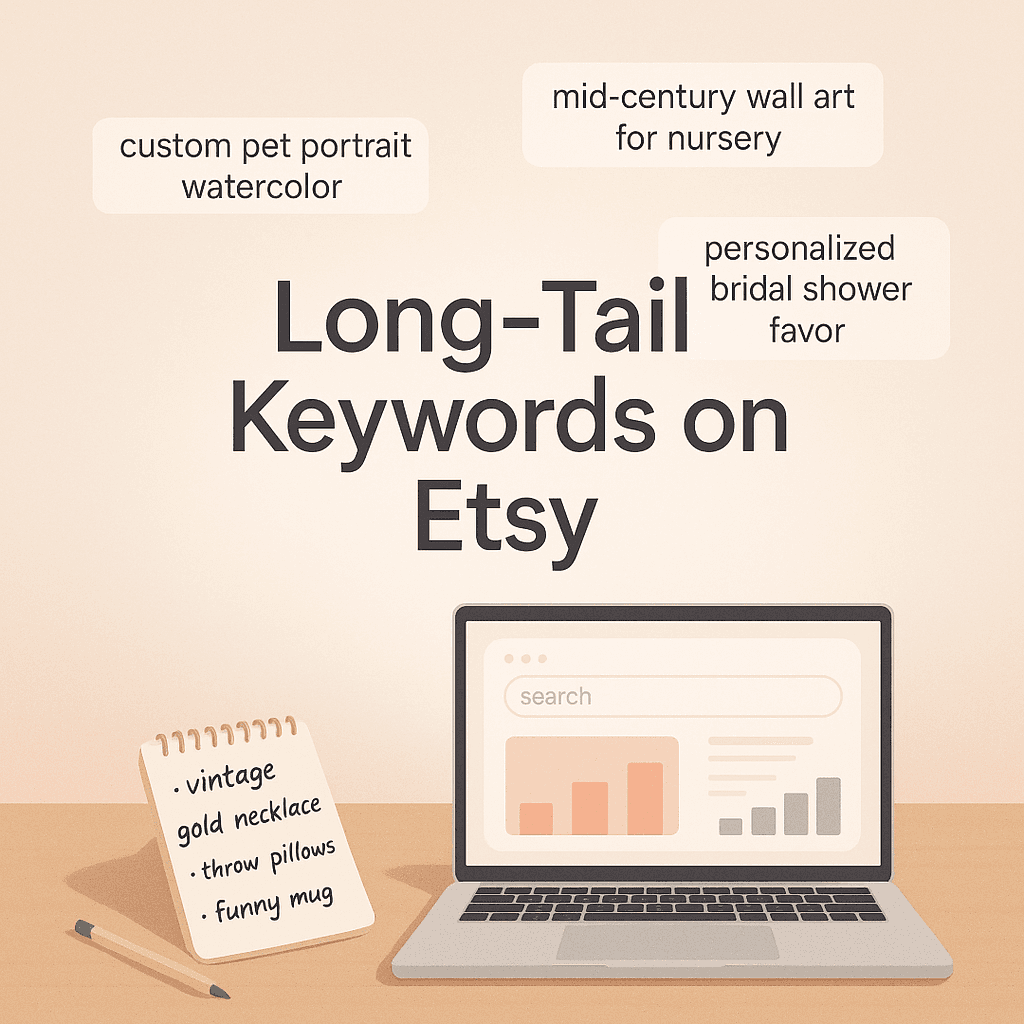
2. Long tail keyword (specific)
Example: “funny kindergarten teacher shirt”
3. Attribute keyword (Etsy filter language)
Example: “women’s”, “unisex”, “crewneck”, “sweatshirt”, “custom name”
The trick is not choosing the fanciest keyword. It’s choosing the clearest buyer intent.
If someone searches “gift for teacher from student” that person is ready. That’s money. Versus “teacher aesthetic” which might just be browsing.
Step 3. Build a simple keyword map for every listing
This is where new sellers level up fast.
Before you write anything, map it like this:
- Primary keyword: the exact phrase you want to rank for
- Secondary keywords: 3 to 5 close variations
- Occasion keywords: 1 to 2 (if relevant)
- Recipient keywords: 1 to 2 (who it’s for)
Example for a print on demand tee:
- Primary: funny kindergarten teacher shirt
- Secondary: kindergarten teacher tshirt, teacher shirt funny, kinder teacher tee, teacher life shirt
- Occasion: teacher appreciation, back to school
- Recipient: teacher gift, gift for teacher
Now every part of your listing pulls from this map. Title, tags, description, even image text overlays if you use them.
You stop guessing.
Step 4. Write titles for Etsy, not for your English teacher
Etsy titles are still important, but not in the old spammy way where people cram 30 phrases with commas. You want readable, front loaded, and specific.
A good Etsy title formula
Primary keyword + main design detail + recipient/occasion + product details
Example:
Funny Kindergarten Teacher Shirt, Teacher Life T Shirt, Back to School Gift for Teachers, Unisex Softstyle Tee
That’s not poetry. It’s clear.
Title rules that actually help
- Put the primary keyword first (first 40 characters matters a lot).
- Use natural phrases, not random fragments.
- Don’t repeat the exact same word 5 times.
- Use separators like commas or pipes. Keep it clean.
- Include the product type: shirt, sweatshirt, mug, poster, sticker.
Also, don’t overthink singular vs plural. Etsy can usually handle it.
Step 5. Tags: use all 13, and stop wasting them
Etsy gives you 13 tags. Use them all. And treat them like 13 separate doors into your listing.
Tag strategy for new sellers
- Use multi word tags (up to 20 characters).
- Use close variations, not repeats.
- Mix intent types.
Example tag set for the teacher shirt:
- funny teacher shirt
- kindergarten shirt
- teacher gift
- teacher life tee
- back to school tee
- teacher appreciation
- gift for teacher
- kinder teacher tee
- teacher tshirt
- unisex teacher tee
- cute teacher shirt
- school teacher gift
- classroom outfit
You’ll notice some overlap. That’s okay. But avoid exact duplicates like “teacher shirt” and “teacher shirts” if you can swap one out for something more specific.
One more thing people miss
Tags don’t need to be grammatical. They just need to match searches.
“gift for teacher” is good. “for the teacher gift” is weird and less likely to be searched.
Step 6. Categories and attributes are basically hidden keywords
This is huge.
When you choose the right category and fill out attributes (color, size, occasion, recipient, sleeve length, etc.), Etsy uses that info like additional matching signals.
So don’t rush through it.
If you sell a shirt, choose the most specific category possible. Not just “Clothing” then stop. Go deep.
Then fill out:
- Who it’s for
- Type
- Occasion
- Primary color (even if it varies, pick your most common)
- Style options (crewneck, v neck, etc.)
These attributes help you show up when shoppers filter results. Which they do a lot, especially on mobile.
Step 7. Your first photo is an SEO factor, in a sneaky way
Etsy says SEO is keywords. True. But clicks matter. And your photo is what wins the click.
If your listing shows up in search and nobody clicks, Etsy learns it’s not a good result for that keyword.
So treat your main photo like a billboard.
What tends to work (especially for print on demand)
- Clean mockup, not cluttered
- Design large enough to read on mobile
- Neutral background
- Consistent style across your shop (so it looks real, not random)
For apparel, lifestyle mockups often beat flat lays. But it depends on niche. Test it.
Also, try not to use 10 different mockup styles across 10 listings. That makes your shop look like a collage.
Step 8. Descriptions: not the ranking lever people think, but still important
Descriptions help conversion more than ranking. Etsy does index descriptions to some extent, but it’s not the main driver like tags, titles, attributes.
Still, a good description increases sales, and sales increase ranking. So yes. It matters.
Simple description structure that works
- First 1 to 2 lines: restate what it is, with the primary keyword naturally.
- Bullet points: materials, fit, sizing, production time.
- Gift info: who it’s for, occasions.
- Care instructions (for apparel).
- How to order, personalization if any.
- Shop policies and support.
Keep it human. Like you’re helping someone buy, not trying to impress an algorithm.
Step 9. Start with fewer listings, but make them tight
This might sound backwards, especially if you’re doing print on demand and you can theoretically upload endless designs.
But in the beginning, your goal is feedback.
You want to find:
- Which designs get clicks
- Which keywords get impressions
- Which products convert
If you upload 300 messy listings, you’ll learn slower. Because you won’t know what worked. It’s just noise.
A strong plan for a new shop:
- 20 to 40 listings in one niche
- Same mockup style
- Same general price range
- Keyword mapped properly
- Variations filled correctly
Then iterate.
Step 10. Use Etsy Stats like a detective, not like a scoreboard
Go to Shop Manager → Stats.
Look at:
- Search terms bringing visits
- Listings with high views but low orders (conversion problem)
- Listings with low views (SEO problem)
If you see a search term like “teacher shirt funny” bringing visits, make sure:
- It’s in your tags or title
- The listing photo matches that vibe
- The price isn’t way off compared to the page you’re on
If you see irrelevant search terms, it usually means your keywords are too broad. Tighten.
Step 11. The repeatable weekly SEO routine (new seller friendly)
Here’s a schedule that doesn’t make you lose your mind.
Once per week
- Optimize 5 listings (title, tags, attributes)
- Add 2 to 5 new listings based on what’s already getting impressions
- Improve 1 main photo (your worst performer)
Once per month
- Refresh underperforming listings (new photos, new keyword map)
- Build 1 small collection for a seasonal event (Mother’s Day, back to school, Halloween)
This is boring work. But boring work wins on Etsy.
Step 12. Print on demand SEO at scale, without the chaos
Now the part a lot of people struggle with. POD sellers usually fail for one of two reasons:
- They upload too many generic designs and nobody cares.
- They try to do everything manually, burn out, disappear.
If you want to scale, you need a repeatable process for listing creation. Especially for SEO and mockups, because those take time.
This is where tools can help, as long as you still control the strategy.
For example, NinjaSell is an AI print on demand automation tool built specifically for Etsy. The basic idea is simple:
- You upload your designs
- NinjaSell automatically creates optimized Etsy listings
- It generates mockups
- It fulfills print on demand orders with white label shipping
The reason this matters for SEO is consistency.
Because the hard part is not writing one good title. It’s writing 50 good titles that don’t overlap, with clean tags, correct attributes, solid mockups, and a workflow you can repeat every week.
Automation helps you move faster, but you still want to do the keyword mapping first. Always. Otherwise you just scale the wrong thing.
So think of it like this:
- You decide the niche and keyword plan.
- NinjaSell helps you produce the listings and fulfill orders without you babysitting every step.
That’s a much healthier way to grow a POD shop.
Common Etsy SEO mistakes new sellers make (and how to fix them)
Mistake 1: Using single word tags
“gift” is useless. Too broad. You want “gift for teacher” or “teacher appreciation”.
Mistake 2: Copying a competitor title word for word
You end up competing head on with a listing that has 5,000 sales. You will lose, at least early on. Go long tail and specific.
Mistake 3: Listing in the wrong category
Etsy can’t match you properly if you don’t tell it what the product is. Choose the most specific category you can.
Mistake 4: Ignoring attributes
Attributes are free keywords. Fill them.
Mistake 5: Keyword stuffing titles
Readable titles convert better. Conversion helps ranking. Keep it clean.
Mistake 6: Changing everything every two days
Give listings time to collect data. If you keep rewriting tags constantly, you never learn.
A decent testing window is usually 2 to 4 weeks unless something is clearly broken.
A simple “best Etsy SEO strategy” checklist
Use this for every new listing:
- One niche aligned keyword map
- Primary keyword at the start of the title
- Title is readable and includes product type
- All 13 tags used, mostly long tail phrases
- Correct category chosen (specific)
- Attributes filled fully
- First photo clear on mobile, consistent style
- Description helps buyer choose sizing, shipping, gift use
- Price and shipping competitive for the niche
If you do only this, and you keep doing it, you will be ahead of a lot of Etsy sellers. Because most people don’t.
Final thoughts
Etsy SEO for new sellers is less about hacks and more about clarity.
Clear niche. Clear keywords. Clear listing structure. Clear photos.
Then repeat. Slowly at first, then faster. And if you’re doing print on demand, you’ll probably want some level of automation as you scale, because otherwise you’re spending your life generating mockups and copy pasting tags. Tools like NinjaSell are built for that exact problem.
But the strategy part is still you. That’s the part that makes Etsy understand what you sell, and who should see it.
Do the basics really well, give it time, watch the stats, adjust. That’s the game.
FAQs (Frequently Asked Questions)
What is the main concept behind Etsy SEO for new sellers?
Etsy SEO is primarily about matching what buyers type into the search bar with what your listing clearly describes. It’s not magic but a process of aligning keywords and listing content to shopper intent.
Why should I focus on one niche instead of selling a variety of unrelated products?
Focusing on one niche helps your keywords become consistent, allows Etsy to understand who your shop serves, and builds topical authority. This targeted approach leads to better SEO performance than having many random listings.
How can I do keyword research effectively on Etsy?
Effective Etsy keyword research involves using the Etsy search bar suggestions to find real buyer phrases, exploring category breadcrumbs for high-volume terms, and smartly analyzing competitor listings to identify common keywords without copying them.
What types of keywords should I include in my Etsy listings?
You should include a mix of three types: main keywords with high buyer intent (e.g., ‘teacher shirt’), long-tail keywords that are more specific (e.g., ‘funny kindergarten teacher shirt’), and attribute keywords that match Etsy filters (e.g., ‘women’s’, ‘unisex’, ‘crewneck’).
How do I build a keyword map for each Etsy listing?
Create a simple keyword map before writing your listing, including a primary keyword, 3-5 secondary close variations, 1-2 occasion keywords if relevant, and 1-2 recipient keywords. This ensures all listing elements like title, tags, and description align with clear buyer intent.
What are best practices for writing Etsy titles that help SEO?
Write readable, front-loaded titles starting with the primary keyword within the first 40 characters. Use natural phrases separated by commas or pipes, avoid repeating words excessively, include product type (like shirt or mug), and make titles clear rather than spammy.