Etsy SEO is one of those things people either overcomplicate… or completely ignore until they’re three months in and still making two sales a week (one of them is their mom).
The truth is, ranking on Etsy is not magic. It’s mostly just being the most relevant listing for a specific search, with enough signs that shoppers actually like what they see when they land on your page.
So below are the Etsy SEO tips that actually move the needle. Not theory. The stuff you can do today, in the right order, and start seeing your listings climb.
First, what Etsy SEO is actually doing (in plain English)
When someone types something into Etsy, Etsy tries to:
- Understand what the shopper wants.
- Find listings that match that intent.
- Rank them based on how likely they are to get clicked and purchased.
So your job is basically two things:
- Tell Etsy exactly what your product is (relevance).
- Make shoppers respond well to it (performance).
Most “SEO tips” only talk about keywords. Keywords matter. But on Etsy, keywords are the entry ticket. The listing performance is what helps you stay up there and climb.
Alright. Let’s get into the good stuff.
1. Stop targeting broad keywords. Go specific and win smaller battles first.
A newer or average Etsy shop usually won’t outrank the giants for something like:
- “t shirt”
- “wall art”
- “wedding gift”
Those are just too broad. Everyone is fighting there.
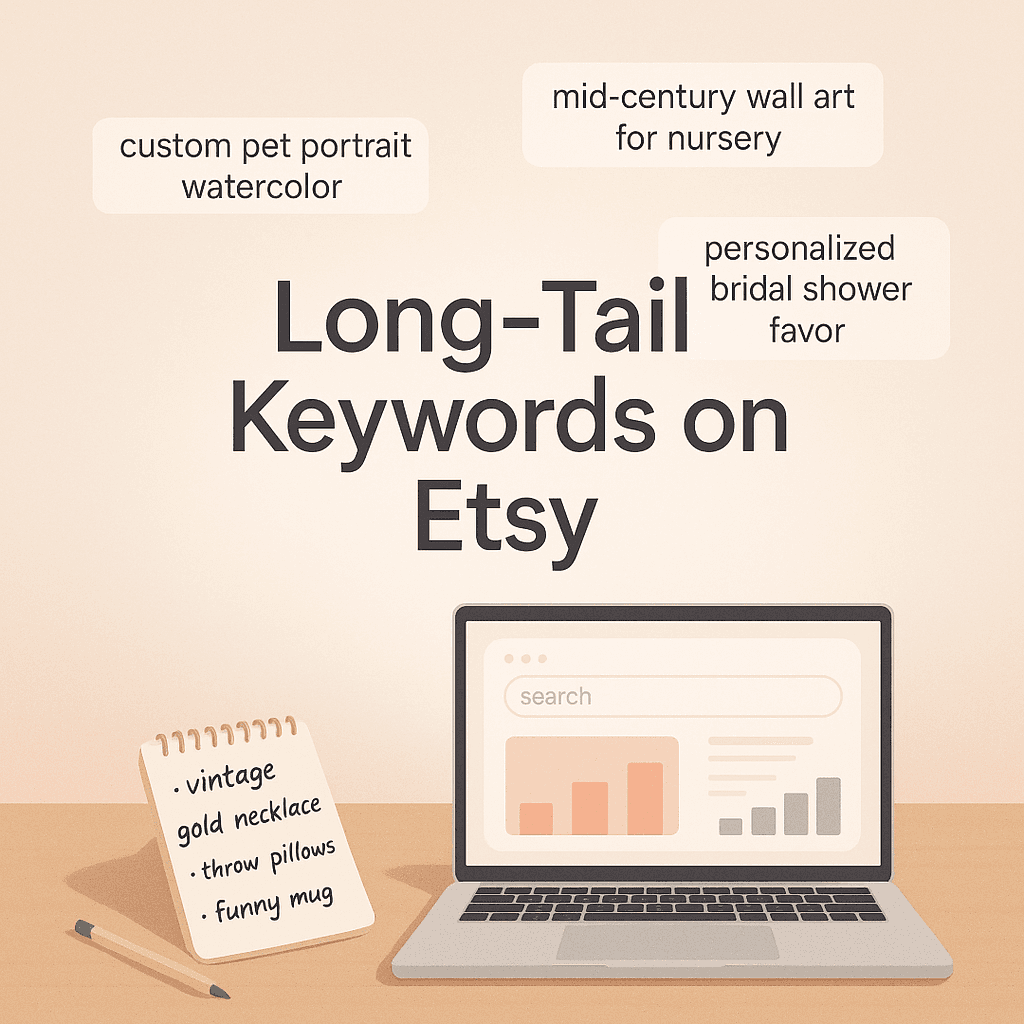
Instead, you want keywords that are:
- specific
- buyer intent focused
- less competitive
- still searched enough to matter
Examples (just to show the pattern):
- “minimalist line art print set of 3”
- “custom pet portrait sweatshirt”
- “funny dad fishing t shirt”
- “boho nursery wall art neutral”
You’re not trying to get all traffic. You’re trying to get the right traffic.
Quick test
If your keyword could describe 50,000 different products, it’s probably too broad.
2. Nail your title. Not pretty. Not clever. Just clear and keyword led.
Etsy titles still matter a lot for ranking. And no, you don’t need titles that look like a spammy keyboard smash… but you do need clarity.
A strong Etsy title usually looks like:
- Primary keyword first
- Then 1 to 2 close variations
- Then details shoppers care about (style, recipient, occasion, material, etc.)
Example structure:
Primary Keyword | Variation | Recipient or Use | Style/Feature
Example:
Custom Pet Portrait Sweatshirt, Dog Mom Gift, Personalized Animal Sketch Hoodie, Minimal Line Art
Not poetic. Not cute. But Etsy immediately gets it, and shoppers do too.
Little rule I use
If the first 5 to 8 words of your title don’t describe the product clearly, rewrite it.
3. Use all 13 tags, but don’t waste them repeating the same thing
Etsy gives you 13 tag slots. Use them. Every time.
But don’t do this:
- “dog mom gift”
- “gift for dog mom”
- “dog mom present”
Yes, they’re related. But you’re burning space you could use for different search paths.
Instead, think like this:
- 3 to 5 tags = your main keyword and close variants
- 4 to 6 tags = adjacent intents (recipient, occasion, style, vibe)
- 2 to 4 tags = long tail specifics (material, color, niche phrases)
Example for a “funny fishing dad shirt” listing:
- funny fishing shirt
- dad fishing gift
- fisherman tshirt
- bass fishing tee
- lake life shirt
- outdoorsy dad gift
- mens graphic tee
- weekend fishing top
- fathers day shirt
- retirement fishing gift
- funny dad shirt
- fishing lover gift
- gift for fisherman
You’re basically casting multiple hooks, without repeating the same bait 13 times.
4. Match your tags to your title (not 1:1, but intentionally)
Etsy SEO works best when your title and tags support the same topic.
You don’t have to copy your full title into tags. But your main phrase should show up in both places.
So if your title is about a “custom pet portrait sweatshirt”, and your tags are mostly like:
- “cute hoodie”
- “comfy sweatshirt”
- “winter top”
…that’s a mismatch. Etsy isn’t getting a strong, consistent signal.
A simple approach:
- Make sure your #1 and #2 tag phrases appear in your title.
- Make sure your title includes at least a few words that appear across your tags.
5. Don’t ignore categories and attributes. Etsy treats them like keywords too.
This one’s underrated.
When you pick a category like:
Clothing > Unisex Adult Clothing > Hoodies & Sweatshirts
You’re telling Etsy extra context. Same with attributes like:
- color
- size
- occasion
- material
- room (for wall art)
- holiday
- recipient
These act like “built in tags” in many cases. And shoppers filter by them constantly, which helps you show up in filtered search too.
So… fill them out. All of them that make sense.
6. Write descriptions for humans first, but sprinkle in keywords naturally
Etsy says descriptions don’t carry the same SEO weight they used to, but they still matter for:
- conversion (which impacts ranking)
- Google indexing (yes, external traffic can help)
- buyer confidence (less messages, fewer refunds)
The best descriptions aren’t long essays. They’re skimmable and practical.
A simple format that works:
- 2 to 3 lines: what it is, who it’s for, what makes it special
- Bullet points: sizes, materials, shipping info, personalization steps
- Short FAQ style section
- Care instructions (for apparel)
- Gentle reminder about processing times
And yes, use your primary keyword once or twice naturally, especially near the top.
Not like this:
“This custom pet portrait sweatshirt custom pet portrait sweatshirt custom pet portrait sweatshirt…”
Just. Don’t.
7. Your main photo is part of SEO, because CTR matters
Etsy doesn’t rank listings only on keywords. It watches behavior.
If your listing shows up and nobody clicks it, it drops. If people click it a lot, it climbs.
So your first image matters more than most SEO tricks.
Quick photo upgrades that usually increase clicks:
- clean background
- product fills the frame
- readable design (especially on shirts and posters)
- lifestyle shot that matches the buyer vibe
- consistent style across your shop (it builds trust fast)
With print on demand, mockups matter a lot. Not “a lot” like “nice to have”. A lot like “this is your storefront window”.
8. Conversion rate is your silent ranking weapon
Etsy wants buyers to buy. So listings that convert tend to get rewarded.
Things that improve conversion (and help rankings indirectly):
- competitive pricing (or at least justified pricing)
- clear personalization instructions
- fast processing times
- shipping that doesn’t scare people off
- social proof: reviews, photos from buyers
- strong FAQs and shop policies
One weird but real tip: if you’re getting views but no sales, don’t assume it’s traffic. It’s usually the listing page.
Fix the offer, the photos, or the clarity.
9. Keep listings fresh, but don’t randomly edit everything every day
There’s a common Etsy seller habit where they panic edit titles and tags daily.
Sometimes that helps. Usually it just resets the data Etsy is collecting on your listing, and you end up confused about what worked.
A better approach:
- give a listing at least 2 to 4 weeks (unless it’s clearly broken)
- make one meaningful change at a time
- track views, clicks, favorites, conversion
If a listing is getting impressions but low clicks, fix photos and title. If it’s getting clicks but low sales, fix price, description clarity, mockups, or shipping.
10. Make more listings. Seriously. Etsy rewards depth.
Etsy is one of the few platforms where “more good listings” is a legitimate growth strategy.
Why?
Because each listing is another chance to rank for a different long tail phrase.
If you have 15 listings, you’re basically fishing with one rod. If you have 150 listings, you’ve got a whole net in the water.
This matters a lot for print on demand sellers because you can create variations without holding inventory.
Just keep quality high. Don’t copy paste the same thing 200 times with different colors.
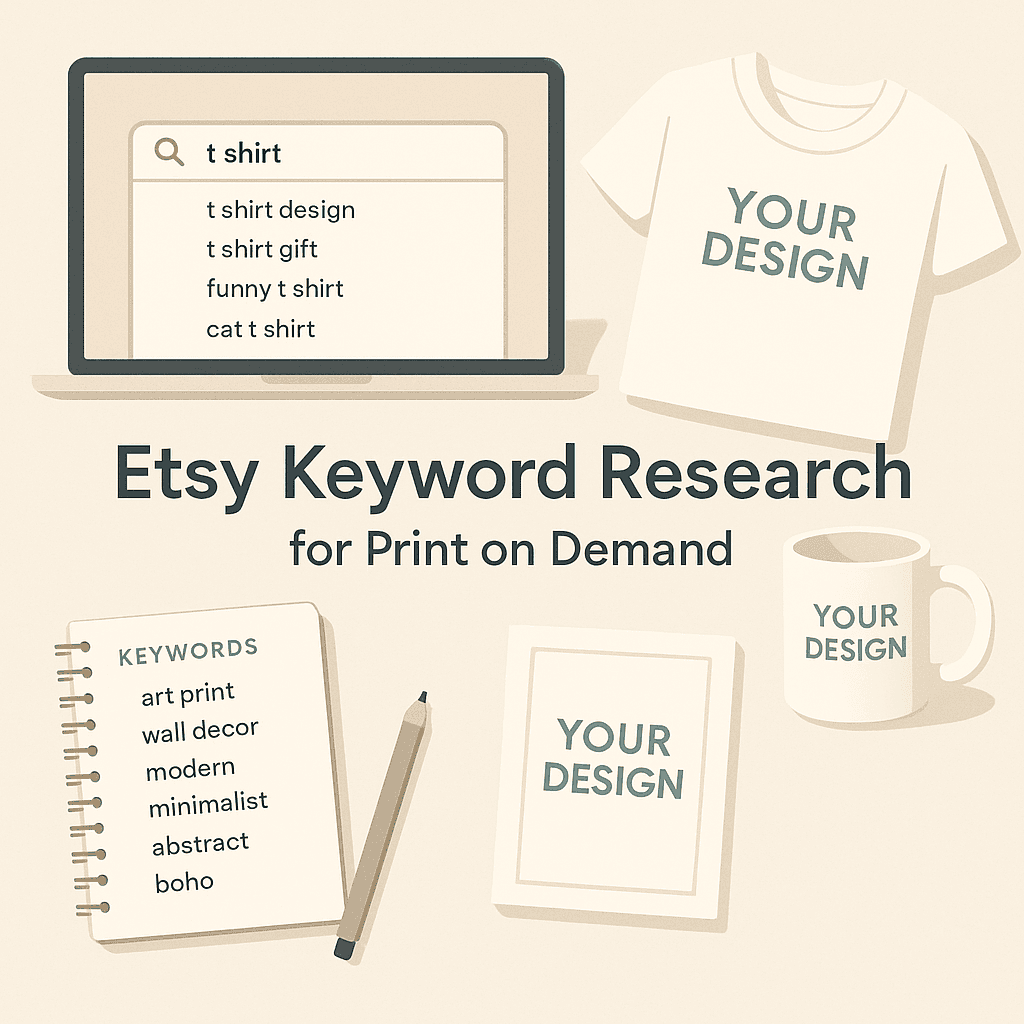
11. Use Etsy search like a free keyword tool (it’s sitting right there)
Go to Etsy and start typing your main keyword. The autocomplete suggestions are real searches.
Type:
- “custom pet portrait…”
- “boho wall art…”
- “funny dad shirt…”
Write down what Etsy suggests.
Those phrases are pure gold because they are literally Etsy telling you what buyers search.
Also, scroll down on a top listing and look at the “tags” section (many listings show related terms). That’s more keyword inspiration.
12. Don’t split keywords across multiple tags like it’s 2018
You might hear advice like:
Use one word per tag. Etsy will mix and match.
Etsy does mix and match, but in practice, exact phrase matching still matters a lot for long tail searches.
So prefer:
- “funny fishing shirt”
Over splitting into:
- funny
- fishing
- shirt
Use phrase tags whenever possible. That’s usually how buyers search anyway.
13. The fastest way to scale Etsy SEO is to systematize listing creation
This is where most Etsy sellers hit a wall.
They understand SEO. They know they should create more listings, test more keywords, improve photos.
But then reality shows up.
- writing optimized titles takes time
- tags take time
- mockups take time
- order fulfillment takes time
- and suddenly you’re doing everything except designing
If you’re running print on demand, automation can help a lot here.
Example: NinjaSell (for POD sellers who want to move faster)
NinjaSell is an AI print on demand company built around Etsy automation.
The core idea is simple: you upload your designs, and NinjaSell automatically:
- creates optimized Etsy listings
- generates mockups
- fulfills print on demand orders
- ships with white label shipping
So instead of spending your whole Sunday writing 30 titles and resizing mockups, you can focus on what actually grows the shop. Better designs, better niches, better offers.
Is automation a replacement for knowing SEO? Not really.
But it makes it easier to execute the boring parts consistently, and that’s usually what separates “I have 20 listings” from “I have 300 listings and steady daily orders”.
A quick Etsy SEO checklist (save this)
Before you publish a listing, check:
- Primary keyword is at the start of the title
- Title includes 1 to 2 close variations
- All 13 tags used, mostly phrase based, not repetitive
- Category is correct and specific
- Attributes filled out (color, occasion, material, etc.)
- First photo is clear and scroll stopping
- Description is skimmable and answers basic questions
- Pricing and shipping make sense for the niche
- Personalization steps are obvious (if applicable)
Let’s wrap this up
If you want to rank your Etsy listings faster, don’t obsess over one tiny SEO trick. Focus on the full loop.
Get the keywords right. Yes.
But also get the click. Get the sale. Get the review. Then repeat that process across more listings.
That’s how Etsy shops grow. It’s not glamorous. It’s just consistent.
And if you’re doing print on demand, tools like NinjaSell can take a huge chunk of the repetitive work off your plate, so you can scale faster without burning out.
FAQs (Frequently Asked Questions)
What is Etsy SEO and why is it important for my shop?
Etsy SEO is the process of optimizing your product listings so they rank higher in Etsy search results. It’s important because Etsy aims to show shoppers the most relevant listings that match their intent and are likely to be clicked and purchased. Good SEO helps your listings get discovered by the right buyers, increasing your sales potential.
How do I choose the right keywords for my Etsy listings?
Avoid broad keywords like “t shirt” or “wedding gift” that have too much competition. Instead, target specific, buyer-intent focused keywords that are less competitive but still searched enough to matter. For example, use phrases like “minimalist line art print set of 3” or “custom pet portrait sweatshirt” to attract the right traffic.
What’s the best way to write an effective Etsy listing title?
Your title should be clear and keyword-led, not overly clever or spammy. Start with your primary keyword, followed by 1-2 close variations, then details shoppers care about such as style, recipient, or occasion. For example: “Custom Pet Portrait Sweatshirt, Dog Mom Gift, Personalized Animal Sketch Hoodie, Minimal Line Art.” If the first 5-8 words don’t clearly describe your product, rewrite it.
How should I use tags on Etsy to improve my SEO?
Use all 13 tag slots provided by Etsy without repeating the same phrase in different forms. Allocate tags as follows: 3-5 for main keywords and close variants; 4-6 for adjacent intents like recipient or occasion; 2-4 for long-tail specifics such as material or color. This strategy casts multiple hooks to capture diverse search paths effectively.
Why is it important to match my tags with my title on Etsy?
Etsy SEO works best when your title and tags support the same topic consistently. Your main keyword phrase should appear both in your title and among your top tags. This alignment sends a strong signal to Etsy’s algorithm about what your product is, improving your chances of ranking well for relevant searches.
Should I fill out categories, attributes, and descriptions fully on Etsy?
Yes! Categories and attributes act like built-in tags that provide extra context to Etsy about your product. Filling them out helps you appear in filtered searches shoppers frequently use. Descriptions should be written for humans first—clear, skimmable, and practical—while naturally including keywords to boost conversion and external traffic from Google.