If you have ever stared at your Etsy title box and thought, wait, do I write for humans or for the Etsy search robot. Yeah. Same.
And if you have watched a few Etsy SEO videos, you have probably heard some version of this advice:
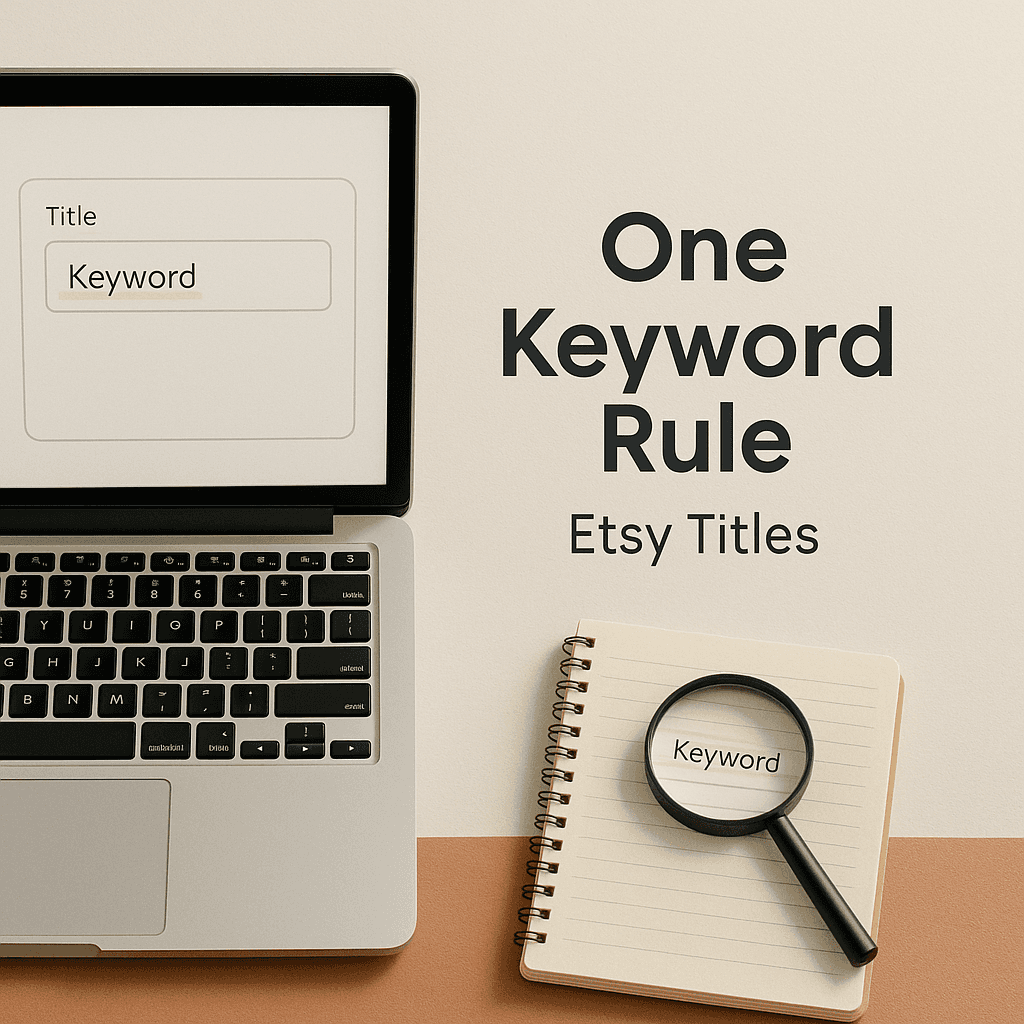
Use one main keyword per title.
People call it the “One Keyword” rule. And it sounds almost too simple. Like, surely you need to cram more in there, right?
But the truth is, this rule is less about using fewer words and more about avoiding a weird, messy title that tries to be everything at once. Etsy is better at matching phrases than most people think. And buyers are way better at ignoring keyword soup than we want to admit.
So let’s break it down properly. What it means, why it works, when it does not, and how to write titles that still rank without looking like a ransom note.

What people mean by the “One Keyword” rule
In plain English, it means:
Pick one primary search phrase you want this listing to rank for. Then build the title around it.
Not one word. One keyword phrase.
So instead of thinking “keyword = mug”, think:
- “cat mom mug”
- “personalized teacher mug”
- “funny birthday mug for her”
- “boho rainbow wall art”
That is the keyword.
Everything else in the title is supporting detail. Not additional unrelated keywords you are also trying to rank for.
Because that is where titles go off the rails.
Why Etsy titles get messy in the first place
Most sellers do this because they are trying to cover every possible search:
“Personalized Name Necklace Gold Necklace Minimalist Necklace Gift For Her Birthday Gift Bridesmaid Gift Custom Jewelry”
You can almost feel the panic in it.
The problem is, a title like that is not “SEO”. It is just a pile of phrases, and some of them fight each other.
A shopper searching “minimalist necklace” might still click, sure. But a shopper searching “bridesmaid gift” might bounce because the listing looks unfocused. And Etsy also has to decide what your product actually is, which matters more than people think.
So the One Keyword rule is basically a discipline rule.
Choose what the listing is primarily about.
The real reason it works (and it is not magic)
Etsy’s search is trying to match buyer intent. That means:
- exact phrase matches help
- words near the beginning of your title matter more
- relevancy matters a lot
- click through rate and conversion rate matter over time
If your title is focused, buyers click more often because it reads clearly. And when buyers click and buy, Etsy learns that the listing satisfies that query.
A keyword soup title can technically “contain” a lot of phrases, but it often converts worse. And conversion is a ranking signal you cannot fake forever.
So the rule works because it makes your listing clearer. And clarity tends to convert.
What counts as “one keyword” (examples)
Here are good “one keyword” choices, because they describe a clear thing someone would actually type:
- “custom dog portrait shirt”
- “minimalist line art print”
- “funny coworker leaving mug”
- “teacher appreciation tote bag”
- “retro sunset t shirt”
- “boho nursery wall art set”
Now here are examples that look like one keyword but are actually too broad:
- “gift for her”
- “wall art”
- “t shirt”
- “wedding gift”
Those can be supporting words, but they are rarely the best primary phrase unless your shop is already huge and ranking is easy mode for you.
So how long should the title be
People get weirdly obsessed with title length. Here is the simple version:
- Make the first 40-ish characters count.
- Use the rest for readable support phrases.
- Do not repeat yourself.
Etsy gives you 140 characters. You can use them. But the goal is not “use all 140”. The goal is “use them well”.
A good title often ends up in the 90 to 130 range. Not always. But often.
A simple title formula that follows the rule
This is the format I recommend if you want something you can repeat without thinking too hard.
Primary keyword phrase + short clarifier + secondary attributes
Example:
Cat Mom Mug, Funny Coffee Cup, Gift for Cat Lovers, Cute Pet Mom Present
Primary keyword phrase: Cat Mom Mug
Everything else: supports it.
Notice what is not happening. We are not also trying to rank for “teacher mug” or “custom mug” or “minimalist mug”. One listing, one main idea.
Another example:
Boho Rainbow Wall Art Print, Neutral Nursery Decor, Minimal Kids Room Poster
Primary keyword phrase: Boho Rainbow Wall Art Print
Support phrases: nursery decor, neutral, kids room.
Still cohesive. Still one product.
The biggest mistake: trying to target multiple audiences in one title
This is where the One Keyword rule saves you.
Bad example:
“Funny Dad Shirt, Fathers Day Gift, Husband Gift, Grandpa Shirt, New Dad, Step Dad, Dad Joke Tee”
That is like seven audiences. The buyer can feel it.
Pick one:
- Funny Dad Shirt (broad dad)
- New Dad Shirt (new dad audience)
- Grandpa Shirt (grandpa audience)
If you want to sell to all of them, make separate listings or variations with separate SEO angles. POD makes that easier than ever, because you can reuse the design.
When the One Keyword rule does NOT mean what people think
A lot of sellers misinterpret it as:
“I can only use one keyword in my title.”
No. You will absolutely have more than one phrase in the title. The rule is just saying:
Only one phrase is the main target. The rest should reinforce the same intent.
So this is fine:
Custom Pet Portrait Sweatshirt, Personalized Dog Mom Gift, Embroidered Look
Still one intent: custom pet portrait sweatshirt. The rest supports.
This is not fine:
Custom Pet Portrait Sweatshirt, Goth Shirt, Cottagecore Pullover, Y2K Aesthetic
Now you are mixing aesthetics that do not naturally go together. Etsy will not know what to do with you. Buyers will not either.
Practical steps to pick your “one keyword” (without guessing)
Here is how to choose it without vibes. Understand the search intent behind your target audience’s queries to make an informed decision about your primary keyword.
1. Start with what the product actually is
Not what you want it to be. What it is.
- “comfort colors shirt” is a product detail, not the product
- “gift” is a purpose, not the product
- “personalized” is a modifier, not the product
Usually the product is something like:
- shirt
- mug
- tote bag
- sweatshirt
- poster
- sticker
Now add the theme or audience.
2. Add the buyer intent
Why would they buy it.
- gift for cat lovers
- teacher appreciation
- bachelorette party
- memorial
3. Make it sound like a real Etsy search
Read it out loud. If it sounds like a robot wrote it, rework it.
Before and after examples (realistic POD style)
Example 1: Teacher tote bag
Before (keyword soup):
Teacher Tote Bag Personalized Tote Bag Gift For Teacher Canvas Bag Teacher Appreciation Back To School Gift For Her
After (one keyword focus):
Teacher Tote Bag, Teacher Appreciation Gift, Canvas Shopping Bag, Back to School Present
Primary keyword phrase: teacher tote bag.
Example 2: Funny kitchen towel
Before:
Funny Kitchen Towel Cute Dish Towel Housewarming Gift Farmhouse Decor Kitchen Decor Gift For Mom Funny Saying Towel
After:
Funny Kitchen Towel, Housewarming Gift, Cute Dish Towel, Farmhouse Kitchen Decor
Primary keyword phrase: funny kitchen towel.
Example 3: New baby onesie
Before:
Baby Onesie Funny Onesie Newborn Gift Baby Shower Gift Custom Onesie Personalized Baby Bodysuit Cute Baby Outfit
After:
Funny Baby Onesie, Newborn Bodysuit, Baby Shower Gift, Cute New Baby Outfit
Primary keyword phrase: funny baby onesie.
See how the “after” titles still include multiple phrases. But they stay in one lane.
Where tags fit in (because yes, you still need them)
Your title is not the only SEO field. Etsy also uses tags and categories and attributes.
So the One Keyword rule is not saying “ignore everything else”. It is saying:
Let the title be focused. Let the tags do the extra work.
A listing can have:
- one main keyword phrase in the title
- supporting phrases in the rest of the title
- related variations in tags (synonyms, alternate phrasing, long tails)
- strong attributes (color, occasion, recipient, etc.)
This is also why stuffing the title is less necessary than it used to be.
A quick way to sanity check your title
Ask:
- If a stranger read only this title, would they know what the product is?
- Does the title sound like one listing, or like ten listings glued together?
- Are the first words the exact phrase you want to rank for?
- Are you repeating the same word 4 times (gift gift gift)?
- Are your extra phrases actually related to the same buyer intent?
If you hit yes on 1 and 3 and 5, you are usually fine.
How NinjaSell makes this easier (especially for POD)
This is the part where POD sellers usually sigh, because writing titles for 50 designs is annoying. And doing it for 500 is… not happening.
NinjaSell is basically built for this exact bottleneck.
You upload a design, and it generates Etsy-ready listings including optimized titles, tags, and descriptions based on Etsy bestseller and trend data. So instead of guessing your “one keyword”, you are starting with what is already working in the market.
It also does trademark checks against USPTO data (important, because Etsy is not forgiving), creates Etsy-style mockups, and lets you publish to Etsy as drafts with one click. Fulfillment is US-only right now, but if you sell mainly to the US, that is kind of the point.
If you want to try it, you can sign up here: https://ninjasell.com

A few title templates you can steal (and tweak)
Use these as starting points. Just swap the bracketed part with your primary keyword phrase.
- [Primary Keyword], [Main Feature], [Recipient or Use], [Occasion]
- [Primary Keyword], [Style], [Material or Format], [Gift Intent]
- [Primary Keyword], [Trend/Theme], [Short Benefit], [Who it’s for]
Examples filled in:
- Personalized Name Necklace, Dainty Gold Jewelry, Gift for Her, Birthday Present
- Retro Sunset T Shirt, Vintage Style Tee, Summer Graphic Shirt, Gift for Him
- Minimalist Line Art Print, Modern Wall Decor, Neutral Home Poster, Housewarming Gift
Notice how each one still has one clear target phrase at the start.
Wrapping it up (the non dramatic version)
The “One Keyword” rule is really just focus.
- Choose one primary keyword phrase per listing.
- Put it at the front of your title.
- Keep the rest of the title supportive, readable, and in the same lane.
- Use tags and attributes to catch the extra variations.
Do that consistently and you will not just write better titles. You will probably convert better too, which is the part that actually moves rankings.
And if you are building a big POD shop and want the titles, tags, mockups, and drafts handled in one workflow, NinjaSell is worth a look: https://ninjasell.com
FAQs (Frequently Asked Questions)
What is the ‘One Keyword’ rule for Etsy titles?
The ‘One Keyword’ rule means choosing one primary search phrase (a keyword phrase, not just one word) that you want your listing to rank for, and building your Etsy title around that phrase. This helps avoid messy titles and makes your listing clearer and more focused.
Why do Etsy titles often become messy or confusing?
Titles get messy because sellers try to cover every possible search by piling unrelated keywords together, which confuses shoppers and Etsy’s search algorithm about what the product really is. This approach can reduce click-through and conversion rates.
How does focusing on one main keyword phrase improve Etsy SEO?
Focusing on one main keyword phrase improves SEO because Etsy’s search matches buyer intent by prioritizing exact phrase matches, words near the beginning of the title, relevancy, and listings with higher click-through and conversion rates. Clear titles convert better, signaling to Etsy that your listing satisfies that query.
Can you give examples of good ‘one keyword’ phrases for Etsy titles?
Good ‘one keyword’ phrases are clear, specific product descriptions like ‘custom dog portrait shirt,’ ‘minimalist line art print,’ ‘funny coworker leaving mug,’ or ‘boho nursery wall art set.’ These phrases reflect what buyers actually type in searches.
How long should an effective Etsy title be according to the One Keyword rule?
An effective Etsy title should make the first 40 characters count with your primary keyword phrase, followed by readable supporting phrases. While Etsy allows up to 140 characters, a good title often ranges between 90 to 130 characters without unnecessary repetition.
What is a simple formula for writing an Etsy title that follows the One Keyword rule?
A recommended formula is: Primary keyword phrase + short clarifier + secondary attributes. For example: ‘Cat Mom Mug, Funny Coffee Cup, Gift for Cat Lovers.’ This keeps the title focused on one main idea while adding supporting details without trying to rank for multiple unrelated keywords.