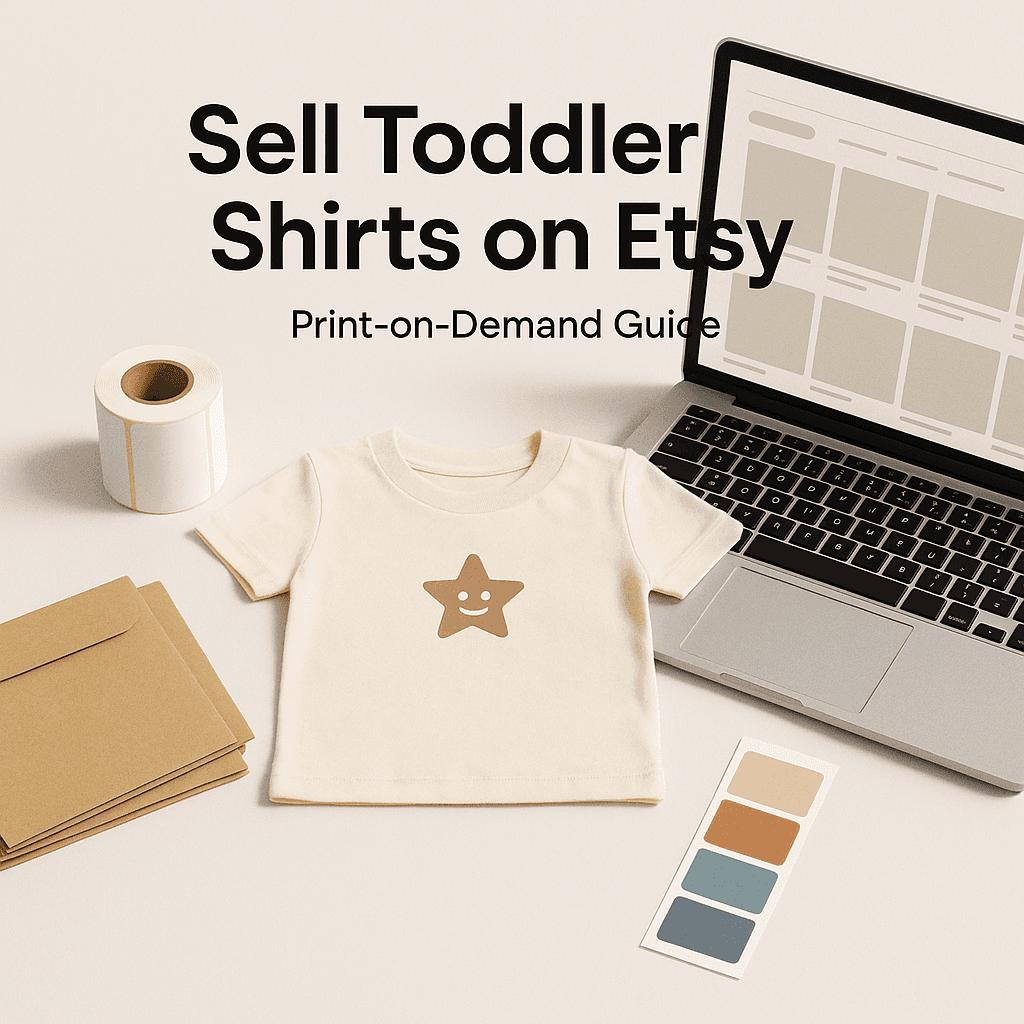
Selling toddler shirts on Etsy sounds simple on paper. Cute designs, tiny sizes, parents who love buying stuff that says things like “Snack Boss” and “Tiny Tornado”. But when you actually start, you hit the usual walls.
What do I design. What blank shirts do I use. How do I price. How do I get found. And the big one, how do I keep up with listings and orders without it turning into a second full time job.
Print on demand helps a lot, because you don’t buy inventory up front. And Etsy helps because people are already there searching.
So let’s walk through it like a normal person would. Not the overly polished guru version.
Why toddler shirts are a solid Etsy niche
Toddler clothing is one of those categories that keeps cycling. Kids outgrow things constantly. Gifts happen constantly. Holidays and birthdays never stop.
And toddler tees specifically are a sweet spot because:
- They’re cheap enough for impulse buys.
- They’re easy to personalize.
- Parents and relatives love “message” shirts.
- The photos look adorable, which helps clicks.
- You can build collections fast (colors, phrases, matching sets, sibling themes).
The downside is competition. There are a lot of sellers. Which just means you need to be a bit smarter about your niche and your listings.
Step 1: Pick a direction (do not start with “cute toddler shirts”)
If your plan is to sell “cute toddler shirts”, you’ll end up with 40 listings that look like everyone else’s. Etsy will not magically pick you.
You want a theme you can repeat 20 to 100 times with variations. Something you can become known for.
Here are toddler shirt angles that work well:
1) Mom and dad humor
Think tired parent jokes, coffee jokes, “I run on snacks”, stuff that makes adults laugh.
2) Birthday shirts
Age based designs. “Two Wild”, “Three Rex”, “Four Ever”. Make them editable by age so you can scale.
3) Seasonal and holiday collections
Halloween, Christmas, Thanksgiving, 4th of July, Valentine’s Day. Parents buy outfits for photos.
4) Interests and mini identities
Trucks. Dinosaurs. Ballet. Soccer. Space. Princess but more modern. Cottagecore kids. You get the idea.
5) Personalization
Name shirts. “Big Brother” with the kid’s name. “Our Little Pumpkin” with custom year. Personalization tends to convert because it feels special.
If you’re stuck, do this quick exercise: go to Etsy and type “toddler shirt”, then add a word after it. Like “toddler shirt dinosaur”, “toddler shirt birthday”, “toddler shirt funny”. Open the top listings and look for patterns, not to copy, but to see what customers keep buying.
Then choose one direction and stick with it long enough to matter.
Step 2: Choose a print on demand setup that won’t ruin your reviews
Toddler shirts come with very real expectations. Parents care about softness, shrinkage, and whether the print cracks after two washes. If you pick a cheap blank or a poor printer, you’ll learn the hard way via 2 star reviews.
When you’re choosing your POD options, look for:
- Soft fabric (ringspun cotton is usually a safer feel)
- Good sizing consistency
- Print quality (DTG that doesn’t look faded)
- Reliable production time
- Tracking + on time delivery
- Easy reprints/refunds when something goes wrong
Also. Make sure your shirt options include toddler sizes, typically 2T, 3T, 4T, 5T. Some suppliers go beyond that, but those are the common ones buyers filter for.
Step 3: Build designs that actually sell in toddler land
This part matters more than people admit. Not because you need to be a “designer”. But because toddler shirts have a specific vibe.
A few rules that keep you out of trouble:
Keep it readable
If it’s text based, use thick fonts, high contrast, and fewer words. Toddler shirts are small. Tiny script fonts look pretty on a mockup and then unreadable in real life.
Avoid complicated art with too many thin lines
DTG prints can lose detail on small prints, and thin lines can look fuzzy.
Pick colors that look good on the shirt colors you plan to offer
A lot of shops forget this. A white design looks great on black. But then they offer white shirts too and it disappears.
Be careful with trademarks
This is a big one. Do not use Disney, Marvel, Bluey, Paw Patrol, Taylor Swift lyrics, sports team names, anything like that. Etsy will eventually smack you. Even if “everyone else is doing it”.
If you want safe inspiration, build around generic themes: dinosaurs, tractors, woodland animals, birthdays, family roles, seasonal puns, simple icons.
Step 4: Create listings that look like they belong on page one
On Etsy, you’re not just selling a shirt. You’re selling a listing. Titles, tags, photos, and clarity.
Photos and mockups: your click comes from this
You need mockups that show:
- The shirt clearly (front view)
- Color options (a grid works)
- Size chart (easy to read)
- Close up of print texture if possible
- Lifestyle mockup if you can (kid vibe, but keep it clean)
A common mistake is using one mockup and calling it done. Toddler buyers want reassurance. They want to know what they’re getting, fast.
Title: explain the product the way people search
Etsy titles can be long. Don’t write poetry. Write searchable phrases.
A good structure is:
Primary keyword + occasion + personalization + gift intent
Example style (not to copy directly, just format):
- “Toddler Birthday Shirt, Two Wild 2nd Birthday Tee, Cute Jungle Party Outfit, Personalized Name Shirt, Toddler Girl Boy Gift”
It’s a mouthful, yes. Etsy search likes context.
Tags: use all of them
Use all 13 tags. Mix broad and specific.
Examples of tag types:
- “toddler shirt”
- “toddler tee”
- “2nd birthday shirt”
- “birthday outfit”
- “jungle birthday”
- “two wild”
- “personalized toddler”
- “toddler boy shirt”
- “toddler girl shirt”
- “kids birthday tee”
Don’t repeat the same phrase in 5 ways. You want coverage.
Description: short, clean, and confidence building
A good Etsy description for POD toddler shirts usually includes:
- What it is (toddler shirt, printed to order)
- Material and feel
- Sizing guidance (and remind them to check size chart)
- How personalization works (if applicable)
- Processing and shipping timelines
- Care instructions
- Returns/exchanges policy for personalized items
Keep it skimmable. Parents are reading on phones while doing 10 other things.
Step 5: Price it like you want to stay in business
New sellers underprice. Then they make $2 per sale and burn out.
Your price needs to cover:
- POD base cost
- Shipping (or part of it)
- Etsy fees (listing fee + transaction + payment processing)
- Any ads you run
- Refund/reprint cushion
- Your profit
A practical way to price:
- Add your POD base cost + average shipping cost.
- Add Etsy fees estimate (often around 8 to 12 percent depending on factors).
- Add profit that feels worth it.
Most toddler POD shirts on Etsy commonly land somewhere around the mid teens to mid twenties depending on personalization and shipping structure. You do not need to be the cheapest. You need to be clear, trustworthy, and easy to buy from.
Also, consider offering:
- Bundle options (two shirts discount, sibling sets)
- Rush upgrade (if your supplier can handle it)
- Personalization upgrade (name + age)
Step 6: Handle personalization without losing your mind
Personalization sells. Personalization also creates back and forth messages, mistakes, and “I forgot to add the name” situations.
If you offer personalization, make it idiot proof:
- Use Etsy personalization field with an example: “Name and age. Example: Olivia, 3”
- Repeat the instructions in the first line of description
- Add a listing photo that shows exactly what to type
- Decide what you do if they leave it blank (message them, or default to no name)
Then build your workflow around catching issues before printing. One bad personalized order can waste your margin for a week.
Step 7: Automation matters more than you think (where NinjaSell fits)
The part that quietly kills Etsy POD stores is not design. It’s operations.
You make designs, then you have to create listings. Titles, tags, descriptions, mockups, variants, pricing. Then orders come in. Then you fulfill. Then you upload tracking. Then customers ask questions. Then you repeat.
This is where a tool like NinjaSell can be useful, especially if you’re trying to scale beyond a handful of listings.
NinjaSell is an AI print on demand company focused on Etsy automation for POD. The workflow is basically:
- You upload your designs
- NinjaSell automatically creates optimized Etsy listings
- It generates mockups
- And it fulfills print on demand orders with white label shipping
If your goal is to sell toddler shirts at any real volume, listing creation and fulfillment speed become the bottleneck. Automation can remove a lot of the repetitive parts so you can spend your time on the two things that actually move the needle.
New designs and better niche research.
Just be aware, automation doesn’t replace judgment. You still need to review listings, make sure mockups look good, and make sure the keywords aren’t weird. AI can be “confidently wrong” in a very specific way.
But as a system for scaling, it can save you hours.
Step 8: Get your first sales (without begging friends)
A new Etsy shop has no momentum. You need initial traction.
Here are a few realistic ways to do it.
Launch with a small collection, not one shirt
Try 10 to 20 listings that look connected. Same style, same vibe, different phrases or ages.
Etsy likes shops that feel like a shop.
Use Etsy SEO first, then ads later
If you run ads too early with weak listings, you pay for clicks that don’t convert.
Dial in:
- photos
- title clarity
- price competitiveness
- shipping expectations
- sizes and color options
Then test Etsy ads on your best 1 to 3 listings, small budget, and watch conversion rate.
Create seasonal lead time
If you want to sell Halloween toddler shirts, you list them in August. Not October 20th.
POD production plus shipping takes time, and Etsy shoppers plan outfits earlier than you think.
Simple Pinterest works for toddler products
Toddler outfits and birthdays do well on Pinterest. Post mockups, link to Etsy, and keep it consistent. You don’t need to go viral. You need steady clicks over time.
Step 9: Keep reviews clean (toddler buyers are picky, but fair)
Your reviews will often come down to:
- Was it delivered on time.
- Did it match the mockup.
- Does it feel soft.
- Did the size fit.
- Did the personalization come out right.
So, do the boring things:
- Put processing time that matches reality.
- Be honest about shipping time.
- Include sizing info everywhere.
- If something goes wrong, fix it fast.
- Message customers if you need personalization clarification.
A calm, quick response saves reviews.
Step 10: Scale by repeating what works, not by adding random stuff
After you have data, scaling is mostly pattern recognition.
If “Two Wild” sells, build:
- Three Wild, Four Wild, Five Wild
- Girl version, boy version, neutral version
- Jungle theme, safari theme, boho theme
- Matching sibling onesie, matching mom shirt, etc
You don’t need new ideas every day. You need stronger variations of proven ideas.
Also, keep an eye on your shop stats in Etsy. Which search terms are bringing traffic. Which listings have high views but low sales (usually pricing or photo clarity). Which listings convert (make more like those).
Let’s wrap it up
Selling toddler shirts with print on demand on Etsy is not some mystical side hustle. It is mostly: pick a niche, make designs that fit it, create listings that actually answer questions, and then stay consistent long enough for Etsy to trust you.
And if you want to scale, you need a workflow that doesn’t collapse under its own weight. That’s where automation tools like NinjaSell can help, since it can auto create optimized Etsy listings, generate mockups, and fulfill POD orders with white label shipping after you upload your designs.
Start small. Make it clean. Build collections. Then scale what already sells. That’s the game.
FAQs (Frequently Asked Questions)
Why are toddler shirts a good niche to sell on Etsy?
Toddler shirts are a solid Etsy niche because kids constantly outgrow clothes, gifts are frequent, and holidays and birthdays provide ongoing demand. Specifically, toddler tees are affordable for impulse buys, easy to personalize, popular for “message” shirts among parents and relatives, visually adorable for photos that drive clicks, and allow sellers to quickly build collections with colors, phrases, and themes like sibling sets.
How do I pick a unique direction for my toddler shirt designs on Etsy?
Avoid generic ‘cute toddler shirts’ which blend in with the competition. Instead, choose a specific theme you can repeat with variations—such as mom and dad humor, birthday age-based designs, seasonal/holiday collections, interests like dinosaurs or ballet, or personalized name shirts. Research top listings on Etsy by searching ‘toddler shirt’ plus keywords like ‘dinosaur’ or ‘birthday’ to spot patterns and pick a direction you can consistently develop.
What should I consider when choosing a print-on-demand (POD) supplier for toddler shirts?
Select POD providers that offer soft fabrics like ringspun cotton, consistent sizing especially in toddler sizes (2T-5T), high-quality direct-to-garment (DTG) printing that doesn’t fade or crack after washes, reliable production times with tracking and on-time delivery, and easy reprint or refund policies. This helps avoid negative reviews related to softness, shrinkage, or print durability.
What design tips help create toddler shirts that sell well?
Keep text readable with thick fonts and high contrast; avoid complicated art with thin lines as DTG printing can blur details; choose colors that stand out on the shirt color options you offer; and steer clear of trademarked characters or phrases like Disney or Marvel to prevent Etsy takedowns. Focus instead on generic themes like dinosaurs, birthdays, family roles, seasonal puns, or simple icons.
How can I make my Etsy toddler shirt listings stand out on page one search results?
Create listings with clear titles using searchable keywords structured as: primary keyword + occasion + personalization + gift intent. Use multiple mockups showing front views of the shirt, color options in a grid format, an easy-to-read size chart, close-ups of print texture if possible, and lifestyle images featuring toddlers in clean settings. This reassures buyers about product quality and drives clicks.
Why is print-on-demand recommended for selling toddler shirts on Etsy?
Print-on-demand helps avoid upfront inventory costs since you don’t buy stock before selling. It simplifies order fulfillment by printing only when orders come in. This reduces risk and workload compared to managing inventory yourself. Combined with Etsy’s existing customer base actively searching for toddler clothes, POD enables more manageable scaling without turning your shop into a second full-time job.