If you sell print on demand on Etsy, shipping is not a “set it once and forget it” thing. It feels like it should be, but it’s not.
Because one tiny setting can quietly eat your margin for weeks. Sometimes months. And you only notice when you’re like… wait, why did this order make me $0.84.
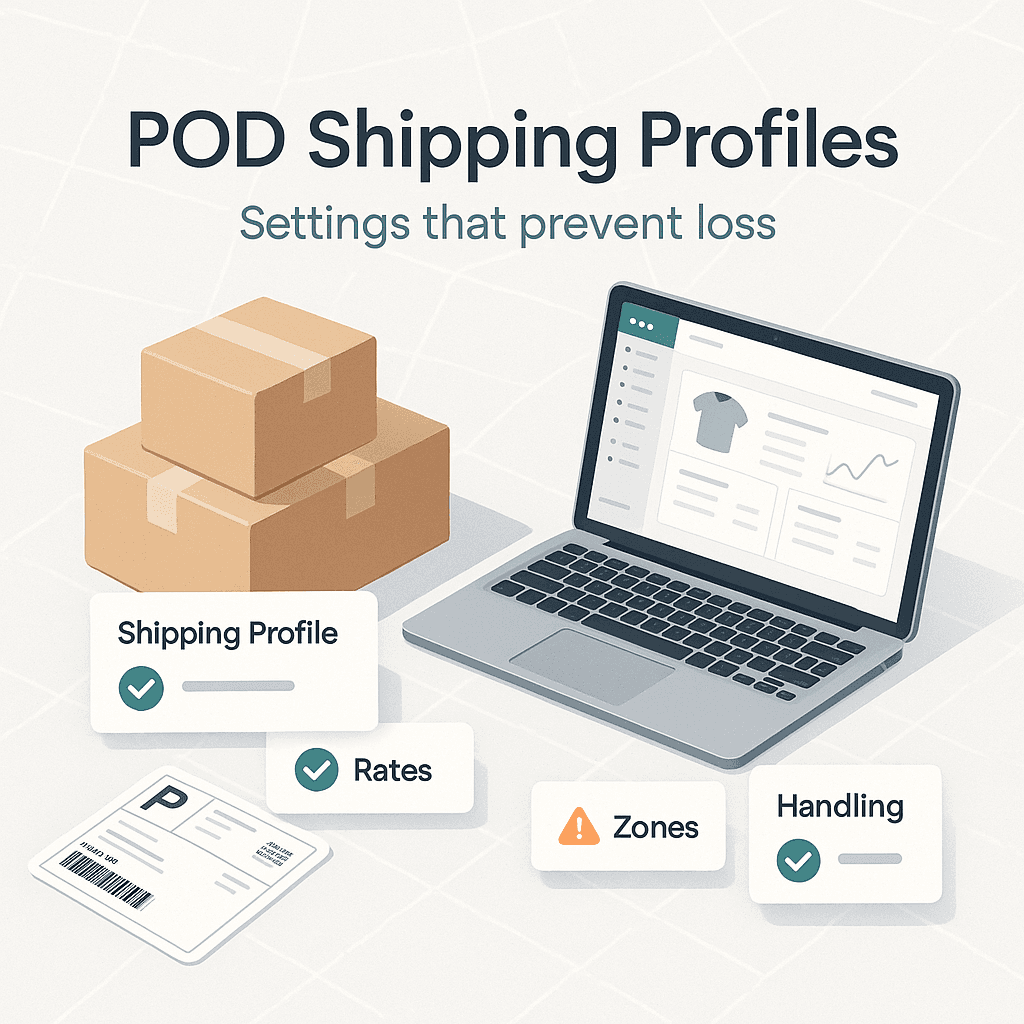
This is mostly about shipping profiles. Not sexy. But they’re one of the fastest ways to stop accidental losses, especially if you run multiple product types, or you’re adding new listings every week.
And yes, the advice below works even better if you’re using a POD automation workflow (like NinjaSell) because automation multiplies whatever shipping rules you have. Good rules scale. Bad rules scale too.

Why shipping profiles are where POD profits go to die
Here’s the problem: POD shipping costs are not stable.
They vary by:
- product type (tee vs hoodie vs mug)
- weight and package size
- destination (still US only for some fulfillers, but even within US there are differences)
- production partner pricing changes
- Etsy updates, like how they display delivery ranges or prioritize “free shipping”
And if your profile isn’t aligned with your real costs, you’ll either:
- overcharge (and tank conversion), or
- undercharge (and pay out of pocket)
Undercharging is the silent killer. Because sales still come in. Nothing breaks. You just bleed.
So we’re going to build shipping profiles that are boring, predictable, and hard to mess up.
First, decide your pricing strategy (before touching profiles)
You basically have three options on Etsy POD:
1) Free shipping (price includes shipping)
You bake an average shipping cost into your item price.
Pros: better conversion sometimes, cleaner offer
Cons: if your averages are wrong, you lose money fast
2) Paid shipping (customer pays shipping)
You keep item price lower and set shipping rates in the profile.
Pros: easier to stay profitable per order
Cons: customers hate shipping surprises, and Etsy pushes free shipping a lot
3) Hybrid (free over $35, otherwise paid)
Common for US Etsy because of the $35 thing Etsy loves.
Pros: you can maintain margins if configured right
Cons: the configuration is where things go wrong
There isn’t one correct answer. But whichever you pick, your shipping profiles have to match it. No “kinda free shipping but also $2.99 handling” chaos.

The core shipping profile mistake: mixing products that shouldn’t share one
A lot of sellers create one profile called “POD Shipping” and slap it on everything.
That works only if your catalog is basically one product type. Like, only tees. Same printer. Same shipping class.
But if you sell, say:
- tees
- hoodies
- sweatshirts
- mugs
- posters
You need at least separate profiles by product family. Minimum.
Because Etsy shipping profiles use a few key numbers (base shipping, additional item shipping) and those numbers behave very differently across product types.
If you mix a mug with a hoodie in one profile, you’re guessing. And guessing means losses.
A clean baseline setup (simple but safe)
Create profiles like:
- Apparel Lightweight (tees, tanks)
- Apparel Heavy (hoodies, crewnecks)
- Drinkware (mugs, tumblers if you sell them)
- Wall Art (posters, canvases)
Even if you only sell US, do this. It keeps your math sane.
The setting that saves you most often: “Additional item” shipping
This is the one that ruins people.
- One item shipping (what customer pays to ship the first item)
- Additional item (what customer pays for each extra item in the same order)
If your “additional item” is too low, bundles will destroy your margin.
Why it matters more for POD than handmade
Because POD fulfillment often charges you shipping per item, or per “package logic” that is not as generous as Etsy assumes.
Example scenario:
- Customer buys 3 shirts.
- Etsy charges: $4.99 first item + $1.00 each additional = $6.99 total shipping paid.
- Your POD partner charges: $4.50 first + $4.00 each extra (or similar) = $12.50 actual shipping cost.
You just paid the difference.
So don’t set additional item shipping as a cute little number unless you’ve verified how your fulfillment actually bills multi item orders.
What to do instead
Set “additional item” to a number that assumes:
- items might ship separately
- or you might get charged close to per item shipping
It can still be discounted, just not fantasy-level cheap.
If you want to be aggressive on shipping discounts, do it later after you have data.
Handling fees: yes, they can help. But don’t use them to hide mistakes
Etsy lets you add a handling fee (depending on region/settings).
Handling fees can be useful if:
- you have packaging costs
- you want to cushion cost fluctuations
- you want to cover the occasional address issue, reship, etc
But I’d rather you fix the shipping profile first, then add a small cushion.
A common “safe” cushion for POD is something like $0.50 to $1.50, depending on your product and margin. Not huge. Just enough that if shipping bumps up a bit, you’re not instantly negative.
If your shipping is off by $4, a $1 handling fee is not a solution. That’s a band aid on a broken leg.
Don’t let Etsy “calculated shipping” trick you into thinking you’re safe
Calculated shipping sounds like the best option, right. Etsy calculates based on carrier rates.
But for POD, your fulfillment partner’s shipping price is often not the same as USPS retail rates Etsy uses.
Also:
- you may not control box dimensions
- you may not control service level used
- you may be billed differently for multi item orders
So calculated shipping can still cause loss. Sometimes worse, because you assume it’s handled.
If you do use calculated shipping, you need to validate it with real order invoices from your POD provider. Like actually compare.
Delivery estimates matter, even if you’re not changing shipping speed
Etsy shows delivery ranges. Those impact conversion and reviews.
If your processing time is wrong, you’ll trigger:
- “Where is my order?” messages
- bad reviews
- refunds you didn’t need to give
For POD, processing times are not the same as you shipping it yourself.
So set processing time based on reality, not wishful thinking.
General guidance:
- if your POD provider prints in 2 to 5 business days typically, don’t set 1 to 2.
- if holidays spike production times, consider updating processing windows during Q4.
This is less about “loss per order” and more about “loss through refunds and damage control”.

Stop relying on one average shipping number if you have multiple variants
If your listing has variants that change weight and packaging, be careful.
Example:
- Shirt sizes up to 2XL ship normally
- 3XL to 5XL might cost more (sometimes base cost too)
- Hoodies in larger sizes can also cost more
If your shipping profile is based on “most common size” and you sell a lot of larger sizes, you can quietly lose.
Two ways to handle it:
- Price the item to absorb the highest likely shipping (simpler, safer, less precise)
- Split listings so the high cost variants are separate listings with different shipping profiles (more work, more control)
Most sellers choose option 1 until they have enough volume to justify splitting.
Create a “Loss Prevention” shipping profile before you optimize
This is a mindset thing, but it works.
You make one profile per product family that is intentionally conservative. It might slightly overcharge sometimes. That’s fine in the beginning.
Once you have:
- 20 to 50 orders in that category
- real invoices
- real bundle behavior
Then you optimize.
Too many sellers start by optimizing based on vibes, and the market “feels competitive”, so they set shipping low.
And then they wonder why the shop grows but their bank account doesn’t.
A simple checklist for shipping profiles that don’t lose money
When you create or audit a profile, check these in order:
- What product family is this for?
If it covers more than one shipping behavior, split it. - What is your average shipping cost per single item?
Use your POD provider’s actual rates. - What is your worst case shipping cost for multi item orders?
Not theoretical. Look at how they bill “additional items”. - Set additional item shipping to match worst case more than best case.
This alone prevents most bundle losses. - Confirm processing times are realistic.
Reduces refunds and angry messages. - Decide free shipping vs paid shipping intentionally.
Don’t half do it. - Add a small cushion only after the above is correct.
Handling fee or baked into price.
Print that checklist. Or pin it. It’s the boring stuff that keeps you profitable.
How this gets easier with an automation workflow (and where you can still mess up)
If you’re using a platform like NinjaSell to push out Etsy drafts faster, refresh keywords, generate mockups, all that, the shipping profile part becomes even more important.
Because automation means:
- you publish more listings
- you publish them faster
- you rely on templates and defaults more
So the win is: set up shipping profiles correctly once, then your workflow stays clean.
The risk is: one wrong profile gets applied to 200 drafts. And you won’t notice until the orders start coming in.
If you’re building at scale, it’s worth doing a quick “default settings” audit in your process:
- Which shipping profile is your default?
- Are you assigning profiles based on product type automatically or manually?
- Do you have separate profiles ready for new product categories before you launch them?
This is the unglamorous side of scaling.
Subtle CTA, but real: if you’re already using NinjaSell to automate Etsy listing creation, take 30 minutes to build clean shipping profiles first. You’ll feel it later when you’re not doing refund math at midnight.
Common “it looked fine” scenarios that cause losses anyway
A few patterns I see a lot:
You offered free shipping, but didn’t raise the item price enough
You thought shipping was $4.50 average. It’s actually $6.20.
That’s $1.70 per order. Every order. Brutal.
Your additional item shipping is set like you ship everything in one box
Your fulfillment splits packages. Or charges per item heavily.
Bundles become negative margin orders.
You forgot to update profiles after a provider price change
This happens. Especially if you don’t watch your invoices closely.
Do a shipping audit monthly. It’s annoying, but it’s less annoying than losing money.
You created a new product type and reused an old profile
You added hoodies. You reused the tee shipping profile.
Congrats, every hoodie order is now a small fire.
Suggested shipping profile structure (copy this)
Not numbers, because those depend on your provider. But structure wise, this is clean:
Profile: Apparel Lightweight (Tees, tanks)
- shipping type: fixed (or calculated only if you have verified it)
- one item shipping: based on real cost + small cushion
- additional item: set closer to real additional item cost, not $0.50
- processing: realistic POD production time
Profile: Apparel Heavy (Hoodies, crews)
- higher base shipping
- higher additional item
- longer processing time if needed
Profile: Drinkware
- base shipping that assumes breakable packaging and higher handling
- additional item not too low (mugs can ship separately)
Profile: Wall Art
- consider tube shipping behavior
- be conservative on additional item unless you know they bundle
If you do just that, you’re already ahead of most POD shops.

Quick way to test if your shipping profile is safe
Pick three “test carts” and do the math:
- One item order (your most common item)
- Two item order (same item twice)
- Mixed order (two different listings that might share a profile)
For each cart:
- What does the customer pay in shipping (based on Etsy profile)?
- What do you expect your POD provider to charge you?
- What happens if the destination is farther (still US, but different zones)?
If you can’t answer the provider side, that’s your signal: you’re guessing. So set conservative rates until you can confirm.
Wrap up (so you can actually go fix this)
Shipping profiles are not fun, but they are one of the few Etsy settings that directly decide whether you make money.
If you want the short version:
- Don’t mix product families in one shipping profile.
- Set additional item shipping like your fulfillment will charge you per item. Because sometimes they do.
- Be conservative first, optimize later with real invoices.
- Keep processing times honest to avoid refund losses.
- If you’re scaling listings fast with automation (NinjaSell or anything else), shipping defaults matter even more.
If you want, tell me what product categories you sell (tees, hoodies, mugs, posters, etc) and what your average shipping costs look like, and I can suggest a clean shipping profile map you can copy into Etsy.
FAQs (Frequently Asked Questions)
Why are shipping profiles critical for maintaining profits in Etsy print on demand shops?
Shipping profiles are vital because POD shipping costs vary by product type, weight, destination, and production partner pricing. If your shipping profile doesn’t reflect these costs accurately, you risk undercharging customers and losing money silently or overcharging and hurting conversions. Properly configured shipping profiles help prevent accidental losses and keep your margins healthy.
What are the main pricing strategies for shipping on Etsy POD, and how do they impact profit?
There are three main pricing strategies: 1) Free shipping where the cost is baked into the item price; 2) Paid shipping where customers pay separate shipping fees; 3) Hybrid models like free shipping over a certain order value. Each affects profit differently—free shipping can boost conversions but risks losses if averages are off; paid shipping protects margins but may deter buyers; hybrids balance both but require precise configuration.
How should I organize my Etsy shipping profiles when selling multiple product types in POD?
You should create separate shipping profiles by product family to reflect different shipping costs accurately. For example, have distinct profiles like ‘Apparel Lightweight’ for tees, ‘Apparel Heavy’ for hoodies, ‘Drinkware’ for mugs, and ‘Wall Art’ for posters. Mixing diverse products in one profile leads to guessing and potential margin loss.
What is the ‘additional item’ shipping setting on Etsy, and why is it especially important for POD sellers?
‘Additional item’ shipping defines what customers pay for each extra item in the same order beyond the first. It’s crucial because many POD partners charge shipping per item or have less generous package logic than Etsy assumes. Setting this too low means you cover extra costs out of pocket when customers buy bundles, eroding profits quickly.
How can I set realistic ‘additional item’ shipping rates to avoid losing money on bundled orders?
Set the ‘additional item’ rate assuming that items may ship separately or that you’ll be charged close to per-item shipping by your fulfillment partner. While you can offer some discount on additional items, avoid setting fantasy-level low rates without data. Start with conservative estimates based on actual fulfillment charges and adjust as you gather order data.
Can handling fees help cover unexpected POD shipping costs on Etsy?
Yes, handling fees can help offset extra costs but should not be used to hide mistakes in your core shipping profile settings. They are best applied transparently to cover packaging or processing expenses after you’ve optimized your base and additional item shipping rates to reflect true fulfillment costs.