Etsy titles are weird.
They look like a simple line of text, but they’re doing two jobs at once. They have to help Etsy understand what you’re selling (so you rank). And they have to help a real human decide, in half a second, to click your listing (so you convert).
Most sellers lean too hard one way.
They either write a “pretty” title that sounds like a boutique sign. Or they write a keyword dump that reads like a robot having a panic attack. And both can underperform.
So let’s fix it. I’m going to show you how to write Etsy titles that actually rank and convert, without stuffing, without guessing, and without spending three hours staring at the search bar.
How Etsy titles actually work (in plain English)
Etsy search is basically trying to match a shopper’s words to your listing.
It pulls signals from:
- Your title
- Your tags
- Your categories and attributes
- Your description (less important than people think, but still matters)
- Your listing performance (clicks, favorites, sales, reviews, shipping experience)
Your title and tags are the big ones you control on day one.
And Etsy doesn’t “read” your title like a human. It breaks it into words and phrases and tries to match them to search queries.
So if a shopper types:
“personalized dog mom sweatshirt”
Etsy is looking for listings that contain those words (and close variations) in the title and tags. Exact match helps. Close match still works. But if you wrote a poetic title like “Cozy Love for Pet Parents” you’re invisible.
The other half though is conversion.
If you rank but no one clicks, Etsy will slowly stop showing you as much. Ranking and converting are connected. Not perfectly, but enough that you can’t ignore either.
So the goal is: make titles that are searchable, readable, and specific.
The biggest mistake: trying to rank for everything in one title
You don’t need to rank for 40 keywords in one listing.
You need to rank for the right cluster of related searches. Like a tight theme.
Example, if you sell a “custom birth flower necklace”.
Your cluster might include:
- birth flower necklace
- personalized birth flower necklace
- custom flower necklace
- birth month flower necklace
- dainty floral necklace
- gift for mom necklace
Those are all connected. Same intent.
What you don’t want is to shove in unrelated stuff like “valentines gift”, “anniversary gift”, “teacher gift”, “boho jewelry”, “minimalist necklace”, “bridesmaid necklace” all at once. Some of those could be relevant, sure, but the title becomes mush. Etsy gets mixed signals and shoppers feel the clutter.
You can cover extra angles with tags, attributes, and separate listings.
What a high ranking Etsy title is made of
A good Etsy title usually has 4 parts, in this order:
- Primary keyword phrase (the exact thing people type)
- Key differentiator (who it’s for or what makes it different)
- Secondary keywords (close variations, not random)
- Specs or format (size, material, style, digital, instant download, etc)
Not every title needs all 4, but that’s the backbone.
Here’s a clean example:
Personalized Dog Mom Sweatshirt, Custom Pet Name Hoodie, Cozy Gift for Dog Lovers, Embroidered Style Pullover
Primary: “Personalized Dog Mom Sweatshirt”
Differentiator: “Custom Pet Name”
Secondary: “Gift for Dog Lovers”
Specs/style: “Embroidered Style Pullover”
It reads like a human wrote it. But it also hits multiple relevant searches.
The Etsy title formula I use (steal this)
Use this template:
[Main Keyword] + [Personalization/Recipient/Use] + [Style/Material] + [Occasion (optional)] + [Secondary Keyword Variation]
Examples:
- Custom Name Necklace, Personalized Minimalist Pendant, Gold Initial Jewelry, Birthday Gift for Her, Dainty Necklace
- Printable Wedding Seating Chart Template, Editable Minimalist Canva Design, Instant Download, Modern Reception Sign
- Funny Camping Shirt, Vintage Outdoors Graphic Tee, Soft Unisex T Shirt, Gift for Campers, Nature Lover Shirt
You’ll notice something. It’s not just keywords. It’s clarity.
If someone clicks, they should feel like “yep, that’s exactly what I searched for”.
How long should Etsy titles be?
Etsy allows long titles (up to 140 characters). You do not have to use all of it, but you usually should use a good chunk, especially in competitive categories.
A practical range that works for most sellers:
- 90 to 140 characters for most physical products
- 70 to 120 characters for digital products (often shorter works fine because the format is obvious)
Also, the first part matters most.
Not because Etsy only reads the first words, it reads the whole thing. But humans skim. And on mobile, Etsy may cut off the visible title. So put the strongest phrase up front.
Exact match vs broad match. What you should aim for
Etsy uses phrase matching and word matching.
If your title has: “birth flower necklace”
You can match searches like:
- birth flower necklace
- necklace birth flower
- personalized birth flower necklace
- birth month flower necklace (depending on other keywords and tags)
But if you scatter words too far apart, you can weaken the phrase signal.
So if you can, keep your main phrase intact.
Good:
- “Birth Flower Necklace, Personalized Floral Pendant…”
Less ideal:
- “Birth Month Gift, Flower Pendant Necklace…”
Still possible to rank, but you’re making Etsy guess more.
The move is: one exact main phrase, then expand.
How to find keywords that actually bring buyers
Keyword research sounds intimidating but on Etsy it’s pretty straightforward. You’re looking for phrases with:
- Clear buying intent
- Specific product language
- Not too broad
Here are the easiest places to pull title keywords from.
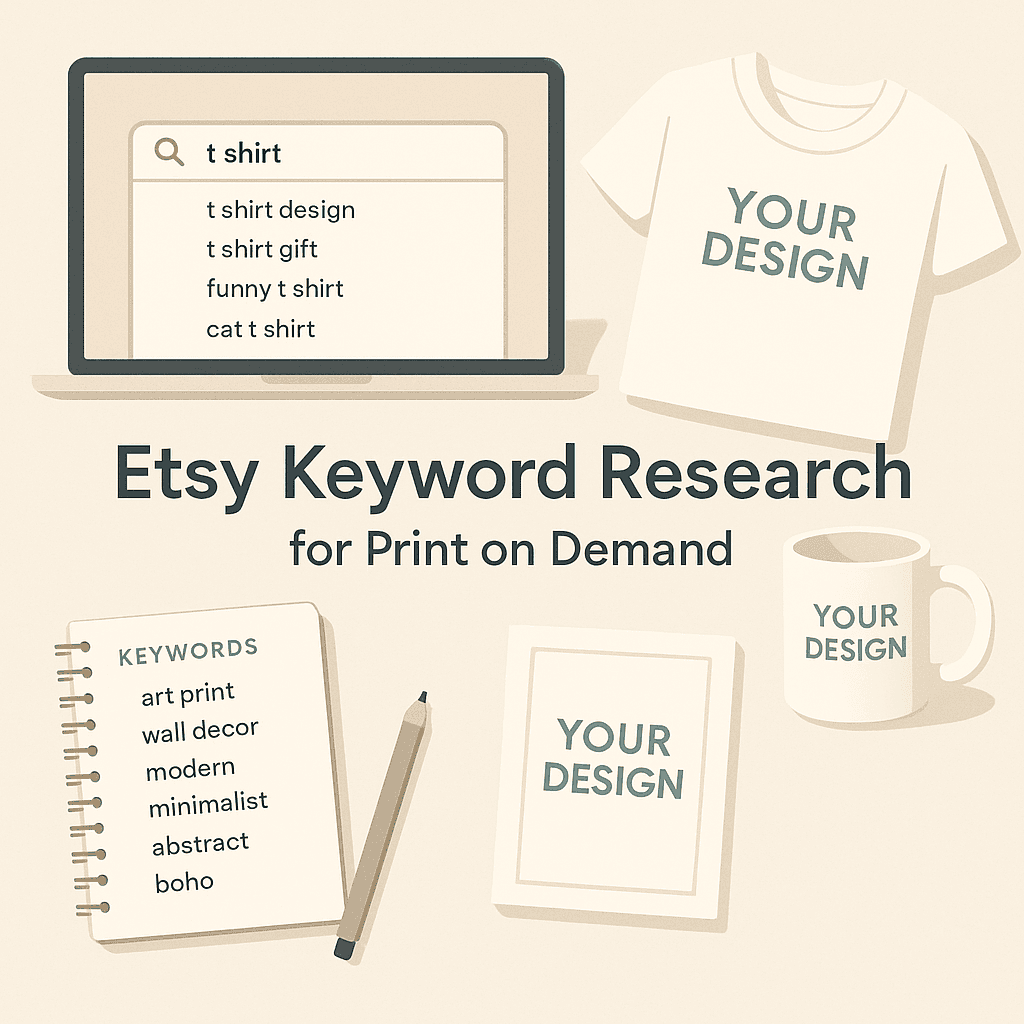
1. Etsy search suggestions (the simplest goldmine)
Start typing your core product in Etsy search and write down what Etsy auto completes.
Those suggestions are real searches. Etsy is literally telling you what people type.
Type:
- “dog mom sweatshirt”
- “dog mom sweatshirt personalized”
- “dog mom sweatshirt embroidered”
- “dog mom crewneck”
Now you have a mini keyword list.
2. Competitor titles (but don’t copy them blindly)
Open the top listings and look for patterns:
- What phrase do they lead with?
- What modifiers show up a lot? (“custom”, “personalized”, “embroidered”, “minimalist”, “retro”, “funny”)
- What recipients keep showing up? (“gift for her”, “gift for mom”, “new mom”)
You’re not copying. You’re confirming demand language.
3. Your own listing stats (once you have traffic)
In Etsy Shop Manager, check which search terms bring people to a listing.
If you see a term converting well, consider moving it closer to the front of your title. If you’re getting traffic for terms you don’t actually match well, tighten the title to reduce mismatched clicks.
Keyword stuffing. Where it goes wrong
Keyword stuffing usually looks like:
Dog Mom Sweatshirt Dog Mom Hoodie Dog Lover Gift Dog Mom Shirt Pet Mom Sweater Personalized Dog Mom
This can still rank sometimes. But conversion suffers. And Etsy is getting better at understanding relevance without needing you to repeat the same phrase 5 times.
Here’s the simple rule:
- Don’t repeat the same keyword more than once unless it’s part of a different phrase with new meaning.
So you might use:
- “Dog Mom Sweatshirt” and later “Gift for Dog Lovers”
That’s fine. Different intent. Different words.
But “dog mom” five times is wasted space.
Commas, separators, and readability
Etsy doesn’t require commas, but humans do.
Use commas to separate phrases. It makes the title scannable, especially on mobile.
Good separators:
- commas
- pipes ( | )
Avoid:
- all caps
- random symbols
- repeating emoji (yes people do this)
Also avoid weird spacing tricks. Keep it clean.
The “buyer intent” checklist (use this before you publish)
Before you finalize a title, ask:
- Is the exact product obvious in the first 4 to 6 words?
- Would a stranger know who it’s for? (mom, teacher, bride, gamer, etc)
- Did I include the main personalization or format? (custom name, printable, digital download)
- Do the extra keywords support the same search intent?
- Does it read like a real product, not a keyword list?
If you can’t answer yes to at least 4, rewrite.
Real title makeovers (so you can see the difference)
Example 1: Print on demand shirt
Bad: Funny Shirt, Cool Tee, Unisex T Shirt, Gift Idea
No main keyword. No niche. No search intent.
Better: Funny Introvert Shirt, Social Battery Graphic Tee, Soft Unisex T Shirt, Gift for Introverts, Minimalist Quote Shirt
Now you’re targeting actual searches: “introvert shirt”, “social battery shirt”, “gift for introverts”.
Example 2: Digital download
Bad: Editable Template, Instant Download, Canva, Printable
Too vague. Could be anything.
Better: Editable Baby Shower Invitation Template, Minimalist Canva Invite, Instant Download, Neutral Gender Reveal Invite
Specific event + format + style.
Example 3: Personalized gift
Bad: Custom Gift, Personalized Present, Unique Handmade Item
Again, nothing concrete.
Better: Personalized Family Name Sign, Custom Last Name Wall Decor, Rustic Farmhouse Wood Style, Housewarming Gift
Even if you don’t make wood signs and you do POD style prints instead, the structure holds.
Where NinjaSell fits in (and why it matters for titles)
If you’re doing print on demand, you’re probably creating a lot of listings. Which is great. Also exhausting.
This is where people mess up. They get tired and start reusing the same title format across everything, or they publish with placeholder titles and promise themselves they’ll “optimize later”. Later rarely comes.
NinjaSell is built for this exact problem.
Since NinjaSell is an AI print on demand automation tool that can automatically create optimized Etsy listings, generate mockups, and fulfill orders with white label shipping, the real advantage is speed without letting quality collapse.
So instead of spending your whole Sunday writing 40 titles and tags and then still feeling unsure, you can:
- upload designs
- generate listings faster
- keep titles structured and keyword focused
- stay consistent across your shop
And consistency is underrated on Etsy. Not just branding. Operational consistency. The ability to publish and test more products without burning out.
One quick note though. Even with automation, you should still spot check titles for accuracy, weird phrasing, and anything that feels off for your niche. AI gets you 80 to 90 percent there fast. Your job is the last 10 percent. The human part.
Quick rules for Etsy title writing (print this mentally)
- Put the main keyword first
- Keep the main phrase intact when possible
- Add 2 to 4 supporting phrases that are close variations
- Mention the buyer or use case if it’s gift driven
- Don’t repeat the same keyword over and over
- Make it readable. Commas are your friend
- Match what’s in the photos and description. No bait titles
A few copy and paste title templates (by category)
Print on demand apparel
[Primary Keyword Product] , [Design Style or Theme] , [Fit or Fabric] , [Recipient or Niche] , [Gift Keyword]
Example: Retro Cat Shirt, Vintage Funny Graphic Tee, Soft Unisex T Shirt, Gift for Cat Lovers, 90s Aesthetic Tee
Posters and wall art (POD)
[Primary Keyword Art Type] , [Style] , [Room or Use] , [Recipient] , [Secondary Keyword]
Example: Minimalist Kitchen Wall Art Print, Black and White Food Poster, Modern Home Decor, Gift for Foodies, Printable Style Art
Digital templates
[Primary Keyword Template] , [Software] , [Style] , [Instant Download] , [Use Case]
Example: Editable Thank You Card Template, Canva Minimalist Design, Instant Download, Small Business Packaging Insert
Jewelry or accessories
[Primary Keyword] , [Personalization] , [Material or Finish] , [Recipient] , [Occasion]
Example: Birth Flower Necklace, Personalized Name Pendant, Gold Filled Dainty Necklace, Gift for Mom, Mother’s Day Gift
Let’s wrap this up (without overcomplicating it)
If you want Etsy titles that rank and convert, you don’t need a “perfect” title. You need a clear one.
Lead with what it is. Add what makes it different. Sprinkle in a few real search phrases that match the same buyer intent. Keep it readable.
Then publish. Watch what gets clicks and sales. Adjust.
And if you’re building a print on demand store and trying to scale listings without losing your mind, tools like NinjaSell can take a lot of the repetitive work off your plate. Titles, mockups, fulfillment, the whole loop. You still steer, but you’re not pushing the car uphill alone.
If you want a simple next step, do this today:
Pick your best selling item (or the one you wish would sell). Rewrite the title using the structure above. Put the strongest keyword phrase first. Save. Give it a couple weeks. Compare traffic and conversion.
That’s the game. Small edits, repeated, over time.
FAQs (Frequently Asked Questions)
Why are Etsy titles important for both ranking and conversion?
Etsy titles serve two key purposes: they help Etsy’s search engine understand what you’re selling to improve your ranking, and they quickly inform potential buyers about your product to encourage clicks and conversions. Balancing both aspects ensures your listing is visible and appealing.
What is the biggest mistake sellers make when writing Etsy titles?
The biggest mistake is trying to rank for too many unrelated keywords in one title. This creates clutter, confuses Etsy’s algorithm, and overwhelms shoppers. Instead, focus on a tight cluster of related keywords that share the same intent to improve clarity and performance.
What are the four essential parts of a high-ranking Etsy title?
A strong Etsy title typically includes: 1) Primary keyword phrase (exact search term), 2) Key differentiator (who it’s for or unique feature), 3) Secondary keywords (close variations), and 4) Specs or format (size, material, style). This structure balances searchability with readability.
How can I structure my Etsy title using a proven formula?
Use this template: [Main Keyword] + [Personalization/Recipient/Use] + [Style/Material] + [Occasion (optional)] + [Secondary Keyword Variation]. For example: ‘Custom Name Necklace, Personalized Minimalist Pendant, Gold Initial Jewelry, Birthday Gift for Her, Dainty Necklace’ combines clarity with relevant keywords effectively.
What is the ideal length for Etsy titles?
Etsy allows up to 140 characters. For physical products, aim for 90 to 140 characters; for digital products, 70 to 120 characters often works well. Use enough characters to include important keywords while keeping the most vital phrases at the beginning since shoppers skim titles quickly.
Should I focus on exact match or broad match keywords in my Etsy title?
Aim for exact match or close phrase matching by keeping your main keyword phrase intact in the title. This strengthens Etsy’s ability to match your listing to relevant searches. Scattering keywords too far apart weakens this signal and may reduce your ranking effectiveness.