If you sell print on demand on Etsy, you already know the weird truth.
Traffic is hard. SEO is messy. Trends change fast.
But there is another lever a lot of sellers ignore because it feels too simple to matter.
Average order value.
Not just more orders. Better orders.
And one of the cleanest ways to lift AOV on Etsy, without begging the algorithm for mercy, is your listing variation strategy. Not “make more variations because Etsy lets you”. I mean… building variations that gently push shoppers into bigger carts, higher priced options, and bundles that feel like a no brainer.
This is that strategy. A little practical, a little opinionated, and yes, it works especially well for POD.
What “variations” actually do on Etsy (beyond being a dropdown)
Variations are not just logistics.
They are:
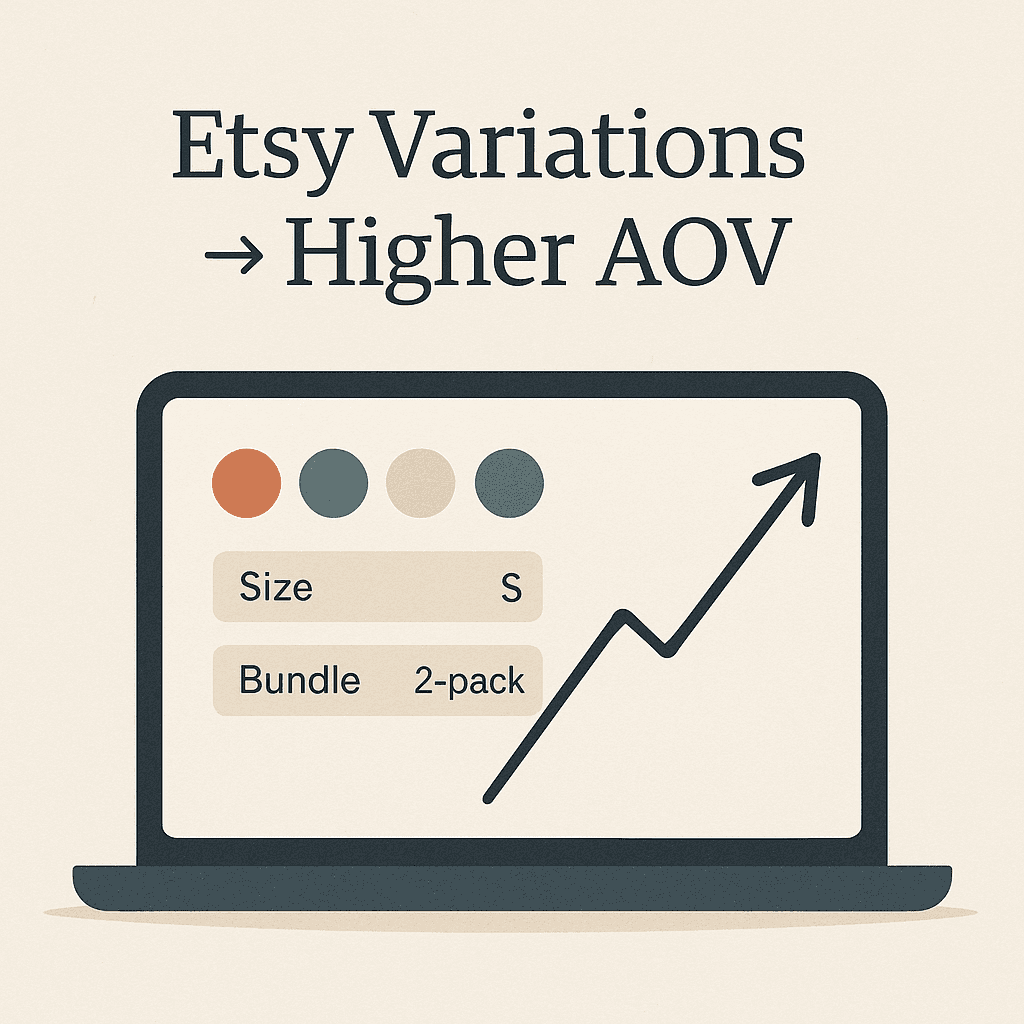
- Price anchors (showing a higher priced option makes the mid option feel cheaper)
- Upsells (bigger size, premium garment, back print, rush shipping)
- Bundles disguised as choices (set of 2, family pack, matching pair)
- Friction reducers (the buyer feels in control, less hesitation)
The key is: the variation menu is right next to the buy button. It’s one of the highest intent areas on the page. If you waste it on boring stuff, you are leaving money sitting there.
The AOV math (why small changes matter a lot)
Let’s say you sell a tee for $19.99.
If you get 100 orders a month, that is about $1,999 in revenue.
Now imagine your variation strategy nudges your AOV from $19.99 to $26.99 because more buyers pick a hoodie, a bundle, or a premium shirt.
Same 100 orders.
Now it is $2,699.
You did not “grow traffic”. You did not “go viral”. You just built a smarter menu.
That is the whole point.
The core idea: build variations that ladder up, not sideways
A lot of Etsy sellers do variations like this:
- Size: S, M, L, XL
- Color: Black, White, Gray, Navy
That is fine. Necessary. But it does not increase AOV by itself. It is a sideways choice.
What you want is a ladder.
A ladder means every step up feels like:
- a better deal
- a better gift
- more “complete”
- more premium
And the shopper can climb without feeling sold to.
Variation Strategy #1: Product ladder (tee → sweatshirt → hoodie)
This is the simplest AOV booster in POD. You turn one design into multiple garment types under the same concept, and you structure it so the upgrade is obvious.
Typical ladder:
- Classic Tee (entry price)
- Comfort Tee or Premium Tee (small upgrade)
- Crewneck Sweatshirt
- Pullover Hoodie
How to make this work (important)
You need to name it clearly inside variations. “Style” or “Choose Your Item” works well.
Example variation names:
- Style: Classic Tee, Premium Tee, Crewneck, Hoodie
- Fit: Unisex Tee, Women’s Fit, Hoodie
And don’t price them too close. If your tee is $19.99 and your hoodie is $24.99, you’re basically telling people “just buy the hoodie” but you are also crushing margin. Give the ladder real spacing.
A cleaner spacing is more like:
- Tee: $19.99
- Premium Tee: $23.99
- Crewneck: $32.99
- Hoodie: $38.99
Not perfect for every niche, but you get it.
Image to include
Show a simple ladder graphic.
Variation Strategy #2: Bundle ladder (1 item → set of 2 → set of 3)
Bundles are where AOV gets fun. Especially for:
- family matching shirts
- couples gifts
- friend group trips
- bachelorette parties
- team events
- holiday shirts
Instead of forcing the buyer to buy multiple separate listings, you build it into variations.
Variation example:
- Quantity: 1 Shirt, 2 Shirts (Save 10%), 3 Shirts (Save 15%)
Even if only a small percentage chooses bundles, your AOV climbs fast.
Bundle pro tip
Make the savings visible in the variation name. Etsy does not always show discount messaging where you want it. Put the hint directly in the option.
Also, don’t overcomplicate it with 6 bundle sizes. Start with 1, 2, 3. Clean.
Image to include
A mockup set showing 1 shirt vs 2 shirts folded together.
Variation Strategy #3: “Gift upgrade” variations (small add-on, big perceived value)
This one is underrated because POD sellers think “I can’t add extras, it’s print on demand”.
You still can. You just have to think digital and presentation.
Gift style upgrades that work:
- “Gift message” (free, but feels thoughtful)
- “Birthday year on sleeve” (small personalization fee)
- “Back print add-on” (higher price, higher wow)
- “Pocket print + back print” (premium layout)
- “Rush processing” (if your fulfillment supports it)
If you can’t do physical gift wrap, do design upgrades.
Example:
- Print Option: Front Only, Front + Back (+$8), Front + Sleeve (+$6)
This is perfect for shirts where a back print makes it look like a premium brand tee.
Warning (a real one)
Don’t offer upgrades you can’t fulfill reliably. Late shipments will erase all gains with bad reviews. Keep it tight.
Variation Strategy #4: Size-based AOV bumps (but do it the right way)
Some sellers avoid charging more for extended sizes because they worry it will hurt conversion.
But blank costs do go up. And Etsy shoppers are used to it.
Variation example:
- Size: S to XL, 2XL (+$2), 3XL (+$3), 4XL (+$4)
The “right way” part is how you communicate it. You don’t need to apologize. Just list it cleanly.
And make sure your photos include at least one plus size model or size chart that feels respectful and real.
Variation Strategy #5: Personalization as a premium tier (not a free-for-all)
Personalization increases AOV, yes. It also increases customer messages, confusion, and mistakes.
So you want personalization, but controlled.
A clean structure:
- Option: No Personalization, Add Name (+$4), Add Name + Date (+$6)
Then in personalization box you request only what you can handle:
- Name (exact spelling)
- Date (optional)
- Thread color (if relevant)
Do not ask for five inputs if you don’t need them. Your production flow will hate you later.
Variation Strategy #6: “Choose your design” variation (multi-design listing without keyword cannibalizing)
This is for collections. Like:
- 8 cat designs
- 12 birth flower designs
- 6 minimalist zodiac designs
Instead of making 12 separate listings that fight each other, you can group them, then use variation “Design”:
- Design: Cat 1, Cat 2, Cat 3…
This can increase AOV in two ways:
- It looks like a bigger shop, more choice, more trust.
- It pairs well with bundles. People pick two designs in one order.
But. You have to show it well in images.
Image to include
A grid showing design options with labels.
The Etsy listing image rule that makes variations sell
If your variation strategy lives only in the dropdown, you are relying on the buyer to explore.
Most won’t.
So your images need to do the selling.
A simple image stack that supports higher AOV:
- Hero mockup (best selling option shown, usually mid tier not the cheapest)
- “Choose Your Style” image (tee, crewneck, hoodie)
- “Bundle & Save” image (1, 2, 3)
- Size chart
- Color chart
- Personalization example (if offered)
- Close-up detail (print texture, embroidery if relevant)
This is not about making your listing pretty. It is about removing hesitation and making upgrades feel obvious.
Pricing psychology: anchor high, sell mid
Most shoppers won’t buy your highest tier. Some will. Many will buy the middle.
That is perfect.
So structure your variations like this:
- Good: cheapest option
- Better: premium tee or front plus sleeve
- Best: hoodie or full print
Then feature the “Better” in your hero image.
If your hero image shows the cheapest item, you anchor low and every upgrade feels expensive. If you show the mid tier, upgrades feel reasonable and the cheapest still exists as a safety net.
For more insights on structuring your pricing effectively, consider exploring some retail pricing strategies that can help maximize your sales potential.
Where most Etsy variation strategies break (and how to fix it)
1. Too many options
If your variation menus look like a restaurant menu, shoppers freeze.
Fix: limit ladders. Pick one primary ladder (Style or Bundle) and one secondary ladder (Personalization or Print Option). That’s usually enough.
2. Confusing names
“Option 1” is not an option. It’s a headache.
Fix: name variations like a human would. “Hoodie”, “Crewneck”, “Premium Tee”. Not codes.
3. SEO drift
If you stuff everything into one listing, you may lose keyword clarity. Etsy still needs to know what you’re selling.
Fix: your title and first photo should match your primary item, and the rest are upgrades. Don’t turn a “Funny Dad Shirt” listing into a hoodie blanket mug universe.
A practical template: one listing, built for AOV
Here is a structure that works well for POD apparel.
Variation 1 (Primary): Style
- Classic Tee
- Premium Tee (+$4)
- Crewneck (+$13)
- Hoodie (+$19)
Variation 2 (Secondary): Bundle
- 1 Item
- 2 Items (Save 10%)
- 3 Items (Save 15%)
Then in description you explain how bundles work:
- “If you choose 2 items, include two sizes and colors in the personalization box (or message us).”
Yes, it adds a little complexity. But it’s manageable, and it increases cart size.
How NinjaSell fits into this (without making your life harder)
Once you start doing variation ladders, you end up with more SKUs, more mockups, more tags to manage, and more chances to accidentally publish a listing with the wrong SEO.
This is where an automation platform helps, especially if you are building lots of listings fast.
With NinjaSell (https://ninjasell.com), you can take one design and spin it into Etsy-ready products while keeping the listing quality high. It generates optimized titles, tags, and descriptions based on Etsy bestseller and trend data, creates Etsy style mockups, and lets you publish to Etsy as drafts in one click.
It also does built in trademark checks against USPTO data, which is not directly AOV related, but it saves you from the nightmare scenario of scaling a listing that later gets flagged.
And if you have older listings that are not moving, NinjaSell’s “ReSpark” refresh is useful for updating keywords based on current trends. Not a variation feature exactly, but it keeps the traffic flowing so your upsells actually get seen.
Subtle call to action, but real: if you are building out style ladders and bundles across multiple niches, it’s worth trying NinjaSell just to avoid the repetitive listing grind.
Quick checklist: is your variation strategy designed to increase AOV?
Use this like a gut check.
- Do you have at least one “upgrade” variation (style, print placement, premium material)?
- Do you offer a bundle option that clearly saves money?
- Is your hero image showing a mid tier option, not the cheapest?
- Are your variation names obvious without reading the description?
- Do your images explain variations in the first 3 slides?
- Are your prices spaced enough that upgrades feel meaningful?
- Are you avoiding option overload?
If you hit 5 out of 7, you’re already ahead of most shops.
A realistic rollout plan (so you do not break your shop)
Don’t rebuild 100 listings tonight. You will burn out and make mistakes.
Do this instead:
- Pick your top 5 listings by views or favorites.
- Add a simple style ladder (tee, crewneck, hoodie).
- Update images to include a “Choose Your Style” slide.
- Wait 2 weeks.
- Check AOV and conversion changes.
- Then add bundles to the winners.
Slow is smooth. Smooth scales.
Wrap up
Higher AOV on Etsy is not magic. It’s mostly structure.
Variations are one of the closest things Etsy gives you to an upsell engine, right there on the listing page, and POD sellers can use it without changing their whole business model.
Build ladders, not sideways choices.
Make the upgrade feel normal. Make the bundle feel smart. Show it in the images, not just the dropdown.
And if you’re turning one design into ten products and trying to keep listings optimized and consistent, NinjaSell is literally built for that workflow. You can check it out at https://ninjasell.com and test the process without subscription friction.
That’s it. Go raise your AOV.
FAQs (Frequently Asked Questions)
What is the importance of average order value (AOV) in selling print on demand products on Etsy?
Average order value (AOV) is crucial because increasing it means more revenue without needing more traffic or viral sales. By encouraging shoppers to buy higher-priced options, bundles, or premium products through smart listing variations, sellers can significantly boost their monthly revenue.
How do listing variations on Etsy help increase sales beyond just being dropdown options?
Listing variations act as price anchors, upsells, bundle options, and friction reducers. Positioned next to the buy button, they influence buyer decisions by making premium options feel like better deals and reducing hesitation, ultimately boosting average order value.
What does it mean to build a ‘variation ladder’ on Etsy listings?
A variation ladder means structuring product options so each step up is perceived as a better deal, more complete, or more premium. Instead of sideways choices like size or color alone, a ladder encourages customers to upgrade naturally to higher-priced items or bundles.
Can you explain the ‘Product Ladder’ variation strategy for POD sellers on Etsy?
The Product Ladder involves offering multiple garment types under one design with clear pricing differences—for example: Classic Tee ($19.99), Premium Tee ($23.99), Crewneck Sweatshirt ($32.99), Hoodie ($38.99). This encourages buyers to climb the ladder to higher-value items without feeling pressured.
How can bundle variations increase AOV on Etsy for print on demand sellers?
Bundle variations let buyers choose sets like 1 shirt, 2 shirts (with 10% savings), or 3 shirts (with 15% savings). This approach is ideal for family matching shirts or group gifts and makes it easy for customers to add more items in one purchase, raising overall order value.
What are some effective ‘gift upgrade’ variations that POD sellers can offer on Etsy?
Gift upgrades can include free gift messages, small personalization fees like adding a birthday year on the sleeve, back print add-ons, pocket + back prints for a premium look, and rush processing options. These digital or design-based upgrades add perceived value and increase AOV without complicating fulfillment.