If you sell print on demand on Etsy, you probably check your views and clicks a little too often. I do it too. And then you land on the question that actually matters.
What’s a “good” Etsy conversion rate for a POD shop?
Not a vague answer like “it depends”. Like, give me a benchmark. Something you can compare against, so you know whether you need more traffic, better listings, different products, different prices… or you’re actually fine and just panicking.
That’s what this post is. Realistic conversion rate ranges for POD shops, what moves the number, and a few practical ways to lift it without changing your whole business.
First, what Etsy means by conversion rate
Etsy’s conversion rate is basically:
Orders ÷ Visits = Conversion Rate
If you get 1,000 visits and 20 orders, you’re at 2.0%.
A few small things to keep in mind because Etsy stats can mess with your head:
- “Visits” are not the same as “views”. Visits are more like sessions.
- Conversion rate includes all traffic sources (Etsy search, ads, social, direct, etc).
- It does not automatically tell you what’s broken. Low conversion could be bad traffic, not bad products.
If you’re running Etsy Ads, it’s common to see conversion rate dip because you’re buying less targeted clicks. That doesn’t always mean it’s failing. It just means you have to interpret the number correctly.
Etsy conversion rate benchmarks for POD shops (realistic ranges)
Here are the ranges I use when I’m evaluating POD performance. They aren’t “official Etsy numbers” (Etsy doesn’t publish clean benchmarks by niche in a helpful way), but they are very consistent with what you see across POD sellers, coaching groups, agency audits, and just… living in this space.
0.3% to 0.8%: Underperforming (or brand new, or mis-targeted traffic)
If you’re consistently under 1% and you have more than a handful of visits, something is usually off.
Common causes:
- You’re getting broad traffic from generic keywords (lots of clicks, low buying intent)
- Mockups feel low trust
- Pricing is out of market (too high without brand strength, or too low and looks sketchy)
- The product is too “meh” (not specific enough for a buyer to emotionally commit)
Brand new shops often sit here at first because Etsy has no behavioral data on you yet. That part is normal. Staying here for months usually isn’t.
0.8% to 1.5%: Normal early traction
This is a very common range for POD shops that have:
- decent design work
- decent keywords
- decent mockups
- but they are not really dialed in yet
If you’re at 1.2% and you’re profitable, you might not need to obsess. You may just need more listings, more data, and small improvements.
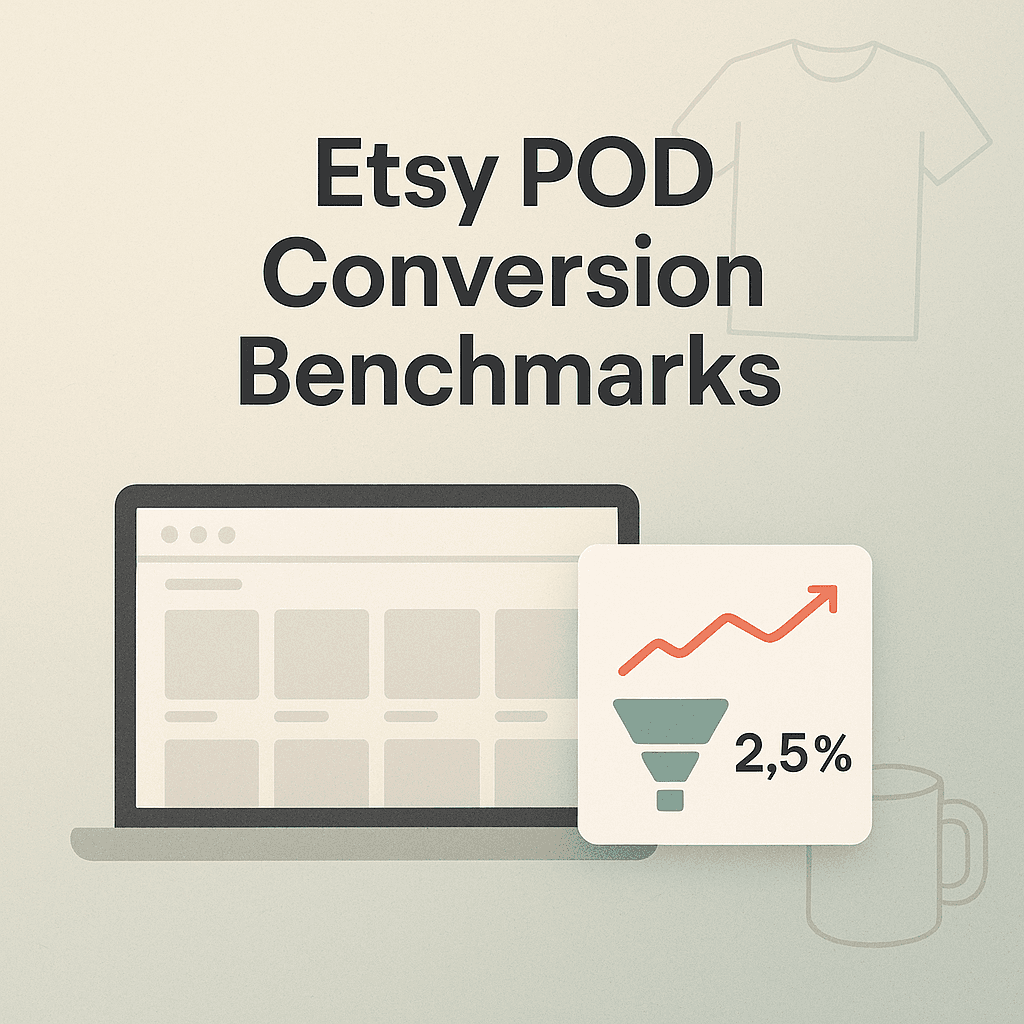
1.5% to 2.5%: Solid, healthy POD shop
This is where things start to feel predictable. You can run small ad tests without setting money on fire. You can add variants and actually see lifts. When you drop a new design in a proven niche, it sells.
A lot of good POD shops sit in this range long term.
2.5% to 4%: Very strong (usually niche focused + strong presentation)
If you’re consistently above 2.5% with meaningful traffic, you’re doing something right. Usually it’s one of these:
- very tight niche targeting (not “funny shirt”, more like “ICU nurse night shift humor tee”)
- listings are clean and confident
- mockups look like a real brand
- reviews help
- pricing is aligned with buyer expectations
Also, your traffic quality is probably good. Etsy search traffic converts better than random social traffic most of the time.
4% to 7%+: Exceptional (but not impossible)
You’ll see this on:
- bestsellers in a tight niche
- seasonal products at the right moment
- personalization-heavy listings (buyers are already committed)
- listings with tons of reviews and social proof
- shops with a real brand look
Be careful though. Very high conversion rate can also happen when your traffic is tiny. If you had 50 visits and 3 orders, that’s 6%. Great, but it’s not enough data yet.
Benchmarks by POD product type (quick reality check)
Different POD categories convert differently because buyer intent is different.
Here’s a useful “sanity check” table.
| POD Product Type | Typical Conversion Range |
| Stickers (often low price, impulse) | 1.5% to 4% |
| Mugs | 1% to 3% |
| Tees and hoodies | 0.8% to 2.5% |
| Sweatshirts (higher AOV) | 0.8% to 2.2% |
| Wall art/posters | 0.7% to 2% |
| Digital-ish style (invites, templates) not POD but common | 2% to 6% |
| Personalized POD (names, pets, custom text) | 2% to 7% |
Not rules. Just typical patterns.
What’s a “good” conversion rate for a POD Etsy shop, really?
If I had to simplify it:
- Under 1%: you probably have a listing or traffic problem
- 1% to 2%: you’re in the game, improve your winners
- 2% to 3%: strong, scale by adding more listings like your best ones
- 3%+: you’re doing something special, protect that niche and don’t get sloppy
But here’s the part people miss.
A “good” conversion rate is the one that gives you profit and room to scale.
If you’re converting at 3.5% but you’re priced too low and margins are garbage, you don’t really win. And if you’re converting at 1.1% but your AOV is high and you’re ranking on valuable keywords, you may be fine.
Why POD shops often convert lower than handmade
This is not you being bad. This is structural.
POD faces extra friction:
- buyers know many POD items are “mass produced-ish”
- shipping times can be longer
- photo consistency is harder (mockups vs real-life)
- competition is insane, especially in apparel
That means you have to earn trust faster.
Your listings have to do more heavy lifting.
The biggest factors that move Etsy conversion rate for POD
1. Traffic quality (keyword intent is everything)
A listing can look amazing and still convert poorly if it ranks for the wrong search.
Example:
- “funny shirt” traffic is broad. Low intent.
- “funny accountant shirt tax season” traffic is narrower. Higher intent.
If you’re getting lots of visits but low conversion, it’s often because you’re ranking for terms that don’t match the design.
This is why trend plus intent matters. Not just trend.
2. Mockups that feel real
POD mockups can look sterile. Flat. Obviously digital.
Better mockups usually:
- show the design at the right size (not micro tiny)
- show at least one close-up
- show color options clearly
- look like a real Etsy shop, not a catalog
If you don’t want to spend hours on mockups, tools can help. NinjaSell, for example, generates Etsy style mockups as part of the listing workflow, so you’re not stuck doing the same repetitive work every time.
3. Price to trust ratio
People talk about “pricing for profit”, which is true. But on Etsy, price is also a trust signal.
If your mug is $8.99 with free shipping, buyers may wonder what’s wrong with it. If it’s $32 with no brand presence, also weird.
Your price has to match:
- niche expectations
- shipping speed
- perceived quality from photos
- review count (social proof lets you charge more)
4. Shipping promise (and clarity)
POD shipping can be totally fine, but buyers hate uncertainty.
Make sure your listing makes it obvious:
- when it ships
- where it ships from (especially if you’re US only)
- if there are holiday cutoffs
If you fulfill US only, that can actually be a conversion advantage for US buyers. Faster delivery. Less risk.
5. Reviews and shop trust
Conversion rate improves with:
- review count
- photo reviews
- consistent branding
- policies filled out
- “About” section done
- quick replies
It’s boring. It works.
6. Design specificity
The biggest POD mistake is trying to appeal to everyone.
Specific converts.
“Dog mom” is saturated and broad.
“Golden retriever mom hiking club” is niche and emotionally sharper.
How to calculate your benchmark the right way (so you don’t misread your own stats)
Here’s a simple way to avoid bad conclusions.
Step 1: Look at conversion rate per listing, not just the whole shop
Your shop average can hide the truth.
If one bestseller converts at 3.2% and 40 other listings convert at 0.2%, you don’t have a “2% shop”. You have one winner.
Step 2: Segment by traffic source
If you can, separate:
- Etsy search
- Etsy ads
- social
Social traffic almost always converts worse unless it’s very targeted.
Step 3: Use minimum data thresholds
I like these rough thresholds:
- under 100 visits: ignore conversion rate, not enough data
- 100 to 500 visits: directional, don’t overreact
- 500+ visits: now you can make decisions
Quick fixes that can lift conversion rate fast (especially for POD)
Not “rebrand your entire shop”. Just the stuff that moves numbers.
1. Tighten your first photo
Your first photo is basically your ad.
Try this:
- make the design bigger in frame
- use a cleaner background
- choose the most popular color first
- remove clutter
Small changes can lift clicks and conversions.
2. Rewrite titles for humans (but keep keywords)
Some POD titles read like this:
“Funny Shirt Gift Shirt Unisex Shirt Trendy Shirt Cute Shirt Humor Shirt”
It’s painful. And buyers feel that.
You want:
- keyword intent
- readable phrasing
- the “who it’s for” early
If you struggle here, using a listing generator that pulls from Etsy bestseller and trend data can help. NinjaSell does this kind of optimization when it generates titles, tags, and descriptions, so you’re not guessing in the dark, and you can publish to Etsy as drafts with one click.
3. Add one photo that answers objections
One slide that says:
- “Printed and shipped from the USA”
- “Soft unisex fit”
- “Fast customer support”
- “Gift ready”
- “Sizing tips”
It sounds basic. It reduces hesitation.
4. Fix sizing confusion
Sizing uncertainty kills apparel conversion.
Add:
- size chart image
- “size up for oversized fit” note (if true)
- model height and size (even approximate)
5. Stop sending bad listings more traffic
This is a weird one, but it matters.
If a listing is converting at 0.3%, pushing more traffic to it (ads, Pinterest spam, whatever) just drags your shop stats down and wastes money.
Instead:
- identify the listings with decent favorites and clicks but low orders
- update keywords and photos first
- then send traffic
Some automation platforms help here too. NinjaSell has a “ReSpark” style feature that refreshes underperforming listings with updated trend based keywords. Not magic. But it’s the right direction when a listing is stale and buried.
Benchmarks for new POD shops (what to expect in the first 30 to 90 days)
If you’re new, the emotional rollercoaster is real.
A realistic path looks like:
- Week 1 to 4: conversion rate can be all over the place, 0% to 3% depending on tiny traffic
- Month 2: if you have 30 to 100 listings and you’re learning, you might land around 0.8% to 1.5%
- Month 3: with a couple small winners and better targeting, 1.5% to 2.5% becomes achievable
Not guaranteed. But realistic.
If you’re at 0.2% with 2,000 visits and no sales after months, it’s not “Etsy hates me”. It’s usually one of these:
- wrong niche
- wrong keywords
- weak offer
- no trust
And the good news is that those are fixable problems.
The metric that matters almost as much as conversion rate
Conversion rate is not the whole story.
Watch these too:
- AOV (average order value): can you bundle? upsell? offer sets?
- Favorites per visit: if favorites are high but sales are low, it’s usually price, shipping, or trust
- Revenue per visit: sometimes a 1.2% conversion rate beats a 2.5% conversion rate if the order value is higher
If you want one number to obsess over (in a healthy way), revenue per visit is underrated.
A simple POD benchmark checklist (so you can self diagnose)
If your conversion rate is under 1%, check:
- Are you ranking for buyer intent keywords, not broad terms?
- Does your first image look like a real product photo?
- Are shipping times clear and reasonable?
- Is your pricing in line with competitors in that niche?
- Do you have at least 6 to 10 photos (mockups, close-ups, size chart)?
- Is the design specific to a niche identity?
- Are policies and shop info filled out?
If you want to move faster on the listing side, this is where a platform like NinjaSell fits naturally. Upload a design, it generates Etsy ready listings based on bestseller and trend data, creates mockups, runs trademark checks, then you can push to Etsy as drafts. Less busywork, more iterations. And iterations are basically how you find winners.
Wrap up (the benchmarks, in plain English)
If you just want the quick takeaway:
- 0.3% to 0.8%: underperforming, fix targeting and presentation
- 0.8% to 1.5%: normal early traction, improve and add listings
- 1.5% to 2.5%: healthy POD shop range
- 2.5% to 4%: very strong, likely niche clarity + trust
- 4%+: exceptional, usually tight niche, strong offer, strong proof
Don’t chase conversion rate in a vacuum. Chase the right traffic, clean listings, and a product that feels like it was made for a specific person.
And if you’re tired of rewriting tags, titles, and descriptions over and over, or you have a graveyard of listings that “should have worked”, it might be time to automate the boring parts. You can check out NinjaSell at https://ninjasell.com and use it to generate and refresh Etsy listings faster, then spend your brainpower on the only part that actually can’t be automated.
The design. The niche. The taste. That part is still you.
FAQs (Frequently Asked Questions)
What does Etsy’s conversion rate mean for a print on demand (POD) shop?
Etsy’s conversion rate for a POD shop is calculated as Orders divided by Visits, expressed as a percentage. For example, if you have 1,000 visits and 20 orders, your conversion rate is 2.0%. It’s important to note that ‘visits’ refer to sessions from all traffic sources including Etsy search, ads, social media, and direct visits.
What are realistic Etsy conversion rate benchmarks for POD shops?
Realistic Etsy conversion rates for POD shops typically range as follows: Under 0.8% indicates underperformance or mis-targeted traffic; 0.8% to 1.5% is normal early traction; 1.5% to 2.5% is solid and healthy performance; 2.5% to 4% is very strong with niche focus and good presentation; and above 4% up to around 7%+ is exceptional but often linked to tight niches or personalization.
Why might my Etsy POD shop have a low conversion rate under 1%?
A conversion rate under 1% often signals issues such as broad or generic traffic with low buying intent, low-trust mockups, pricing that’s either too high without brand strength or suspiciously low, or products that lack specificity to emotionally engage buyers. New shops also commonly start here due to limited behavioral data.
How do different POD product types affect typical Etsy conversion rates?
Conversion rates vary by product type due to differing buyer intent: stickers usually convert between 1.5%-4%, mugs between 1%-3%, tees and hoodies between 0.8%-2.5%, sweatshirts between 0.8%-2.2%, wall art/posters between 0.7%-2%, digital-style products (like invites or templates) between 2%-6%, and personalized POD items between 2%-7%. These ranges serve as useful benchmarks.
What factors contribute to a very strong Etsy conversion rate above 2.5% in a POD shop?
Achieving over 2.5% conversion generally involves tight niche targeting (e.g., specific themes like ‘ICU nurse night shift humor tee’), clean and confident listings, professional mockups that convey brand credibility, positive reviews that build trust, aligned pricing with buyer expectations, and quality traffic—often from Etsy search rather than random social sources.
How can I improve my Etsy POD shop’s conversion rate without overhauling my entire business?
To lift your conversion rate pragmatically: refine your keywords to attract more targeted traffic; enhance your mockups for higher trust and professionalism; adjust pricing to match market expectations; focus on niche-specific designs that resonate emotionally with buyers; gather reviews and social proof; and optimize your listings for clarity and confidence—all incremental changes that can boost sales without drastic business changes.